Irises by Vincent van Gogh: Vibrant Color Edit
Free to Download & Reuse: You are welcome to use this image! If you republish or share it online, you must include a direct link back to this webpage for attribution.
Original Image Source: wikiart.org
Irises by Vincent van Gogh: A Garden Filled with Movement and Feeling
“Irises” by Vincent van Gogh, painted in 1889, is one of the most recognizable flower paintings of the nineteenth century. At first glance, it appears to be a bright garden scene filled with blue irises, green leaves, orange flowers, and reddish earth. Yet the longer one looks, the more the painting becomes something deeper than a simple study of flowers. It feels alive, restless, and intensely personal. Van Gogh transforms a patch of garden into a world of rhythm, color, and emotion.
The painting was created during a difficult period in Van Gogh’s life, shortly after he entered the asylum at Saint-Rémy-de-Provence. Rather than turning inward completely, he looked closely at the natural world around him. Gardens, trees, flowers, and fields became a source of structure and comfort. “Irises” reflects this need for attention and renewal. The flowers are not arranged like a formal bouquet. They grow across the canvas with natural energy, as if the viewer has stepped directly into the garden.
A Composition Built on Flow and Contrast
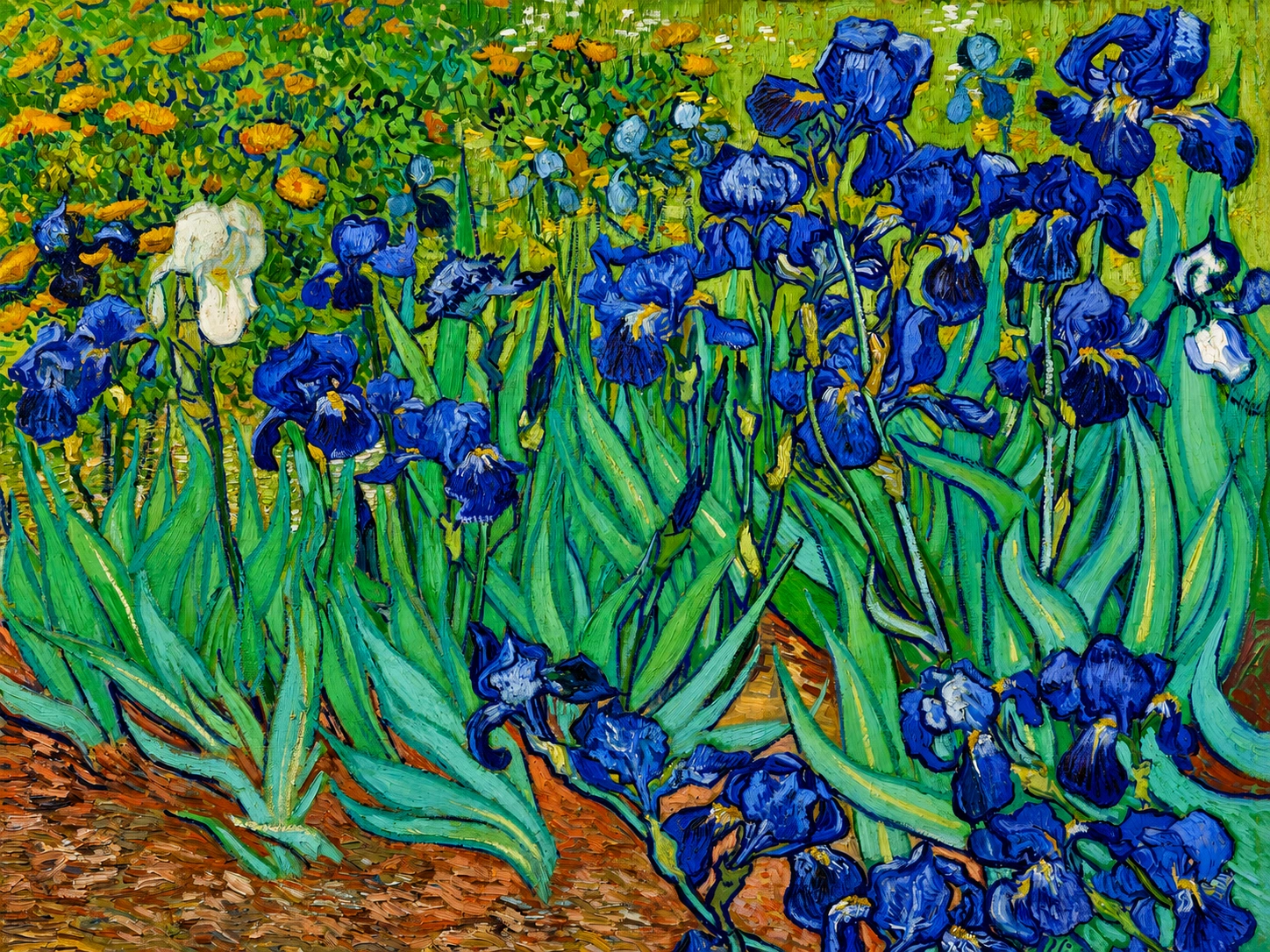
The composition of “Irises” is striking because it does not rely on a traditional central subject. Instead, the eye moves across the entire surface, following the curving stems, blade-like leaves, and clustered blossoms. The irises rise from the lower edge of the painting, filling the foreground with strong vertical and diagonal forms. Their leaves stretch upward like green flames, while the flowers twist, bend, and open in different directions.
This creates a sense of motion, even though the subject is still. Van Gogh does not paint flowers as decorative objects. He gives them posture, character, and movement. Some irises stand tall and alert, while others droop slightly or lean into the surrounding foliage. The garden becomes almost like a crowd of individual figures, each one distinct but connected to the larger pattern.
The single white iris on the left side is especially important. It immediately draws attention because it contrasts with the deep blue and violet blossoms around it. This pale flower introduces a quiet focal point within the busy composition. It does not dominate the painting, but it gives the viewer a place to pause. Its presence also makes the blue irises appear even richer by comparison.
The Power of Blue, Green, and Orange
Color is one of the strongest forces in “Irises.” Van Gogh uses intense blues and violets for the flowers, setting them against fresh greens and warm orange tones. The result is vivid but balanced. The blue irises feel cool and luminous, while the orange flowers in the background and the reddish soil add warmth and depth.
The green leaves are not painted as a neutral background. They are active, varied, and full of life. Some are pale turquoise, others yellow-green, others darker and more shadowed. This range gives the garden a living texture. The leaves seem to overlap, push forward, and weave through one another.
Van Gogh’s use of complementary colors gives the painting much of its energy. Blue and orange intensify each other, while green and red-brown create another subtle contrast near the ground. These color relationships make the surface vibrate. The painting feels bright and natural, but also emotionally heightened.
Brushwork and the Texture of Life
Van Gogh’s brushwork in “Irises” is direct, expressive, and highly visible. The strokes do not disappear into smooth realism. Instead, they form the very structure of the image. The leaves are made with long, sweeping marks. The petals are built with curved, layered strokes that suggest softness, folds, and movement. The soil is painted with shorter, broken marks that create a rough, earthy surface.
This brushwork gives the painting a physical presence. The viewer can sense the artist’s hand moving across the canvas. Every part of the image feels touched and animated. Even the background flowers and patches of grass are treated with active strokes, so there is no empty or passive space.
The texture also helps distinguish the different natural elements. The leaves feel sharp and blade-like. The petals feel more delicate and irregular. The ground feels dry and dense. Van Gogh does not need precise botanical detail to make the garden convincing. He uses rhythm, color, and texture to communicate the experience of seeing it.
Nature as Observation and Emotion
“Irises” shows Van Gogh’s ability to combine close observation with emotional intensity. The flowers are recognizable and carefully studied, but they are not painted in a detached scientific way. Their shapes are simplified, emphasized, and energized. The painting captures both what the irises look like and how they feel to the artist.
This emotional quality is part of what makes the work so powerful. The garden seems peaceful, but not still. It is full of growth, tension, and vitality. The bending stems and twisting petals suggest the fragility of living things, while the bold colors suggest resilience and beauty.
Van Gogh often found deep meaning in ordinary subjects. A bedroom, a chair, a wheat field, or a group of flowers could become a complete emotional world. In “Irises,” the garden becomes a place where beauty and instability exist together. The painting feels joyful in color, yet intense in movement. It is calm and restless at the same time.
Japanese Influence and Decorative Design
The flattened space and strong outlines in “Irises” also suggest Van Gogh’s admiration for Japanese prints. He was deeply influenced by their bold compositions, clear contours, and decorative surface patterns. In this painting, the flowers are placed close to the picture plane, with little sense of deep perspective. The result is a flattened, tapestry-like image where line and color matter as much as illusion.
The irises are outlined with dark blue and green marks, giving them a graphic clarity. The cropped composition also feels modern. The garden continues beyond the edges of the canvas, as if this is only one section of a larger natural pattern. This creates immediacy. The viewer is not standing far away from the scene, but close to it.
This decorative quality does not make the painting shallow. Instead, it strengthens its visual impact. Van Gogh turns the garden into a pattern of living forms, where each petal and leaf contributes to the rhythm of the whole.
Why “Irises” Remains So Beloved
“Irises” remains beloved because it combines beauty, accessibility, and emotional depth. It is easy to enjoy for its color and subject, but it also rewards careful looking. The painting is not simply pretty. It is full of visual intelligence, expressive brushwork, and psychological force.
The work captures Van Gogh’s unique ability to make nature feel intensely present. The irises are flowers, but they are also signs of endurance, sensitivity, and attention. Their blue petals and green leaves seem to pulse with life. The garden becomes a place of recovery, observation, and creative power.
Painted in 1889, “Irises” stands as one of Van Gogh’s great achievements. It shows an artist using color not only to describe the world, but to make it feel more alive. Through a small patch of flowers, Van Gogh creates a vision of nature that is intimate, vivid, and unforgettable.