Dance at Moulin de la Galette by Pierre-Auguste Renoir: Vibrant Color Edit
Free to Download & Reuse: You are welcome to use this image! If you republish or share it online, you must include a direct link back to this webpage for attribution.
Original Image Source: wikiart.org
Dance at Moulin de la Galette by Pierre-Auguste Renoir
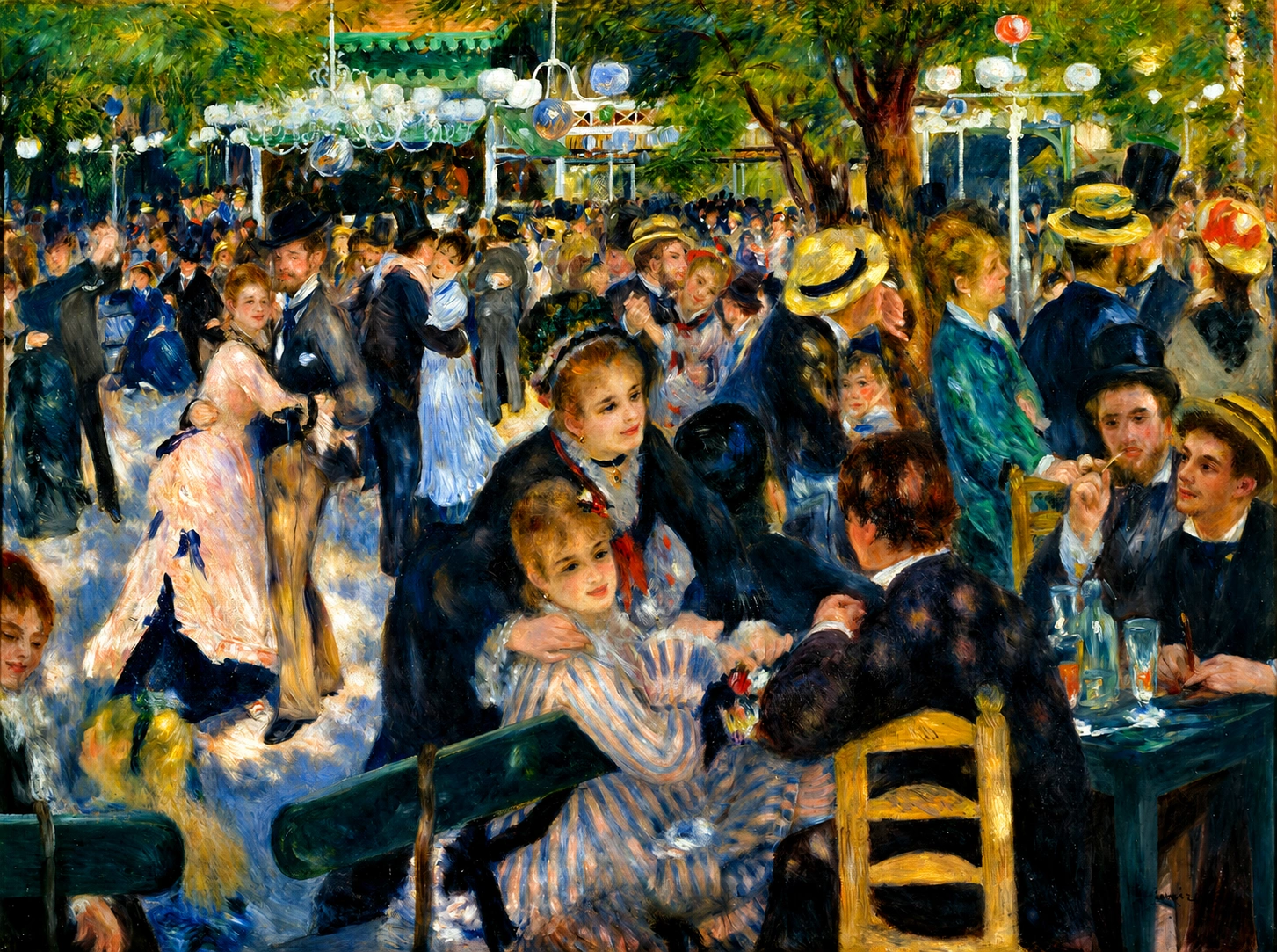
Pierre-Auguste Renoir’s “Dance at Moulin de la Galette” from 1876 is one of the most beloved images of Impressionist Paris. The painting captures an outdoor dance garden in Montmartre, where working people, artists, friends, and fashionable young Parisians gather under trees for music, conversation, flirtation, and rest. Rather than presenting a formal historical scene or an idealized mythological subject, Renoir turns everyday leisure into a grand spectacle of light, color, and social energy. The result is a painting that feels both spontaneous and carefully orchestrated, as if the viewer has just stepped into a living afternoon filled with movement, laughter, and shifting sunlight.
The Social World of Montmartre
The Moulin de la Galette was a popular entertainment spot in Montmartre, a district that still had a village-like atmosphere in the 1870s. Renoir’s choice of subject reflects a major Impressionist interest: modern life as it was actually experienced. The people in the painting are not aristocrats posing in a palace, but ordinary Parisians enjoying a public dance hall. This gives the work a democratic warmth. Everyone seems absorbed in the pleasures of the moment, from the dancers in the middle ground to the seated figures in the foreground.
Renoir does not isolate one single protagonist. Instead, he creates a crowd scene where attention moves from face to face, gesture to gesture. The viewer notices the young woman in the striped dress, the girl leaning close beside her, the men seated at the table, the dancers turning in the background, and the glowing hats scattered across the composition. This variety gives the painting its remarkable sense of life. It is not merely a picture of a dance. It is a portrait of an entire social atmosphere.
Light, Color, and Impressionist Vision
The most famous feature of “Dance at Moulin de la Galette” is its treatment of light. Renoir paints sunlight filtering through the trees, breaking into patches across faces, clothing, hats, tables, and the ground. The scene is filled with blue shadows, creamy whites, warm pinks, golden yellows, and soft greens. These colors do not simply describe objects. They create the sensation of air, movement, and flickering daylight.
Instead of using hard outlines, Renoir lets forms dissolve into loose strokes. Dresses shimmer, faces glow, and the background seems to vibrate with activity. This technique gives the painting a feeling of immediacy, as though Renoir painted the scene quickly before the light changed. Yet the composition is more controlled than it first appears. The figures are arranged in layers, guiding the eye from the intimate foreground table to the crowded dance floor and then into the bright, festive background.
The color harmony is especially important. Renoir balances cool blues and blacks with warm flesh tones, straw hats, and rosy highlights. The dark suits of the men help anchor the composition, while the pale dresses and bright hats create visual rhythm. The painting feels crowded, but it never becomes chaotic. Renoir’s color structure keeps the scene unified.
Composition and Movement
Renoir’s composition places the viewer inside the crowd rather than outside it. The foreground figures are close enough to feel almost life-size, while the dancers behind them merge into a broader social scene. This creates depth without the stiff clarity of traditional academic painting. The viewer’s eye wanders naturally, just as it might in a real gathering.
The painting is full of circular and diagonal movement. Couples turn in the middle distance, heads tilt toward conversation, arms bend around waists and chairs, and bodies lean across tables. Even the hanging lights and tree branches contribute to the feeling of rhythm. Renoir makes the entire canvas feel like music translated into paint.
The central foreground group is especially important because it provides emotional intimacy. The seated young woman in the striped dress looks calm and luminous, while the figures around her are engaged in conversation. Their relaxed poses contrast with the more active dancers behind them. Through this contrast, Renoir captures different kinds of pleasure: dancing, talking, watching, resting, and simply being present in a crowd.
Beauty in Everyday Experience
“Dance at Moulin de la Galette” is not dramatic in the traditional sense. There is no major event, no moral lesson, and no obvious story. Its power comes from the beauty of ordinary experience. Renoir suggests that modern life contains its own poetry, especially in shared moments of leisure. The painting celebrates sociability, youth, and the fleeting happiness of an afternoon.
At the same time, the scene is not purely documentary. Renoir transforms the dance garden into a world of softness and radiance. Faces are idealized, colors are tender, and the mood is affectionate. He does not focus on the noise, fatigue, or social tensions that may have existed in such a crowded place. Instead, he offers an image of urban pleasure as harmonious and generous.
This idealizing quality is central to Renoir’s art. Unlike some Impressionists who emphasized visual analysis or modern alienation, Renoir often sought warmth, beauty, and human connection. In “Dance at Moulin de la Galette,” he uses the language of Impressionism to create a deeply human scene. The painting is modern, but it is also timeless in its interest in friendship, attraction, and communal joy.
The Painting’s Lasting Appeal
The enduring appeal of “Dance at Moulin de la Galette” lies in its ability to make the past feel immediate. Viewers do not simply observe nineteenth-century Paris from a distance. They feel invited into it. The dappled light, crowded tables, lively dancers, and gentle expressions create a strong emotional atmosphere. The painting seems to preserve not only what the Moulin de la Galette looked like, but what it felt like to be there.
Renoir’s achievement is to make a complex scene appear effortless. Every part of the painting contributes to the sensation of a living moment. The looseness of the brushwork suggests movement, while the arrangement of figures gives the image structure. The light makes the scene sparkle, while the human interactions give it warmth. This balance between observation and enchantment is what makes the painting one of the defining works of Impressionism.
“Dance at Moulin de la Galette” remains a masterpiece because it captures the beauty of passing time. Renoir paints people who are not posing for history, yet they have become part of art history because of the tenderness and vitality with which he saw them. The painting reminds us that everyday joy, however temporary, can be worthy of monumental attention.