The Magpie by Claude Monet: Vibrant Color Edit
Free to Download & Reuse: You are welcome to use this image! If you republish or share it online, you must include a direct link back to this webpage for attribution.
Original Image Source: wikiart.org
Overview of “The Magpie” by Claude Monet
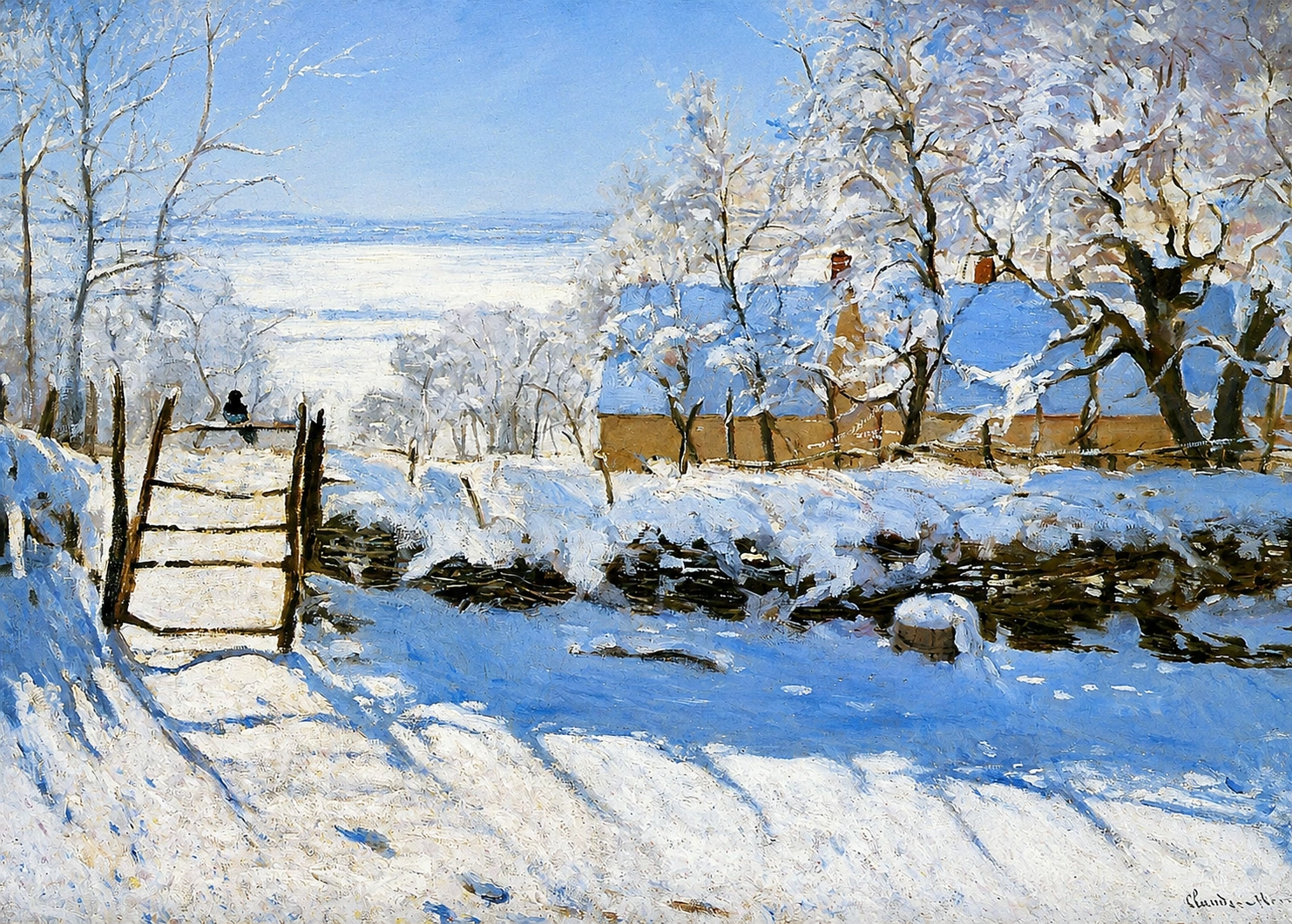
Claude Monet’s “The Magpie,” painted in 1869, is one of the most luminous winter scenes of early Impressionism. At first glance, the painting appears simple: a snow-covered rural landscape, a wooden gate, distant buildings, bare trees, and a small black magpie perched on a fence. Yet the quietness of the subject is exactly what gives the work its remarkable power. Monet turns a familiar countryside view into a study of light, atmosphere, color, and perception. Instead of treating snow as plain white, he reveals it as a surface alive with blue shadows, cream highlights, violet reflections, and subtle changes of temperature.
The painting captures a moment of stillness after snowfall. Nothing dramatic is happening. There are no grand historical figures, no mythological subjects, and no obvious narrative. The magpie, small and almost easy to miss, becomes the emotional center of the composition. Its dark silhouette interrupts the pale landscape and gives the viewer a point of focus. Monet’s genius lies in making this modest bird feel important without exaggerating it. The scene feels observed rather than invented, as if the painter has stepped outside into the cold morning and caught the countryside before human activity has disturbed it.
Composition and the Power of Quiet Space
The composition of “The Magpie” is built around openness, distance, and delicate balance. The left side of the painting contains the wooden gate and the tiny bird, while the right side is filled with trees, rooftops, and the heavier structure of the village. This creates an asymmetrical design that still feels harmonious. The magpie is not placed in the center, but its dark form immediately attracts the eye because it contrasts so sharply with the surrounding snow.
The gate is one of the most important compositional elements. It creates a threshold between the viewer and the landscape beyond. Its vertical posts and horizontal rails give structure to the soft, almost dissolving snow. The viewer stands on one side of this barrier, looking into a world of pale winter light. This gives the painting a quiet sense of invitation, but also distance. The snowy path seems to lead forward, yet the gate and fence hold us back.
Monet uses the receding line of the fence, the snow-covered ground, and the distant horizon to create depth. The eye moves from the foreground shadows to the gate, then toward the pale fields and misty sky in the distance. The village buildings on the right are partly hidden by trees and snow, which makes them feel absorbed into the landscape rather than separate from it. The entire scene seems unified by cold air and reflected light.
Snow, Light, and Color
One of the most revolutionary aspects of “The Magpie” is Monet’s treatment of snow. In academic painting, snow was often represented with large areas of white, gray, or brownish shadow. Monet approached it differently. He understood that snow does not simply have one color. It absorbs, reflects, and transforms the light around it. In this painting, the snow contains pale blues, lavender tones, warm cream, soft pink, and touches of gray. These colors are not decorative additions. They are Monet’s way of recording how light actually behaves outdoors.
The blue shadows are especially important. They stretch across the foreground and give the snow both volume and temperature. These shadows make the bright areas appear warmer and more radiant. Monet does not rely on harsh contrast. Instead, he builds the image through delicate variations. The snow glows because it is surrounded by cool tones, and the cool tones feel natural because they are placed within a convincing winter atmosphere.
The sky is also subtle. It is not a clear blue sky or a dark stormy one. It is pale, hazy, and filled with diffused light. This softness helps explain the even brightness of the scene. The light does not seem to come from a single dramatic source. It spreads across the landscape, touching the trees, rooftops, branches, and snow with a gentle winter radiance. Monet makes the entire painting feel as though it is breathing with cold air.
The Magpie as a Visual and Emotional Center
Although the bird is very small, “The Magpie” would feel completely different without it. The magpie’s black form creates the strongest contrast in the painting. It gives the eye a resting point and introduces life into a nearly silent landscape. Without the bird, the scene might feel empty or purely atmospheric. With the bird, the landscape becomes watchful and alive.
The magpie also changes the emotional tone of the work. It suggests alertness, solitude, and presence. The bird is not sentimentalized. Monet does not paint it with excessive detail or turn it into a symbolic emblem. It remains a natural part of the scene, perched quietly on the fence. Yet because it is the only living figure visible, it carries a surprising amount of meaning. It becomes a sign of life surviving within winter’s stillness.
The scale of the bird is also important. Monet does not enlarge it to make the subject more obvious. He keeps it small, trusting the viewer to notice it. This restraint is part of the painting’s beauty. The viewer discovers the magpie rather than being forced to look at it. That act of discovery mirrors the experience of observing nature closely.
Impressionist Innovation Before Impressionism Was Fully Named
“The Magpie” was painted before Impressionism became a fully established movement. Even so, it contains many qualities that would later define Monet’s mature work. The painting is deeply concerned with outdoor light, changing atmosphere, and the immediate sensation of looking. Monet is less interested in polished detail than in the total effect of the scene. Branches, snowbanks, rooftops, and fence rails are suggested through lively brushwork rather than controlled academic finish.
This looseness does not mean the painting is careless. On the contrary, Monet’s brushwork is carefully tuned to the visual character of each surface. The snow is thick and textured in some places, thin and airy in others. The trees are painted with quick, broken strokes that capture both their structure and their covering of frost. The distant landscape becomes increasingly pale and indistinct, giving the impression of mist, cold, and atmospheric depth.
The painting’s rejection from the official Salon is often seen as evidence of how radical Monet’s approach appeared at the time. To modern viewers, the scene may look peaceful and accessible, but in 1869 its unconventional color, loose handling, and ordinary rural subject challenged traditional expectations. Monet was not painting winter as a backdrop for a story. He was making light itself the subject.
Mood and Meaning
The mood of “The Magpie” is calm, reflective, and quietly joyful. It does not present winter as bleak or hostile. Instead, Monet shows winter as luminous. The snow brightens the land, softens forms, and creates a world of delicate color. The painting invites the viewer to slow down and notice subtle things: the blue of a shadow, the warmth of a wall, the bend of a branch, the small dark shape of a bird against the brightness.
There is also a sense of suspended time. The snow appears fresh, the air still, and the landscape undisturbed. Human presence is implied by the gate, fence, houses, and chimneys, but no people are visible. This absence gives the scene its poetic silence. The countryside seems to exist for itself, independent of human activity. Monet allows nature to be the main event.
Why “The Magpie” Still Matters
“The Magpie” remains one of Monet’s most beloved works because it transforms an ordinary winter view into something extraordinary. Its beauty does not depend on spectacle. It depends on sensitivity. Monet shows that a snowy field, a fence, a few trees, and a small bird can contain endless visual richness when seen with attention.
The painting is also important because it demonstrates Monet’s early mastery of light. His later paintings of haystacks, poplars, Rouen Cathedral, and water lilies would continue this exploration, but “The Magpie” already shows his central artistic mission. He wanted to paint not just objects, but the conditions under which objects are seen. In this winter landscape, snow becomes color, shadow becomes atmosphere, and silence becomes presence.