Rouen Cathedral; Morning – White Harmony by Claude Monet: Vibrant Color Edit
Free to Download & Reuse: You are welcome to use this image! If you republish or share it online, you must include a direct link back to this webpage for attribution.
Original Image Source: wikiart.org
Rouen Cathedral; Morning - White Harmony by Claude Monet
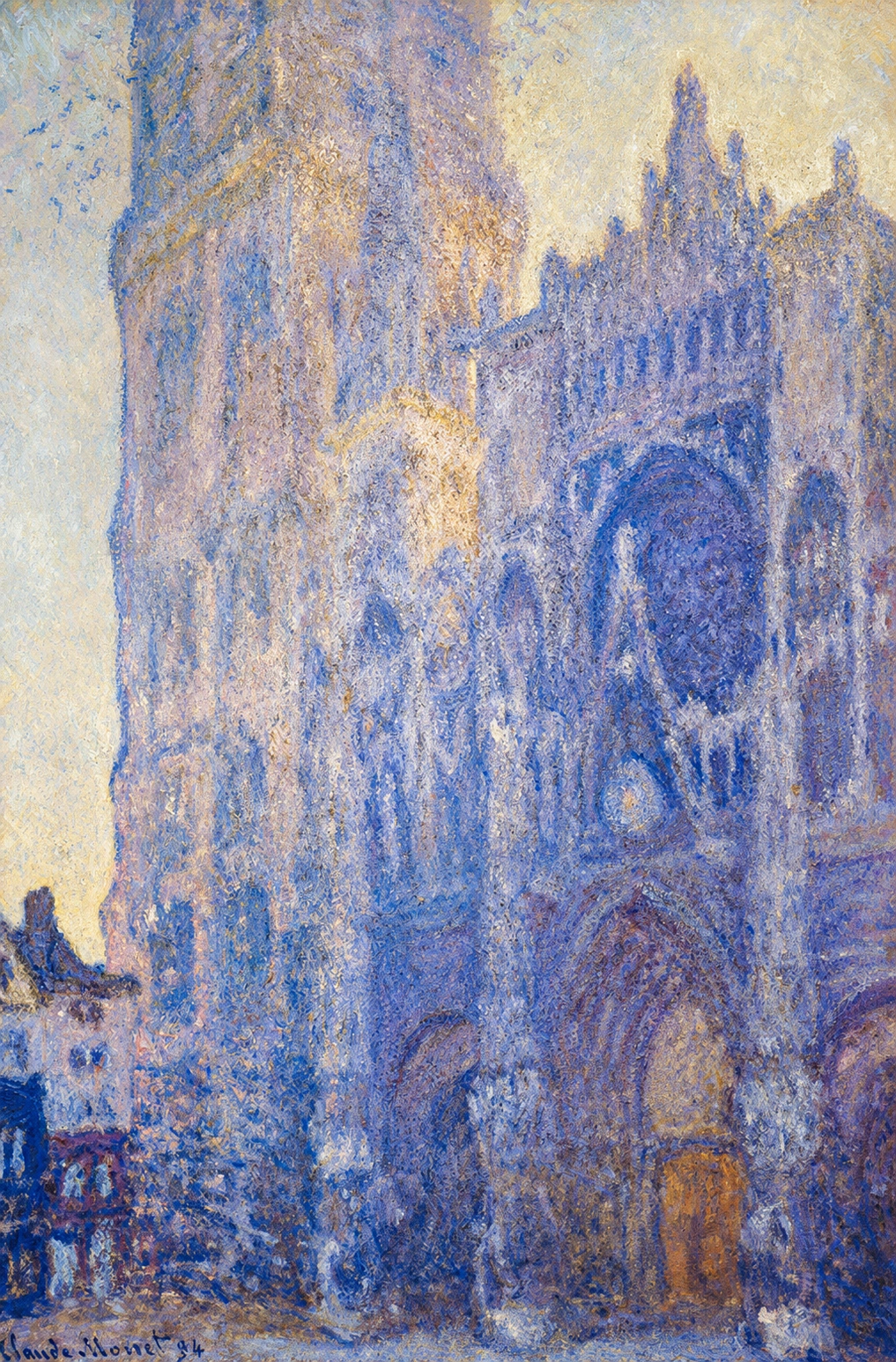
Claude Monet’s “Rouen Cathedral; Morning – White Harmony” is one of the most delicate and atmospheric paintings from his famous Rouen Cathedral series, created in 1894. At first glance, the painting seems almost to dissolve before the viewer’s eyes. The stone facade of the cathedral is present, yet it is not described with firm architectural precision. Instead, Monet transforms the Gothic structure into a shimmering field of pale blues, violets, whites, creams, and silvery grays. The cathedral becomes less a building than a vision of morning light.
This painting belongs to one of Monet’s most ambitious experiments with perception. Rather than painting Rouen Cathedral as a stable monument, he painted it repeatedly at different times of day and under different weather conditions. In doing so, he showed that a subject is never truly fixed. Light changes it. Atmosphere changes it. The eye changes it. “Rouen Cathedral; Morning – White Harmony” captures the cathedral in a cool, luminous state, as if the morning air has wrapped the facade in mist.
The Cathedral as Light Rather Than Stone
Rouen Cathedral was a masterpiece of Gothic architecture, with its elaborate portals, towers, sculptures, and deeply carved surfaces. In a more traditional painting, these architectural features might have been rendered with careful lines and crisp detail. Monet takes the opposite approach. He allows the structure to emerge through layers of broken brushwork, so that the viewer senses the height, depth, and complexity of the cathedral without seeing every individual carving.
The left side of the composition is dominated by the vertical mass of the cathedral facade. It rises upward in pale, ghostly tones, almost blending with the surrounding sky. On the right, the ornate Gothic forms become more visible, especially around the arched portal and the jagged upper silhouette. Yet even here, the building remains unstable. The details flicker. The edges blur. The cathedral seems to be made of vapor, color, and reflection.
This is the power of Monet’s method. He does not simply paint what the cathedral is. He paints what it becomes in a particular moment of light. The result is both architectural and immaterial. The stone has weight, but the light seems stronger than the stone.
The Meaning of “White Harmony”
The title’s phrase “White Harmony” is especially important. The painting is not purely white, but it is built around a pale, unified color atmosphere. Monet uses white as a tonal idea rather than a flat color. The surface contains lavender, blue, beige, gray, yellow, and hints of warmer earth tones, yet all of these colors are softened into a single morning harmony.
This pale color structure gives the painting its quiet emotional effect. The cathedral does not appear dramatic or severe. It feels hushed, cool, and contemplative. The morning light has not yet become bright or golden. Instead, it filters across the facade with a restrained glow. The entire scene has the sensation of early day, when forms are visible but still softened by moisture and air.
The blues and violets are essential to this effect. They prevent the whites from becoming empty or flat. These cooler tones suggest shadow, distance, and the chill of morning. At the same time, the faint yellow and cream tones suggest the first warmth of sunlight beginning to touch the stone. Monet builds the painting from these subtle contrasts, creating a surface that feels both calm and alive.
Brushwork and Surface Texture
Monet’s brushwork in “Rouen Cathedral; Morning – White Harmony” is central to the painting’s meaning. The surface is built from small, active strokes that overlap and vibrate. These strokes do not simply fill in a drawing. They create the form itself. The cathedral appears through the rhythm of paint.
In some areas, the brushwork is dense and grainy, especially across the facade. This gives the impression of carved stone, but it also creates a shimmering optical effect. The eye moves across the surface, gathering fragments of color into recognizable shapes. In other areas, the paint becomes softer and more diffuse, allowing the cathedral to merge with the air around it.
The lower part of the painting contains darker, more compressed forms that suggest figures, street activity, and the base of the cathedral. These elements are not described in detail, but they provide contrast and scale. They remind us that this monumental structure exists within a living city. Yet Monet keeps the human world secondary. The true subject is the meeting between light and architecture.
A Gothic Monument Seen Through Impressionism
The Rouen Cathedral series is one of the great achievements of Impressionism because it applies the movement’s interest in fleeting light to a subject associated with permanence. Gothic cathedrals were often seen as symbols of history, faith, endurance, and national heritage. Monet does not deny those associations, but he changes the way we encounter them.
In this painting, the cathedral is not a static historical object. It is something perceived in time. Its appearance depends on hour, weather, season, and atmosphere. This makes the painting deeply modern. Monet suggests that vision is not passive. Seeing is an event. The world is always changing because light is always changing.
The contrast between Gothic permanence and Impressionist instability gives the painting much of its fascination. The cathedral should feel solid, ancient, and immovable, yet Monet makes it tremble with optical life. The facade seems to breathe. The carved stone seems to absorb and release light. The monument becomes momentary.
Composition and Vertical Grandeur
The composition emphasizes the immense vertical presence of the cathedral. The facade fills most of the canvas, leaving only limited space for the sky and street. This creates a sense of closeness. Monet does not present the cathedral from a distant viewpoint. Instead, he places the viewer directly before it, almost overwhelmed by its scale.
The tall format strengthens this upward movement. The eye travels from the darker lower edge through the pale facade and toward the broken, luminous upper forms. The right side, with its arched entrance and decorative Gothic peaks, provides a stronger sense of structure. The left side is more dissolved, creating a balance between solidity and mist.
This balance is one of the painting’s greatest strengths. Too much detail would make the work architectural illustration. Too much haze would make the cathedral disappear completely. Monet holds the image at the exact point where recognition and atmosphere meet.
The Emotional Atmosphere of Morning
The emotional tone of “Rouen Cathedral; Morning – White Harmony” is quiet, reflective, and almost dreamlike. Unlike some versions of the Rouen Cathedral series, which glow with intense sunlight or heavy shadow, this painting feels restrained. It captures a moment before the day has fully awakened.
The cathedral appears sacred not because Monet emphasizes religious narrative, but because he gives the scene an atmosphere of stillness. The pale light creates a meditative mood. The building seems to exist between presence and memory, between material reality and visual sensation.
This emotional subtlety is part of Monet’s genius. He does not need dramatic storytelling to create depth. A shift in color, a veil of light, and a vibrating brushstroke are enough to suggest an entire experience of time, place, and feeling.
Why This Painting Matters
“Rouen Cathedral; Morning – White Harmony” matters because it shows Monet pushing Impressionism beyond casual outdoor observation. The painting is not just a beautiful view of a famous cathedral. It is a study of perception itself. Monet asks the viewer to consider how light transforms reality, how color creates form, and how a single subject can contain endless variation.
The painting also anticipates later modern art. By allowing the cathedral to dissolve into color and surface, Monet moves closer to abstraction while still remaining connected to the visible world. The viewer can recognize the cathedral, but the painting’s real drama lies in the play of paint, light, and atmosphere.
In “Rouen Cathedral; Morning – White Harmony,” Monet turns stone into radiance. He takes one of France’s great architectural monuments and shows it as something fleeting, fragile, and alive. The result is a painting that feels both historical and immediate, both monumental and intimate. It reminds us that even the most permanent things are transformed by the passing light of a single morning.