La Fornarina by Raphael: Vibrant Color Edit
Free to Download & Reuse: You are welcome to use this image! If you republish or share it online, you must include a direct link back to this webpage for attribution.
Original Image Source: wikiart.org
Introduction
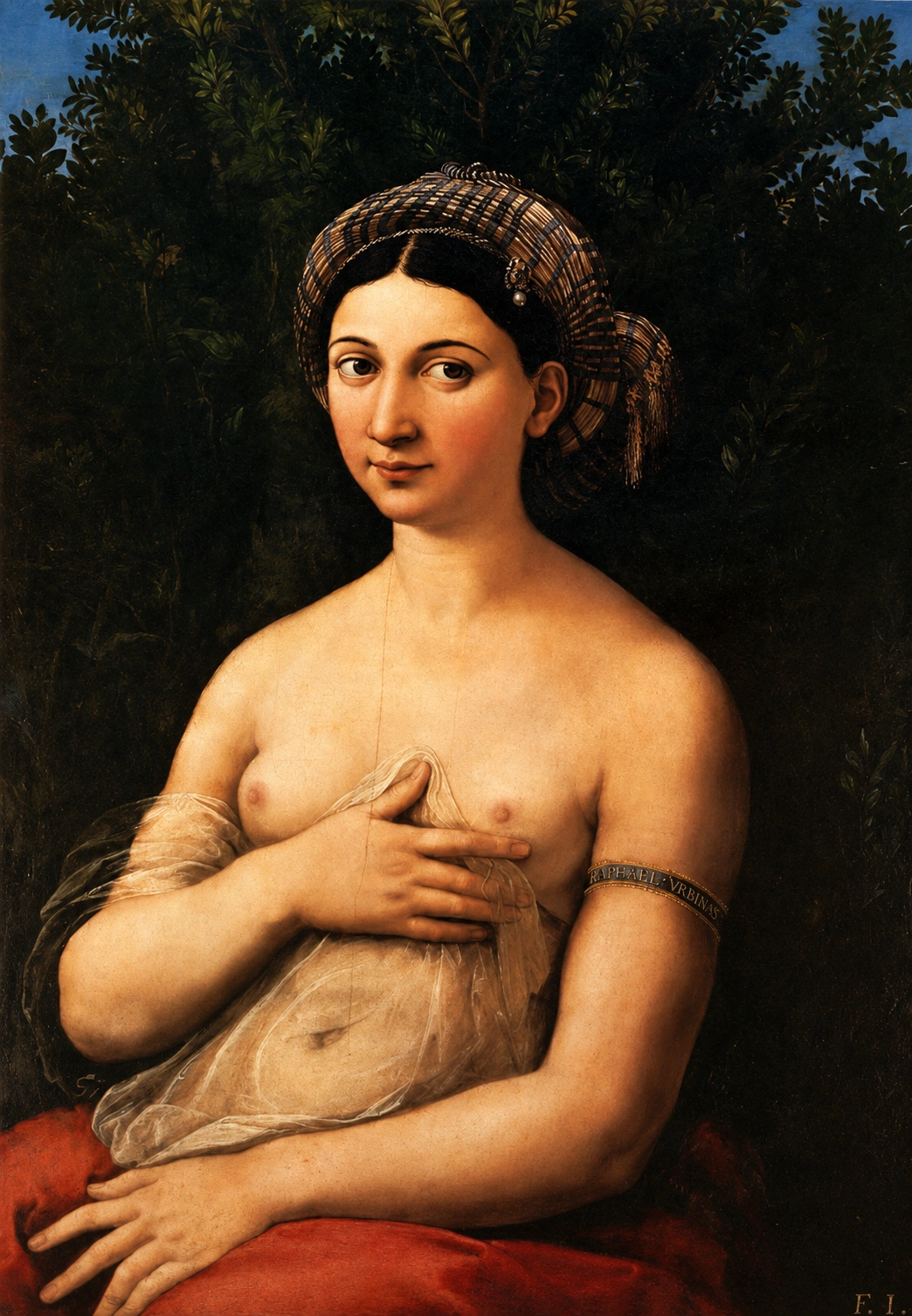
Raphael’s La Fornarina, painted around 1520, is one of the most intriguing portraits of the Italian Renaissance. The painting presents a young woman seated against a dense background of dark vegetation. She wears a patterned headdress, a translucent veil, a jeweled ornament in her hair, and an armband bearing the artist’s name. Her upper body is partially uncovered, while one hand rests across her chest and the other lies upon the red fabric covering her lap.
The identity of the sitter has never been established with certainty. She has traditionally been associated with Margherita Luti, a woman believed to have been Raphael’s lover. According to later stories, she was the daughter of a baker, which explains the name “Fornarina,” meaning “little baker” or “baker’s daughter.” Whether this identification is historically accurate remains uncertain, but it has shaped the painting’s reputation as a deeply personal image connected to Raphael’s private life.
The Mysterious Identity of the Sitter
Unlike Raphael’s formal portraits of aristocrats, religious leaders, and wealthy patrons, La Fornarina feels remarkably intimate. The woman is not surrounded by objects that clearly indicate her social status. There is no elaborate interior, luxurious architectural setting, or recognizable family symbol. Instead, Raphael places nearly all attention on her face, body, clothing, and gestures.
The sitter looks toward the viewer with a calm but slightly guarded expression. Her eyes are alert, while her mouth forms a subtle, restrained smile. She does not appear completely distant, yet she is not openly welcoming either. This emotional ambiguity gives the portrait much of its fascination.
The traditional association with Margherita Luti adds a romantic dimension to the painting. Raphael never married, although he was engaged to Maria Bibbiena, the niece of a powerful cardinal. Stories about his relationship with Margherita developed after his death, presenting her as his secret companion and artistic muse. Although these stories cannot be accepted without question, the personal quality of La Fornarina has encouraged generations of viewers to imagine a close bond between the artist and the sitter.
Raphael’s Signature and the Armband
One of the most significant details in La Fornarina is the narrow armband around the woman’s upper arm. The inscription reads “RAPHAEL URBINAS,” identifying Raphael as an artist from Urbino. This is more than a simple signature placed discreetly in a corner. Raphael has written his name directly onto an object worn against the sitter’s skin.
The placement of the signature creates an unusual connection between the artist and the woman. It may suggest artistic authorship, as though Raphael is proudly identifying the figure as his creation. It can also be interpreted as a sign of personal attachment. The artist’s name becomes part of the sitter’s appearance, almost like a piece of jewelry given to her.
This detail contributes to the painting’s private and possessive atmosphere. Raphael is not merely recording a woman’s likeness. He appears to be declaring his relationship to the image itself. The inscription reminds viewers that the woman exists within a carefully constructed work of art, shaped by Raphael’s observation, imagination, and emotional involvement.
Composition and the Viewer’s Attention
The figure occupies most of the painted surface. Her body forms a broad triangular composition, with her head at the upper point and her arms extending across the lower half of the image. This stable arrangement gives the portrait a sense of balance and calm.
Raphael places the woman close to the front of the picture. There is little space between her body and the viewer. The dark foliage behind her creates a shallow setting, preventing the eye from wandering into a distant landscape. As a result, the sitter seems physically present and immediate.
Her face is positioned near the center of the composition, but the arrangement of her arms guides the viewer’s gaze downward and across the painting. One hand holds the transparent fabric against her chest, while the other rests upon her lap. These gestures create flowing diagonal lines that connect the upper and lower portions of the figure.
The pose is carefully designed to appear natural while remaining highly controlled. Raphael combines physical softness with geometric order, a characteristic associated with his mature style. Nothing feels accidental. Every movement contributes to the painting’s visual harmony.
Light, Color, and Texture
The contrast between the sitter’s illuminated skin and the shadowy background is central to the painting’s effect. Her face, shoulders, arms, and chest emerge from the darkness with a warm, golden glow. This lighting gives her body a sculptural quality, emphasizing rounded forms without making them appear harsh.
The surrounding vegetation is painted in deep greens and browns. These subdued tones allow the warmer colors of the figure to dominate. The red fabric across her lap provides the strongest color accent. Its earthy warmth complements the tones of her skin while anchoring the lower section of the composition.
Raphael also creates a rich variety of textures. The woman’s skin appears smooth, while the headdress is patterned and structured. The translucent veil is delicate and nearly weightless. The jeweled ornament catches the light, and the background leaves form a dense, uneven surface.
These contrasts demonstrate Raphael’s ability to describe different materials while preserving a unified visual effect. The painting does not become overloaded with detail. Instead, each texture strengthens the viewer’s awareness of the woman’s physical presence.
The Headdress and Transparent Veil
The sitter’s headdress is one of the portrait’s most distinctive features. Its striped and folded fabric surrounds her dark hair, creating an elaborate frame around her face. A jeweled decoration appears near the side of her head, introducing a small note of luxury.
The headdress may have been inspired by fashionable Renaissance clothing, but it also gives the woman an exotic or classical appearance. Raphael frequently combined contemporary observation with references to ancient art. Here, the sitter seems to exist between the real world of sixteenth-century Rome and an imagined world of classical beauty.
The transparent veil introduces another layer of complexity. It covers parts of her body without fully concealing them. The fabric emphasizes the difference between covering and revealing, modesty and display. Because the veil is so delicate, it draws attention to the areas it touches rather than hiding them.
This tension is essential to the painting. The woman’s pose suggests modesty, yet the portrait clearly celebrates physical beauty. Raphael avoids presenting the figure as either completely formal or entirely idealized. She remains both an individual woman and an artistic embodiment of beauty.
Symbolism of Love and Beauty
The dark vegetation behind the sitter may include plants traditionally associated with love, fertility, and Venus. Myrtle, in particular, was closely connected to Venus, the classical goddess of love and beauty. If Raphael intended this association, the background transforms the portrait into something more than a private likeness.
The sitter may be compared to representations of Venus in which the goddess modestly covers her body with her hands. Raphael adapts this classical gesture but gives it a more personal and human quality. The woman is not presented as a distant mythological figure. Her direct gaze, individual features, and subtle expression make her feel real.
The painting therefore exists between portraiture and ideal beauty. Raphael may have portrayed a specific woman while also presenting her as a modern Venus. This combination would have allowed him to express personal affection through the respected visual language of classical art.
Raphael’s Ideal of Renaissance Beauty
Raphael was celebrated for creating figures that combined natural observation with graceful idealization. The sitter in La Fornarina has carefully balanced features, smooth skin, a straight nose, and gently curved eyebrows. Her face is individualized, yet it also reflects Renaissance ideals of harmony and proportion.
Her beauty does not depend on dramatic expression. Instead, Raphael creates attraction through calmness, symmetry, and controlled movement. The sitter’s emotional restraint encourages the viewer to study her more closely. Her personality remains partly hidden, making her appear psychologically complex.
This balance between reality and idealization is one of Raphael’s greatest achievements. He does not simply copy what he sees. He reorganizes natural forms to create visual perfection while preserving a sense of living presence.
The Lasting Importance of La Fornarina
La Fornarina remains compelling because it resists a single interpretation. It can be viewed as a portrait of Raphael’s lover, an idealized image of feminine beauty, a private declaration of affection, or a Renaissance reinterpretation of Venus. Each possibility adds to the painting without completely explaining it.
The portrait also stands apart from Raphael’s religious commissions and grand decorative projects. It reveals a quieter and more personal side of the artist. The close composition, direct gaze, subtle smile, and prominent signature create an atmosphere unlike that of a conventional commissioned portrait.
Raphael died in 1520, the year traditionally associated with the completion of the painting. This gives La Fornarina additional emotional significance as one of the final works connected to his brief but extraordinary career. The woman’s identity may remain uncertain, but Raphael’s sensitive treatment ensures that her image continues to feel immediate, mysterious, and unforgettable.