Portrait of Baldassare Castiglione by Raphael: Vibrant Color Edit
Free to Download & Reuse: You are welcome to use this image! If you republish or share it online, you must include a direct link back to this webpage for attribution.
Original Image Source: wikiart.org
Introduction
Raphael’s Portrait of Baldassare Castiglione, painted around 1515, is one of the most admired portraits of the Italian Renaissance. The work presents Baldassare Castiglione, a diplomat, courtier, writer, and intellectual who became closely associated with the refined culture of Renaissance courts. Rather than surrounding his subject with symbols of wealth or political authority, Raphael concentrates on Castiglione’s face, clothing, posture, and quiet psychological presence.
The painting is celebrated for its restrained color palette, balanced composition, and remarkable sense of intimacy. Castiglione appears dignified without seeming distant, intelligent without appearing severe, and fashionable without becoming ostentatious. Raphael creates an image of ideal Renaissance refinement through subtle gestures and carefully controlled visual harmony.
The portrait also reflects the values Castiglione described in his famous book, The Book of the Courtier. In that work, he presented the ideal courtier as educated, graceful, cultured, and capable of making difficult achievements appear effortless. Raphael’s portrait transforms those qualities into a visual form.
Baldassare Castiglione and Renaissance Court Culture
Baldassare Castiglione was born in 1478 into a noble family in northern Italy. He served at several Italian courts, most notably the court of Urbino, where artists, writers, diplomats, and aristocrats gathered in an environment known for its intellectual sophistication. Castiglione participated directly in this culture and observed the manners, conversations, and expectations of courtly life.
His friendship with Raphael gives the portrait a personal dimension. This was not simply a formal commission produced between strangers. Raphael was painting someone he knew and respected. The resulting image communicates familiarity without losing the dignity expected of an aristocratic portrait.
Castiglione’s most famous literary achievement, The Book of the Courtier, describes conversations among members of the Urbino court concerning the qualities of an ideal gentleman and lady. The ideal courtier needed knowledge of literature, music, art, military skills, diplomacy, and polite conversation. Above all, he needed sprezzatura, a term describing the ability to conceal effort and perform difficult tasks with natural grace.
Raphael’s portrait embodies this concept. Nothing in the painting appears forced. Castiglione’s posture seems comfortable, his clothing appears elegant but not theatrical, and his expression combines alertness with calm self-control.
Composition and Pose
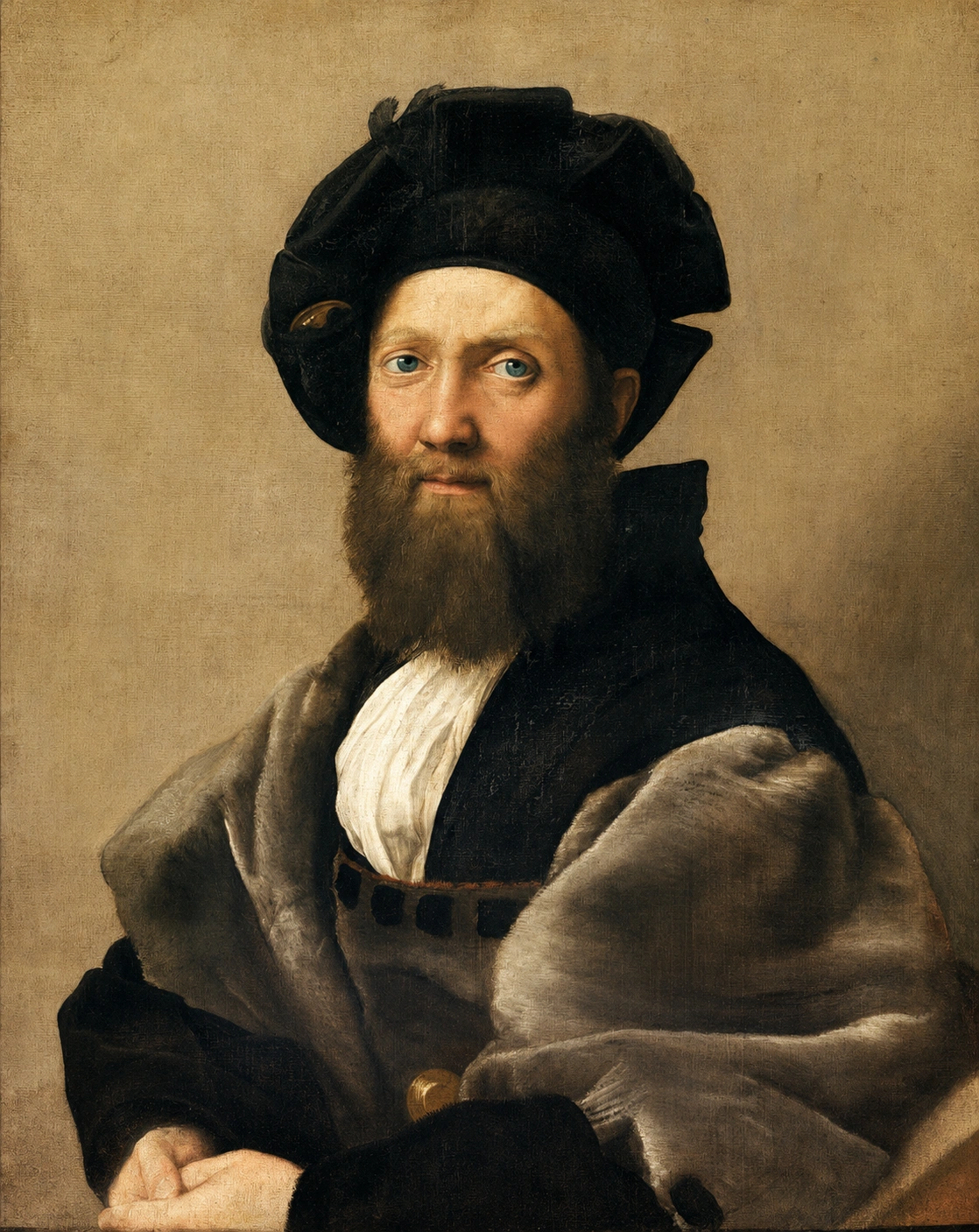
Castiglione is shown in a three-quarter pose, seated against a plain, warm-toned background. His upper body forms a broad pyramidal structure, creating stability and balance. The dark hat provides a strong visual crown above his face, while the large folds of his clothing widen the lower half of the composition.
His hands are visible near the bottom of the painting, gently resting together. Their position reinforces the impression of composure. There is no dramatic gesture or object to distract from his personality. Raphael allows the sitter’s expression and bearing to become the primary subjects.
The slight turn of Castiglione’s body contrasts with the more direct orientation of his face. This creates a sense of natural movement while maintaining contact with the viewer. He does not appear rigidly posed. Instead, he seems to have turned quietly toward someone standing nearby.
The portrait’s close framing strengthens its intimacy. Castiglione occupies most of the canvas, bringing his face and clothing near the viewer. Yet Raphael avoids making the figure feel crowded. The empty background creates enough breathing space around the sitter’s head and shoulders.
Castiglione’s Expression and Psychological Presence
The emotional complexity of Castiglione’s face is one of the painting’s greatest achievements. His pale blue eyes look outward with calm attention. His mouth is relaxed, and his eyebrows are softly raised. The expression is thoughtful, reserved, and quietly receptive.
Raphael avoids presenting Castiglione as either heroic or emotionally dramatic. The sitter’s personality emerges through understatement. He appears capable of listening as well as speaking, an important quality for a diplomat and courtier. His gaze suggests intelligence, but it does not challenge or dominate the viewer.
There is also a subtle vulnerability in his expression. The softness of his eyes and the delicate modeling of his face prevent the portrait from becoming a simple display of aristocratic confidence. Castiglione seems dignified but human. This combination of social authority and personal sensitivity gives the painting its lasting emotional appeal.
The viewer may feel as though Castiglione is present in the same room. This sense of psychological immediacy comes from Raphael’s ability to balance idealization with observation. The sitter is refined, but he is not transformed into an unreachable symbol.
Clothing, Texture, and Social Identity
Castiglione wears clothing dominated by black, gray, brown, and white. These restrained colors communicate elegance and good taste. His black hat is large and fashionable, framing the upper part of his face. Beneath it, a dark garment surrounds his neck and shoulders.
The most visually striking element is the soft gray fur covering much of his upper body. Raphael renders the fur through broad, delicate transitions rather than sharp individual hairs. Its texture appears warm, heavy, and luxurious. The white shirt at the center introduces a gentle contrast, guiding attention toward the face.
Although the clothing indicates high social status, it does not overwhelm the sitter. Castiglione is not covered in bright jewels, elaborate embroidery, or ceremonial objects. Raphael presents luxury through material quality rather than excessive decoration.
This restraint reflects Castiglione’s identity as an intellectual courtier. His status depends not only on wealth or birth but also on judgment, learning, and self-command. His clothing supports his dignity while allowing his personality to remain central.
Color and Light
The painting’s limited color palette is essential to its atmosphere. Warm beige fills the background, while black, gray, white, and muted brown dominate the figure. Castiglione’s blue eyes provide one of the few cool accents, making his gaze especially noticeable.
Raphael uses soft light to model the face and hands. There are no harsh shadows or dramatic contrasts. Light passes gradually across the forehead, cheeks, nose, and beard, giving the sitter a natural three-dimensional presence.
The black hat and dark collar frame Castiglione’s lighter face, creating a strong focal point. The gray clothing then forms a series of gentle curves around the central white shirt. Every color and tonal transition contributes to the painting’s balance.
The background contains no architecture, landscape, or decorative detail. Its neutral surface prevents visual distraction and creates a timeless setting. Castiglione appears removed from a specific event, allowing the portrait to function as a broader image of character and refinement.
Raphael’s Portrait Style
Raphael was renowned for clarity, grace, and compositional harmony. In this portrait, he combines these qualities with close psychological observation. The sitter’s pose recalls earlier Renaissance portrait traditions, particularly the calm three-quarter presentation associated with Leonardo da Vinci.
Raphael, however, develops a distinctive mood. His forms are softer, his design is exceptionally balanced, and his treatment of the sitter feels open and humane. The portrait does not depend on mystery alone. It creates a sense of intelligent companionship.
The careful arrangement of rounded shapes contributes to the harmony. The hat, shoulders, sleeves, hands, and beard form a connected rhythm. No single element disrupts the unity of the image. This visual ease parallels the Renaissance ideal of sprezzatura. Raphael’s technical skill is immense, but the final result appears natural and effortless.
The Meaning of the Portrait
Portrait of Baldassare Castiglione can be understood as a visual statement about ideal character. Castiglione represents a form of masculinity based on education, diplomacy, emotional control, and graceful conduct. His authority is quiet rather than aggressive.
The painting also explores the relationship between outward appearance and inner identity. Castiglione’s clothing establishes his social position, but his gaze reveals something more personal. Raphael suggests that true nobility depends on intelligence, restraint, and humanity.
Because the portrait was created between friends, it may also serve as an expression of respect. Raphael does not merely record Castiglione’s physical features. He preserves an idealized memory of his personality and values.
Legacy and Lasting Appeal
Raphael’s portrait became highly influential in the history of European portraiture. Later artists admired its restrained elegance, soft modeling, and psychological depth. Its influence can be seen in portraits that emphasize thoughtful presence rather than elaborate symbolism.
The painting continues to feel modern because Castiglione appears approachable. His clothing belongs to the Renaissance, but his expression remains familiar. He seems thoughtful, slightly guarded, and fully aware of the viewer.
Through its balanced composition, muted colors, refined textures, and sensitive observation, Portrait of Baldassare Castiglione presents one of the Renaissance’s most convincing images of cultivated humanity. Raphael transforms a courtier and writer into a timeless embodiment of intelligence, dignity, friendship, and effortless grace.