Salvator Mundi by Leonardo da Vinci: Vibrant Color Edit
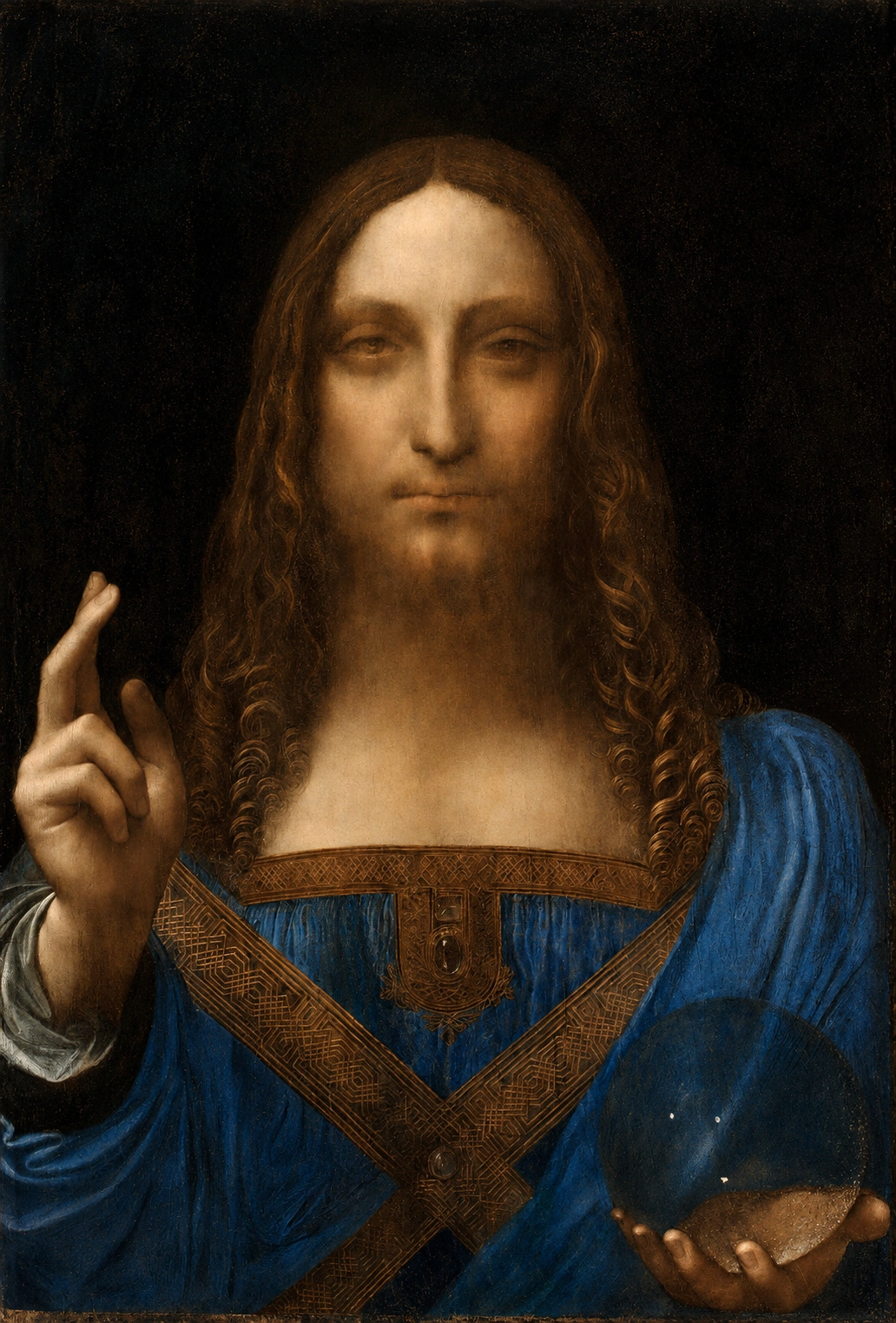
Free to Download & Reuse: You are welcome to use this image! If you republish or share it online, you must include a direct link back to this webpage for attribution.
Original Image Source: wikiart.org
Introduction to “Salvator Mundi” by Leonardo da Vinci
“Salvator Mundi,” painted around 1500 and attributed to Leonardo da Vinci, presents Christ as the Savior of the World. The Latin title translates directly as “Savior of the World,” identifying the figure through a traditional Christian image associated with divine authority, blessing, and universal salvation.
Christ appears frontally against a nearly black background. His right hand is raised in blessing, while his left hand supports a transparent crystal orb. The composition is restrained, symmetrical, and intensely focused on the sitter. There is no landscape, architecture, or narrative action to distract from Christ’s presence. Instead, Leonardo creates a devotional image based on stillness, psychological depth, and a mysterious exchange between the sacred figure and the viewer.
Although the painting follows an established religious format, Leonardo transforms the traditional subject through subtle modeling, atmospheric transitions, and careful observation of human expression. Christ is presented not as a distant symbol but as a living presence whose calm gaze seems to extend beyond the surface of the painting.
The Frontal Composition and Sacred Symmetry
The composition of “Salvator Mundi” is built around a strong central axis. Christ’s face occupies the upper center, while the crossed bands of his robe create a broad triangular structure beneath it. His raised right hand and orb-holding left hand introduce a controlled asymmetry, but the overall design remains balanced and stable.
This frontal pose carries religious significance. Christ faces the viewer directly, establishing an immediate spiritual encounter. Rather than looking toward another figure or participating in a narrative scene, he addresses the person standing before the painting. His body remains still, but the raised hand suggests an active gesture of blessing.
The dark background removes Christ from ordinary space. There is no indication of time, place, or earthly surroundings. This absence gives the figure an eternal quality. Christ appears suspended beyond the physical world, emerging gradually from darkness through carefully controlled light.
Leonardo’s composition also encourages prolonged contemplation. The viewer’s attention moves from Christ’s eyes to the blessing hand, then downward toward the orb. These three elements form the painting’s main spiritual sequence: divine recognition, blessing, and dominion over the world.
Christ’s Face and Mysterious Expression
The face of Christ is the emotional center of the painting. His expression is calm, solemn, and difficult to define. The lips are closed, the eyes are steady, and the features reveal no dramatic emotion. This ambiguity recalls Leonardo’s fascination with expressions that seem to change according to the viewer’s attention.
Christ’s gaze is especially important. He appears to look directly outward, yet his expression remains inward and meditative. The eyes communicate awareness without aggression. They suggest that Christ sees the viewer completely while remaining beyond ordinary human judgment.
The soft transitions between light and shadow contribute to this sense of mystery. Leonardo avoids harsh outlines around the cheeks, nose, and mouth. Instead, the forms seem to emerge through delicate gradations of tone. This technique, often associated with Leonardo’s sfumato, creates a smoky softness that unifies the face and gives it a lifelike presence.
The long brown hair falls in carefully arranged curls on either side of the face. These strands frame Christ’s features almost like a natural halo. Since no painted halo appears behind his head, the luminous skin, symmetrical hair, and surrounding darkness perform a similar visual function.
The Gesture of Blessing
Christ raises his right hand in a formal gesture of benediction. Two fingers extend upward while the others bend inward. This gesture has deep roots in Christian art and identifies Christ as a divine teacher and spiritual ruler.
Leonardo gives the hand considerable prominence. It is positioned close to the picture plane and illuminated against the dark background. The fingers are delicately modeled, with subtle highlights describing the skin and joints. The hand feels both symbolic and physically real.
Its placement creates the impression that the blessing reaches beyond the painting. Christ does not simply bless an invisible group within the composition. He blesses the viewer directly. This makes “Salvator Mundi” especially powerful as a devotional object.
The hand’s soft contours also contrast with the complex textures of the robe. While the garment is decorated with embroidery and folds, the blessing hand remains simple and exposed. This contrast directs attention toward the spiritual meaning of the gesture rather than toward material splendor.
The Crystal Orb and Its Meaning
The transparent orb in Christ’s left hand is one of the painting’s most recognizable elements. In traditional images of the Salvator Mundi, Christ often holds a globe representing the world. Leonardo replaces the usual solid globe with a clear crystal sphere.
The orb symbolizes Christ’s sovereignty over creation. By holding it gently in his palm, he appears to possess authority over the universe without effort. His fingers do not grip the sphere tightly. Instead, it rests lightly in his hand, suggesting perfect control.
The transparency of the orb adds another level of meaning. Crystal was associated with purity, spiritual clarity, and heavenly perfection. The sphere may therefore represent both the physical world and the divine order behind it.
Leonardo’s interest in optics makes the orb particularly intriguing. Small points of light and delicate reflections animate its surface. The object seems solid yet almost immaterial, reinforcing the boundary between the visible world and spiritual mystery.
The orb also balances the raised blessing hand. One hand communicates divine grace, while the other represents universal power. Together, they define Christ as both compassionate savior and ruler of creation.
Color, Light, and the Blue Robe
The painting’s color scheme is limited but symbolically rich. The deep blue robe dominates the lower half of the image, while warm flesh tones and brown hair emerge against the dark background. Gold embroidery crosses the chest, adding structure and visual distinction.
Blue has long been associated with heaven, truth, and spiritual authority in Christian art. Here, its cool depth separates Christ’s body from the surrounding darkness. The fabric appears heavy and luxurious, but its folds remain subdued enough to preserve the painting’s quiet atmosphere.
The golden bands create an X-shaped arrangement across the robe. Their geometric patterns contrast with the organic softness of the face and hair. They also guide the eye toward the central ornament at Christ’s chest, reinforcing the painting’s symmetry.
Light falls gently across the figure rather than entering from a clearly defined source. Christ seems to possess his own illumination. His face, chest, hands, and garment emerge gradually from shadow, giving the impression that sacred light is revealing him from within the darkness.
Leonardo da Vinci’s Interest in the Human and Divine
“Salvator Mundi” reflects Leonardo da Vinci’s ability to combine religious symbolism with close attention to the human body. Christ’s features are idealized, but they are not abstract. The hands possess weight, the skin has tonal variation, and the hair follows carefully observed patterns of movement.
Leonardo was deeply interested in how physical appearance could communicate inner life. In this painting, Christ’s divinity is not expressed through dramatic rays of light or supernatural spectacle. It is conveyed through composure, balance, and psychological intensity.
The image also reflects Leonardo’s fascination with contrasts. Christ is both human and divine, present and distant, illuminated and surrounded by darkness. The orb is both material and transparent. The blessing hand is both physically close and spiritually symbolic.
These tensions make the painting more than a conventional religious portrait. It becomes a meditation on the possibility of representing the sacred through the visible human form.
The Painting’s Emotional Impact
The emotional power of “Salvator Mundi” comes from its silence. Christ does not speak, move, or display obvious emotion. The painting depends on stillness and direct visual contact.
This quietness can feel comforting, solemn, or unsettling. Christ’s expression offers neither a clear smile nor a severe judgment. The viewer must interpret the encounter personally. This openness gives the painting much of its enduring fascination.
The dark setting further intensifies the experience. With no surrounding details, the viewer is left alone with Christ’s gaze and gestures. The painting becomes less like a scene observed from a distance and more like a private audience with a sacred figure.
Leonardo’s subtle transitions prevent the image from becoming rigid. The face appears to breathe, the curls seem to shift softly, and the hands emerge gradually from shadow. These details create a sense of living presence within an otherwise motionless composition.
The Lasting Significance of “Salvator Mundi”
“Salvator Mundi” remains one of the most discussed religious images associated with Leonardo da Vinci. Its fame comes not only from its history and attribution but also from the remarkable simplicity of its design.
The painting reduces the Christian idea of salvation to a single frontal figure, two symbolic gestures, and an atmosphere of darkness and light. Christ blesses the viewer while holding the world, joining mercy and authority within one balanced image.
Its enduring appeal lies in the tension between clarity and mystery. The symbols are recognizable, yet the expression remains elusive. The composition is symmetrical, yet the figure feels alive. Christ is directly present, yet he seems to belong to a realm beyond ordinary experience.
Through restrained color, delicate modeling, and psychological depth, “Salvator Mundi” transforms a traditional devotional subject into a profound meditation on divine presence. It invites the viewer not simply to observe Christ but to stand before him, receive his gaze, and contemplate the meaning of salvation.