La Belle Ferronnière by Leonardo da Vinci: Vibrant Color Edit
Free to Download & Reuse: You are welcome to use this image! If you republish or share it online, you must include a direct link back to this webpage for attribution.
Original Image Source: wikiart.org
Introduction
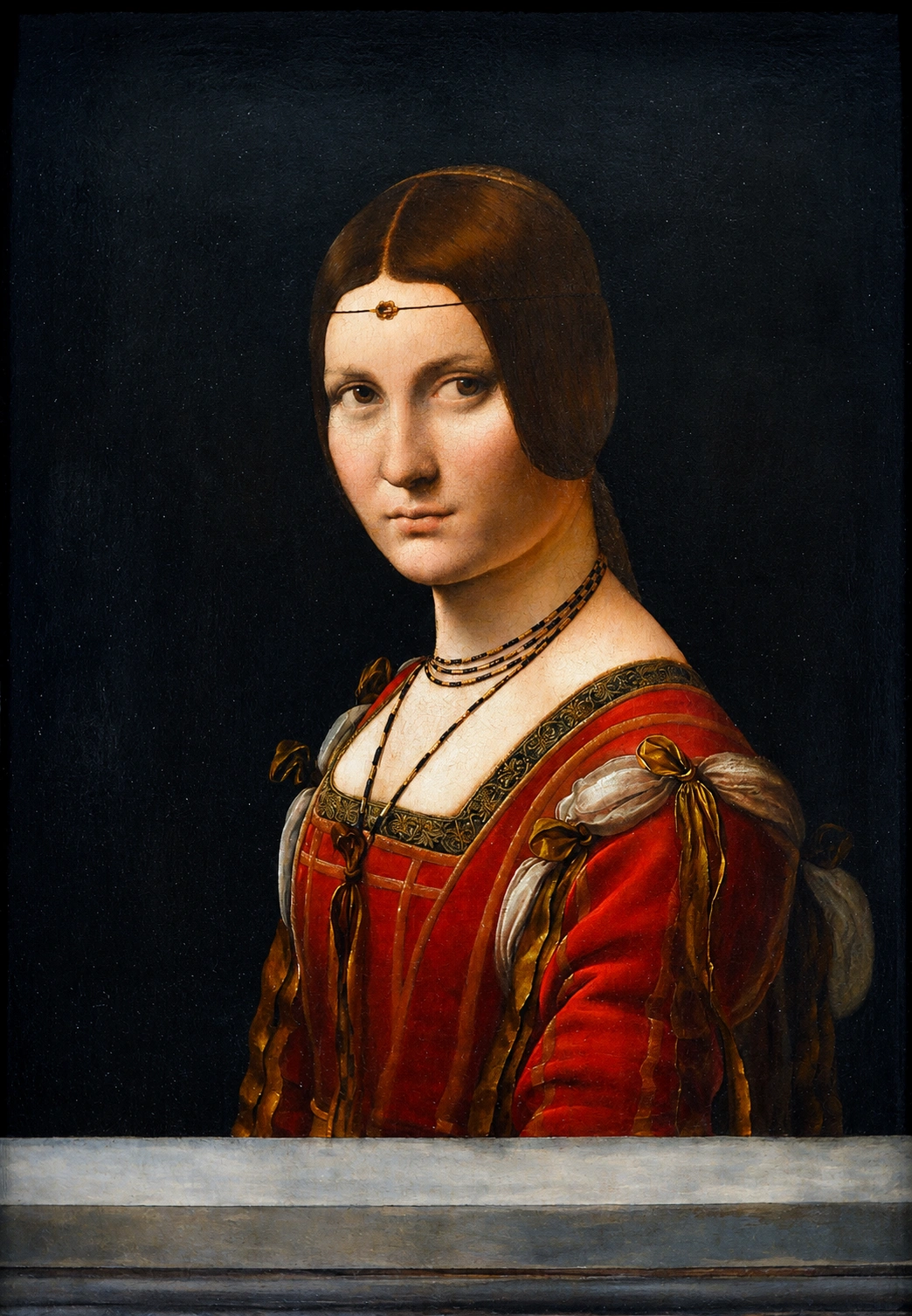
Leonardo da Vinci’s La Belle Ferronnière, painted around 1490, is one of the most compelling portraits of the Italian Renaissance. The painting presents an unidentified woman dressed in the refined fashion of the Milanese court, positioned against a dark background and separated from the viewer by a pale stone parapet. Although the sitter’s identity remains uncertain, her composed expression, elegant clothing, and direct gaze have made the portrait one of Leonardo’s most recognizable studies of female character.
Rather than presenting the woman through elaborate surroundings or symbolic objects, Leonardo concentrates attention on her face, posture, and psychological presence. The portrait appears restrained at first, yet its simplicity creates an atmosphere of tension and intimacy. The sitter does not smile or perform for the viewer. Instead, she turns slightly while looking outward with a calm but guarded expression. This combination of physical stillness and emotional complexity demonstrates Leonardo’s remarkable ability to transform portraiture into an exploration of human consciousness.
The Mysterious Identity of the Sitter
The title La Belle Ferronnière was attached to the painting long after Leonardo created it. It translates approximately as “the beautiful ironmonger’s wife,” though there is no reliable evidence that the sitter was married to an ironworker. The name may have resulted from confusion with another portrait or from the type of jewel worn across the woman’s forehead, which later became known as a ferronnière.
Several women connected to the court of Milan have been proposed as the sitter. One frequently suggested possibility is Lucrezia Crivelli, who became a mistress of Ludovico Sforza, Duke of Milan. Another theory identifies her as Beatrice d’Este, Ludovico’s wife and one of the most influential women of the Milanese court. The portrait has also been associated with Cecilia Gallerani, although she is generally recognized as the sitter in Leonardo’s Lady with an Ermine.
The uncertainty surrounding the woman’s identity contributes to the painting’s fascination. Leonardo created a personality that feels specific and individual, yet the absence of a confirmed name allows her to remain mysterious. She appears close enough to be psychologically accessible but distant enough to resist complete interpretation.
Composition and the Stone Parapet
The composition is carefully balanced. The sitter is shown from approximately the waist upward, with her body turned slightly to one side and her face directed more fully toward the viewer. This subtle contrast between the direction of her body and the direction of her gaze introduces movement into an otherwise stable arrangement.
A pale parapet stretches horizontally across the bottom of the painting. This architectural element creates a boundary between the sitter and the viewer. It may have been inspired by earlier Netherlandish portrait traditions, in which ledges and frames were used to strengthen the illusion of physical space. In Leonardo’s painting, however, the parapet also has a psychological function. It makes the woman appear present and tangible while preserving a sense of separation.
The dark background removes all distractions. There is no landscape, interior, or decorative setting to provide information about the sitter’s life. As a result, her illuminated face and red clothing emerge with extraordinary clarity. Leonardo turns the portrait into a concentrated encounter between the woman and the viewer.
The Sitter’s Expression and Gaze
The most captivating feature of La Belle Ferronnière is the sitter’s gaze. Her eyes are directed slightly to the side rather than meeting the viewer with complete openness. This gives the impression that she has noticed someone or something beyond the picture’s edge. Her attention appears focused, but the object of that attention remains unknown.
Her lips are closed, and her expression is controlled. She does not display the soft smile associated with the Mona Lisa. Instead, her face suggests intelligence, confidence, and emotional reserve. The slightly raised brow and steady eyes create a sense of alertness. She seems aware of being observed, yet she refuses to surrender her inner thoughts.
Leonardo’s approach differs from the more formal and impersonal portraiture often produced for aristocratic courts. Although the sitter’s clothing and jewellery communicate social status, her personality is not reduced to those external signs. The portrait suggests an active mind beneath the carefully arranged appearance.
Clothing, Jewellery, and Courtly Fashion
The woman wears a richly coloured red gown with decorative bands along the neckline and bodice. The squared neckline reflects the fashion of late fifteenth-century Milan, while the patterned trim adds refinement without overwhelming the composition. The fabric appears substantial, and the structured design emphasizes the sitter’s upright posture.
Her sleeves are decorated with tied ribbons and lighter sections of fabric. These details introduce variety into the red garment and demonstrate the complexity of Renaissance court dress. Leonardo carefully observes the folds, seams, and ornamental borders, but he avoids excessive display. The clothing supports the sitter’s dignity rather than competing with her face.
Several necklaces encircle her neck and descend across her chest. The different lengths create gentle visual rhythms that lead the eye downward from her face. The jewellery indicates wealth and courtly sophistication, but its delicate scale maintains the portrait’s overall restraint.
The narrow band worn across her forehead is especially distinctive. A small jewel rests at the centre, drawing attention to the symmetry of her face and the precise parting of her hair. This ornament later became associated with the name “ferronnière,” although that term was not necessarily used in Leonardo’s time.
Leonardo’s Use of Light and Shadow
Leonardo models the sitter’s face through subtle transitions between light and darkness. Illumination falls most strongly on the left side of her face, while softer shadows shape the opposite cheek, jaw, and neck. These gradual changes create a convincing sense of three-dimensional volume.
The technique reflects Leonardo’s interest in how light interacts with the human body. He understood that faces are not defined by hard outlines alone. Their forms emerge through delicate variations of tone. In La Belle Ferronnière, the nose, cheeks, eyelids, and lips are developed through controlled shading that gives the skin a lifelike presence.
The dark background strengthens this effect. Because there are no competing colours or shapes behind the sitter, the illuminated areas seem to project forward. Her face appears suspended within the darkness, almost as though it were slowly emerging from shadow.
The contrast between the pale skin and the deep red dress also contributes to the portrait’s visual power. The warm garment frames the cooler tones of the face, while touches of gold connect the jewellery, ribbons, and decorative borders.
Hair, Line, and Geometric Order
The sitter’s hair is parted precisely in the centre and arranged smoothly against the sides of her head. The rounded shape of the hairstyle creates a dark frame around her pale face. Long sections appear gathered behind her neck, reinforcing the controlled and formal character of her appearance.
Leonardo organizes the portrait through clear geometric relationships. The oval of the face, the curve of the head, the horizontal line of the parapet, and the vertical alignment of the forehead jewel establish a strong underlying structure. These elements create stability, while the sitter’s turned pose prevents the composition from becoming rigid.
The forehead ornament divides the face with almost mathematical precision. At the same time, minor asymmetries in the eyes, lips, and angle of the head preserve the sitter’s individuality. Leonardo balances ideal order with close observation of a particular human being.
Psychological Realism
One of Leonardo’s greatest achievements was his ability to suggest thoughts and emotions without relying on obvious gestures. In La Belle Ferronnière, the sitter’s character is communicated through extremely subtle details. The direction of her gaze, the tension around her mouth, and the controlled turn of her head imply an emotional life that extends beyond the visible image.
The portrait does not explain what the woman is thinking. Leonardo allows uncertainty to remain, encouraging the viewer to participate in the interpretation. She may appear proud, cautious, curious, or quietly suspicious depending on how her expression is read.
This ambiguity gives the painting a sense of duration. It does not resemble a frozen ceremonial pose. Instead, it feels like a moment within an unfolding encounter. The sitter may have just turned toward someone entering the room, or she may be listening to a conversation beyond the frame. Leonardo transforms a static portrait into a scene charged with anticipation.
The Portrait’s Place in Leonardo’s Career
Leonardo painted La Belle Ferronnière during his years in Milan, where he worked for Ludovico Sforza. The Milanese court offered opportunities to create portraits of aristocrats, musicians, courtiers, and members of the duke’s circle. During this period, Leonardo deepened his study of anatomy, facial expression, light, and human psychology.
The painting can be compared with Lady with an Ermine, another Milanese portrait associated with the Sforza court. Both works feature women turned at an angle, their attention directed beyond the picture. However, La Belle Ferronnière is more restrained and monumental. The sitter’s larger scale, dark background, and frontal gaze give her a powerful physical and psychological presence.
The portrait also anticipates qualities later perfected in the Mona Lisa. These include the carefully structured pose, the subtle modelling of the face, and the suggestion of an inner life that cannot be fully understood. Yet La Belle Ferronnière possesses its own distinct character, defined by precision, dignity, and emotional firmness.
Lasting Meaning and Appeal
La Belle Ferronnière remains memorable because it combines formal elegance with psychological mystery. The sitter’s luxurious clothing establishes her connection to an elite courtly world, but Leonardo’s real subject is the individual behind that social identity. Her expression suggests that she possesses thoughts and intentions that remain independent of the viewer’s expectations.
The painting also demonstrates how simplicity can intensify meaning. The dark background, restricted palette, and limited number of objects direct attention toward the woman’s presence. Every visible detail, from the forehead jewel to the line of the parapet, contributes to the controlled atmosphere.
Although her identity remains uncertain, the sitter does not feel anonymous. Leonardo gives her such concentration and individuality that she appears capable of looking back at every generation of viewers. The portrait’s enduring power comes from this silent exchange. We can observe her appearance, clothing, and expression, but her private self remains beyond our reach.