Portrait of Ginevra Benci by Leonardo da Vinci: Vibrant Color Edit
Free to Download & Reuse: You are welcome to use this image! If you republish or share it online, you must include a direct link back to this webpage for attribution.
Original Image Source: wikiart.org
Introduction to Portrait of Ginevra Benci
Leonardo da Vinci’s Portrait of Ginevra Benci, painted around 1474, is one of the most remarkable portraits of the Italian Renaissance. Created when Leonardo was still a young artist working in Florence, the painting already reveals his extraordinary ability to combine physical observation, psychological depth, natural symbolism, and technical experimentation.
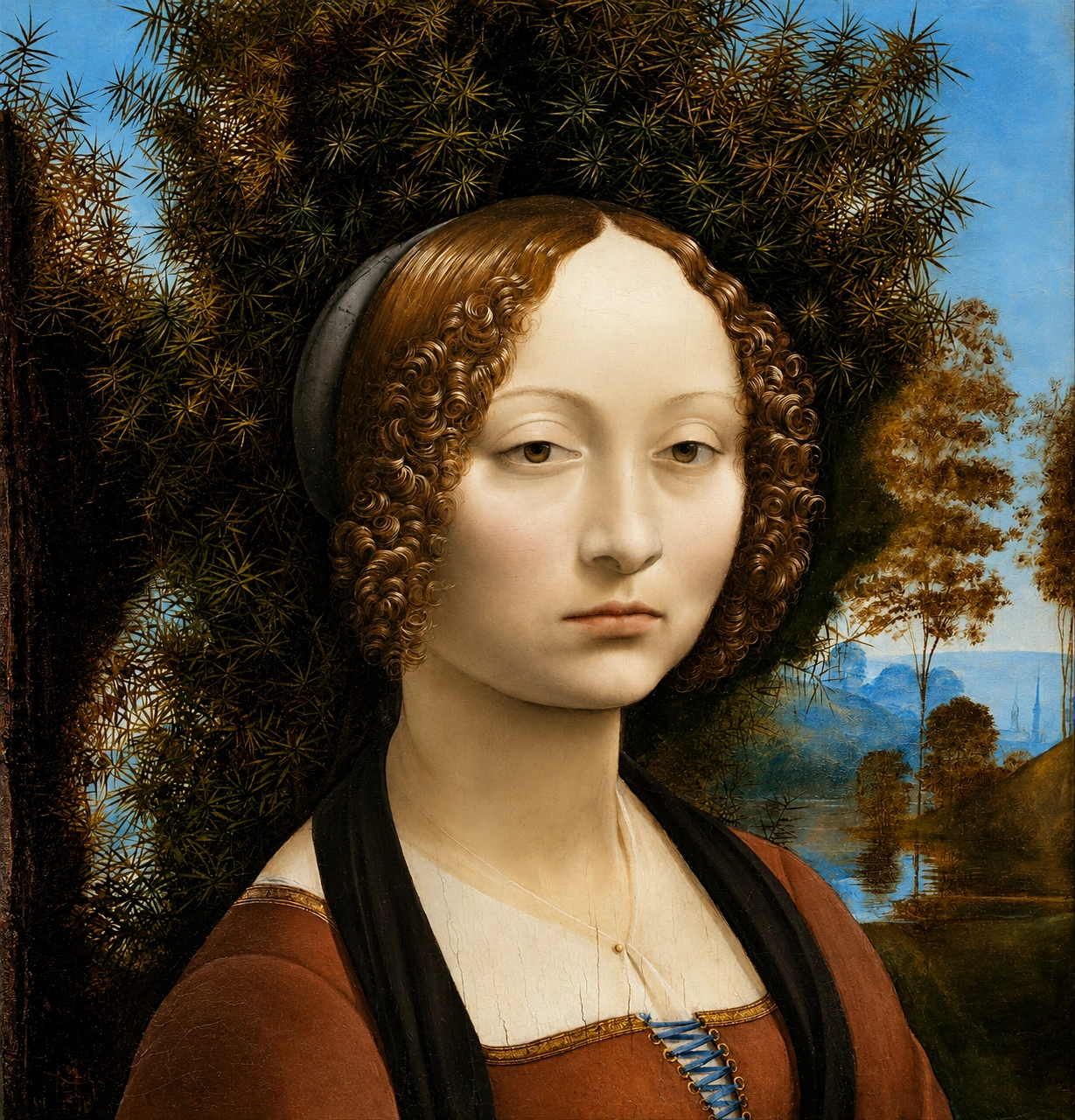
The portrait depicts Ginevra de’ Benci, a young Florentine noblewoman known within the city’s intellectual circles for her beauty, education, and poetry. Rather than presenting her as an ornamental figure surrounded by luxurious possessions, Leonardo places her before a dense wall of vegetation and a distant landscape. Her pale face emerges from the darkness of the juniper bush, while the open countryside behind her introduces light, water, and atmospheric distance.
This combination of an intensely observed face and a mysterious natural setting gives the portrait an unusual emotional power. Ginevra appears physically present, yet psychologically distant. Her expression is restrained, thoughtful, and difficult to interpret, qualities that would later become central to Leonardo’s portraiture.
Ginevra de’ Benci and Renaissance Florence
Ginevra de’ Benci was born into a wealthy Florentine banking family. Her social position placed her within the sophisticated cultural environment of fifteenth-century Florence, where merchants, poets, philosophers, and artists often interacted. She was admired not only for her appearance but also for her intellectual accomplishments.
The portrait may have been commissioned in connection with Ginevra’s marriage to Luigi di Bernardo Niccolini in 1474. Portraits of young women were frequently produced to commemorate marriages, especially among wealthy Florentine families. However, some scholars have also associated the painting with Bernardo Bembo, a Venetian diplomat who admired Ginevra and celebrated her virtue.
Whatever the precise circumstances of its commission, Leonardo avoided the conventional profile pose commonly used for Florentine female portraits. Instead, he turned Ginevra slightly toward the viewer. This three-quarter position gives her body greater volume and makes her presence feel immediate. It also allows Leonardo to explore the relationship between her outward appearance and her private emotional world.
The Composition and Three-Quarter Pose
Ginevra occupies most of the picture, with her head positioned near the center of the composition. Her shoulders turn slightly, while her face remains directed toward the viewer. This subtle difference between the angle of the body and the position of the head creates a sense of restrained movement.
The portrait was originally larger. The lower portion of the wooden panel was cut away at an unknown date, probably removing Ginevra’s hands. Their absence affects the composition, making the figure appear unusually close to the lower edge. Leonardo’s surviving studies suggest that the hands may once have been arranged gracefully in front of her body.
Even in its altered state, the painting remains carefully balanced. The broad shape of Ginevra’s face contrasts with the delicate curls of her hair. Her dark clothing connects visually with the shadowed vegetation, while the warm brown of her dress provides a transition between her pale skin and the darker surroundings.
Leonardo’s arrangement prevents the portrait from becoming static. The branches form irregular patterns around Ginevra’s head, while the landscape opens toward the right side. This movement between enclosure and openness strengthens the painting’s psychological tension.
Ginevra’s Expression and Psychological Presence
The most compelling element of Portrait of Ginevra Benci is Ginevra’s expression. Her lips are closed, her eyes are slightly narrowed, and her face shows little obvious emotion. She does not smile or attempt to charm the viewer. Instead, she appears composed, intelligent, and somewhat withdrawn.
Her gaze is direct without being confrontational. She looks outward, but her expression suggests that her attention may be turned inward. Leonardo presents her as a person with an independent interior life rather than merely as an example of feminine beauty.
This emotional ambiguity separates the portrait from more conventional Renaissance images of women. Many female sitters were shown with idealized features and carefully displayed clothing or jewelry. Leonardo gives relatively little attention to material luxury. The simplicity of Ginevra’s dress directs attention toward her face.
Her pale complexion may reflect Renaissance ideals of aristocratic beauty, but it also creates a striking visual effect. Against the dark juniper branches, her face appears almost luminous. This contrast makes her seem both physically real and strangely detached from the surrounding world.
The Symbolism of the Juniper Bush
The juniper bush behind Ginevra is one of the painting’s most important symbols. In Italian, the word for juniper is “ginepro,” which resembles the name Ginevra. The plant therefore functions as a visual reference to the sitter’s identity.
Juniper was also associated with virtue and moral purity. Its presence reinforces Ginevra’s reputation as a woman of intelligence and honorable character. The plant is not merely decorative. It connects her personal identity with qualities that Renaissance society considered admirable.
The dark branches surround her head like a natural frame. Their pointed leaves contrast with the softness of her skin and hair. This relationship between the human figure and the natural world reflects Leonardo’s belief that humanity was deeply connected to nature.
The reverse of the panel strengthens this symbolism. It contains a wreath formed from juniper, laurel, and palm branches, accompanied by the Latin motto “Virtutem Forma Decorat,” meaning “Beauty Adorns Virtue.” The message suggests that Ginevra’s outward beauty should be understood as the visible expression of her inner character.
The Landscape and Leonardo’s Study of Nature
Behind the dark vegetation, Leonardo includes a distant landscape with trees, water, hills, and a pale blue sky. The scene becomes less distinct as it recedes, demonstrating his early use of atmospheric perspective.
Instead of relying only on sharp outlines, Leonardo softens distant forms and adjusts their colors. The hills become increasingly blue, while the trees and buildings lose detail. This creates a convincing sense of space and atmosphere.
The landscape also contributes to the painting’s mood. The calm water, thin trees, and distant structures suggest a quiet world extending far beyond the sitter. Ginevra belongs to this environment, yet she remains separated from it by the dense juniper bush.
Leonardo’s careful observation of light can be seen in the reflections on the water and the delicate changes across the sky. These effects anticipate the mysterious landscapes that would later appear in works such as the Mona Lisa. Nature is not treated as a neutral background. It becomes an active part of the portrait’s emotional meaning.
Color, Light, and Surface Detail
The painting’s palette is relatively restrained. Leonardo uses deep greens, dark browns, muted reds, cool blues, and pale flesh tones. Rather than creating drama through bright colors, he depends on tonal contrasts.
Ginevra’s face is illuminated by soft light coming from the front and left. The light moves gently across her forehead, cheeks, nose, and chin. Shadows are carefully controlled, giving the head a rounded, sculptural presence.
Her curls are rendered with remarkable precision. Individual strands catch the light, producing golden and brown highlights. The rhythm of these curls echoes the intricate patterns of the juniper needles behind her.
Fine cracks visible across the painted surface reveal the age of the wooden panel, but they do not diminish the subtlety of Leonardo’s technique. His transitions between light and shadow avoid harsh boundaries. Although the fully developed smoky softness known as sfumato would become more prominent in his later works, its beginnings can already be recognized here.
An Innovative Renaissance Portrait
Portrait of Ginevra Benci represents an important stage in the development of Renaissance portraiture. Leonardo rejects the rigid profile format and gives the sitter greater physical and psychological presence. He also unites the human figure with a carefully observed natural environment.
Ginevra is neither dramatically expressive nor richly decorated. Her power comes from restraint. Leonardo invites the viewer to study the smallest details of her face while accepting that her thoughts remain inaccessible.
This tension between visibility and mystery would become one of Leonardo’s greatest artistic achievements. He could describe the physical world with extraordinary accuracy while preserving the emotional complexity of his subjects.
The portrait therefore feels both historical and surprisingly modern. Ginevra’s clothing and hairstyle belong to fifteenth-century Florence, but her guarded expression transcends its period. She appears not as a distant social type, but as an individual whose personality cannot be completely explained.
The Lasting Importance of Portrait of Ginevra Benci
Leonardo da Vinci’s Portrait of Ginevra Benci is a masterpiece of observation, symbolism, and psychological suggestion. Its carefully balanced composition, delicate treatment of light, and atmospheric landscape demonstrate the young artist’s rapidly developing abilities.
The juniper bush identifies Ginevra while symbolizing her virtue. The landscape creates depth and connects her to the natural world. Most importantly, her quiet expression gives the portrait its enduring fascination.
Leonardo does not provide a simple interpretation of Ginevra’s personality. He allows dignity, intelligence, reserve, and melancholy to coexist. The viewer can examine her face closely, but her inner thoughts remain beyond reach.
Through this combination of precise physical description and emotional uncertainty, Leonardo transformed a portrait of a Florentine noblewoman into a profound meditation on beauty, character, and human identity.