The Transfiguration by Raphael: Vibrant Color Edit
Free to Download & Reuse: You are welcome to use this image! If you republish or share it online, you must include a direct link back to this webpage for attribution.
Original Image Source: wikiart.org
Introduction
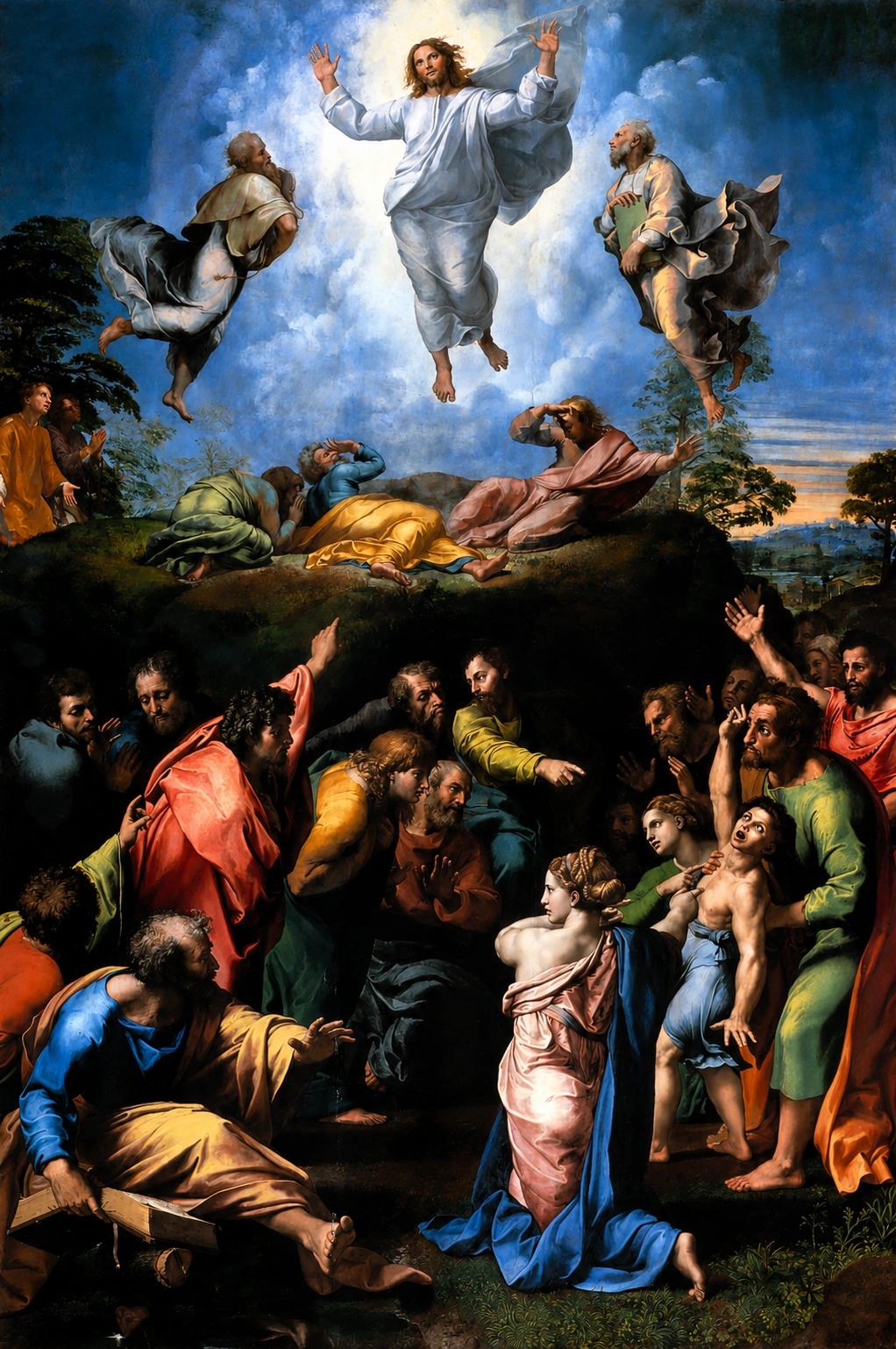
Raphael’s “The Transfiguration,” completed in 1520, is one of the most ambitious and emotionally powerful paintings of the Italian Renaissance. Created during the final years of Raphael’s life, the work combines two biblical episodes within a single monumental composition. The upper section presents Christ’s Transfiguration on Mount Tabor, while the lower section depicts the apostles attempting to heal a suffering boy.
The contrast between these scenes gives the painting its extraordinary dramatic force. Above, Christ appears weightless, radiant, and perfectly calm. Below, the figures are crowded together in a world of confusion, fear, illness, and uncertainty. Raphael connects these different realms through gesture, light, color, and movement, transforming the painting into a meditation on divine revelation, human limitation, and the possibility of salvation.
The Biblical Story
The upper scene represents the Transfiguration of Christ, an event described in the Gospels of Matthew, Mark, and Luke. Christ takes the apostles Peter, James, and John to a mountain, where his appearance suddenly changes. His face shines, his clothing becomes brilliantly white, and the prophets Moses and Elijah appear beside him.
In Raphael’s painting, Christ rises into the luminous sky with his arms extended. Moses and Elijah float on either side of him, holding the tablets of the law and a book. Beneath them, the three apostles recoil from the overwhelming vision. They shield their eyes, turn away, or fall toward the ground.
The lower scene comes from the episode that immediately follows the Transfiguration. A father brings his afflicted son to the remaining apostles, asking them to heal him. The apostles are unable to do so. Christ later returns from the mountain and cures the boy, demonstrating a spiritual authority that his followers do not yet possess.
By combining these stories, Raphael contrasts Christ’s divine power with the helplessness of humanity.
A Composition Divided Between Heaven and Earth
The painting is organized into two distinct sections, yet they remain closely connected. The upper half is spacious, bright, and symmetrical. Christ forms the central point of a triangular arrangement, with Moses and Elijah balancing each other on either side. The apostles below them create a second triangle that anchors the heavenly vision to the mountain.
The lower half is darker and far more crowded. Figures overlap one another, arms stretch across the composition, and faces turn in different directions. The viewer encounters a turbulent gathering rather than a stable arrangement.
A dark horizontal band separates the two scenes, but Raphael does not allow them to become completely independent. Several figures in the lower group point upward, directing attention toward Christ. Their gestures create an invisible line that connects the suffering boy with the divine figure above.
The painting therefore moves visually from disorder to harmony, from darkness to light, and from human despair to spiritual revelation.
Christ as the Center of Divine Light
Christ dominates the upper section without appearing physically heavy. His body floats effortlessly above the mountain, surrounded by a brilliant field of white and pale blue. Raphael gives him a frontal position, open arms, and flowing garments that make his figure seem both human and supernatural.
The radiant light does not come from an ordinary source. It appears to emerge from Christ himself. His white robes reflect subtle tones of blue, silver, and lavender, while the surrounding clouds form a glowing halo around his body.
This luminous atmosphere separates Christ from the earthly world below. He does not participate in the confusion of the lower scene. Instead, he embodies perfect calm, order, and certainty. His raised hands suggest blessing, revelation, and divine authority.
The open shape of Christ’s body also echoes the form of the cross. Raphael does not directly depict the Crucifixion, but the gesture suggests Christ’s future sacrifice. The glory of the Transfiguration is therefore connected to the suffering that will follow.
The Apostles and the Overwhelming Vision
Peter, James, and John lie beneath Christ on the mountain. Their poses reveal the physical and emotional intensity of the event. One apostle covers his face, another twists away from the brightness, and the third appears to collapse beneath the vision.
Their reactions emphasize the difference between divine reality and ordinary human perception. Christ remains balanced and composed, while the apostles lose control of their bodies. They cannot look directly at the radiant transformation.
Raphael uses strong foreshortening to make the apostles appear close to the viewer. Their twisting bodies and dramatic gestures create a sense of movement that contrasts with Christ’s stability.
Two additional figures appear at the far left of the upper scene. They are traditionally identified as Saints Justus and Pastor, whose feast day was associated with the church for which the painting was intended. Their presence connects the biblical narrative to the original religious setting of the altarpiece.
The Suffering Boy and the Crisis Below
The most emotionally intense figure in the lower section is the afflicted boy at the right. His body is unnaturally tense, his mouth is open, and his eyes turn upward. One arm reaches toward the sky while the other extends outward. His pale skin stands out against the darker clothing and shadowed background.
The boy’s father supports him from behind, presenting him to the apostles. His expression communicates desperation and hope. The surrounding people react with concern, fear, astonishment, and confusion.
Raphael does not treat the boy’s suffering as an isolated detail. His distorted pose becomes the visual center of the lower scene. The gestures of the crowd lead toward him, while his raised arm directs the viewer upward toward Christ.
The connection suggests that the solution to the crisis cannot be found among the confused figures below. Healing depends on the divine power revealed above.
Gesture, Emotion, and Visual Storytelling
Raphael uses hands and arms as a language of their own. Nearly every figure communicates through gesture. Some point toward the boy, others indicate the apostles, and several direct attention toward the mountain.
A woman kneeling in the foreground turns sharply toward the apostles. Her pink and blue clothing makes her one of the brightest figures in the lower section. With one arm extended, she presents the suffering child to the group. Her graceful pose contrasts with the surrounding tension, helping to organize the crowded composition.
At the center, an apostle dressed in yellow points upward. This gesture provides the clearest link between the two scenes. Although Christ is physically separated from the lower crowd, the apostle’s raised hand reminds the viewer that divine assistance is approaching.
Raphael carefully balances individual emotion with overall order. Each figure appears to respond personally to the event, yet every movement contributes to the larger structure.
Color and Light
Color reinforces the division between the two realms. The upper scene is dominated by cool blues, radiant whites, and soft atmospheric tones. These colors create an impression of openness and spiritual purity.
The lower scene contains deeper reds, greens, oranges, and dark shadows. The clothing is rich and varied, but the figures appear enclosed within a heavier atmosphere. Strong contrasts of light and darkness intensify the drama.
Raphael uses bright colors to guide the viewer through the crowd. The red cloak on the left, the woman’s pink and blue garments, and the green clothing on the right create a rhythmic movement across the composition.
The contrast between the brilliant sky and the shadowed foreground also carries symbolic meaning. Light represents divine knowledge and revelation, while darkness suggests confusion, suffering, and incomplete faith.
Raphael’s Final Masterpiece
“The Transfiguration” was Raphael’s final major painting. He died in 1520 before the work was entirely finished, and parts were likely completed by members of his workshop. According to tradition, the painting was displayed near Raphael’s body during his funeral, giving it an especially powerful association with his death.
The work reveals Raphael moving beyond the calm balance usually associated with the High Renaissance. The upper scene retains his characteristic harmony, but the lower section introduces greater tension, emotional intensity, and physical complexity. These qualities anticipate the dramatic style later associated with Mannerism and Baroque painting.
Rather than presenting beauty as simple serenity, Raphael shows beauty emerging from conflict. The painting acknowledges pain and disorder while offering a vision of spiritual resolution.
Meaning and Lasting Importance
“The Transfiguration” presents faith as a movement from uncertainty toward understanding. The lower figures inhabit a world where human knowledge and ability are insufficient. The apostles cannot heal the boy, the crowd cannot agree on what to do, and suffering dominates the scene.
Above them, Christ reveals a higher order. His calm presence does not erase the suffering below, but it places that suffering within a larger spiritual narrative. The painting suggests that divine truth may remain invisible during moments of confusion, even when it is near.
Raphael’s achievement lies in his ability to unite theology, emotion, and visual spectacle. The painting can be read as a biblical narrative, a study of human reactions, and a symbolic contrast between earthly darkness and heavenly light.
Through its monumental composition, expressive figures, luminous color, and profound spiritual meaning, “The Transfiguration” stands as a fitting conclusion to Raphael’s career. It remains one of the defining masterpieces of Renaissance art and one of the most compelling representations of divine revelation in Western painting.