The Hay Wain by John Constable: Vibrant Color Edit
Free to Download & Reuse: You are welcome to use this image! If you republish or share it online, you must include a direct link back to this webpage for attribution.
Original Image Source: wikiart.org
The Hay Wain by John Constable: A Complete Analysis
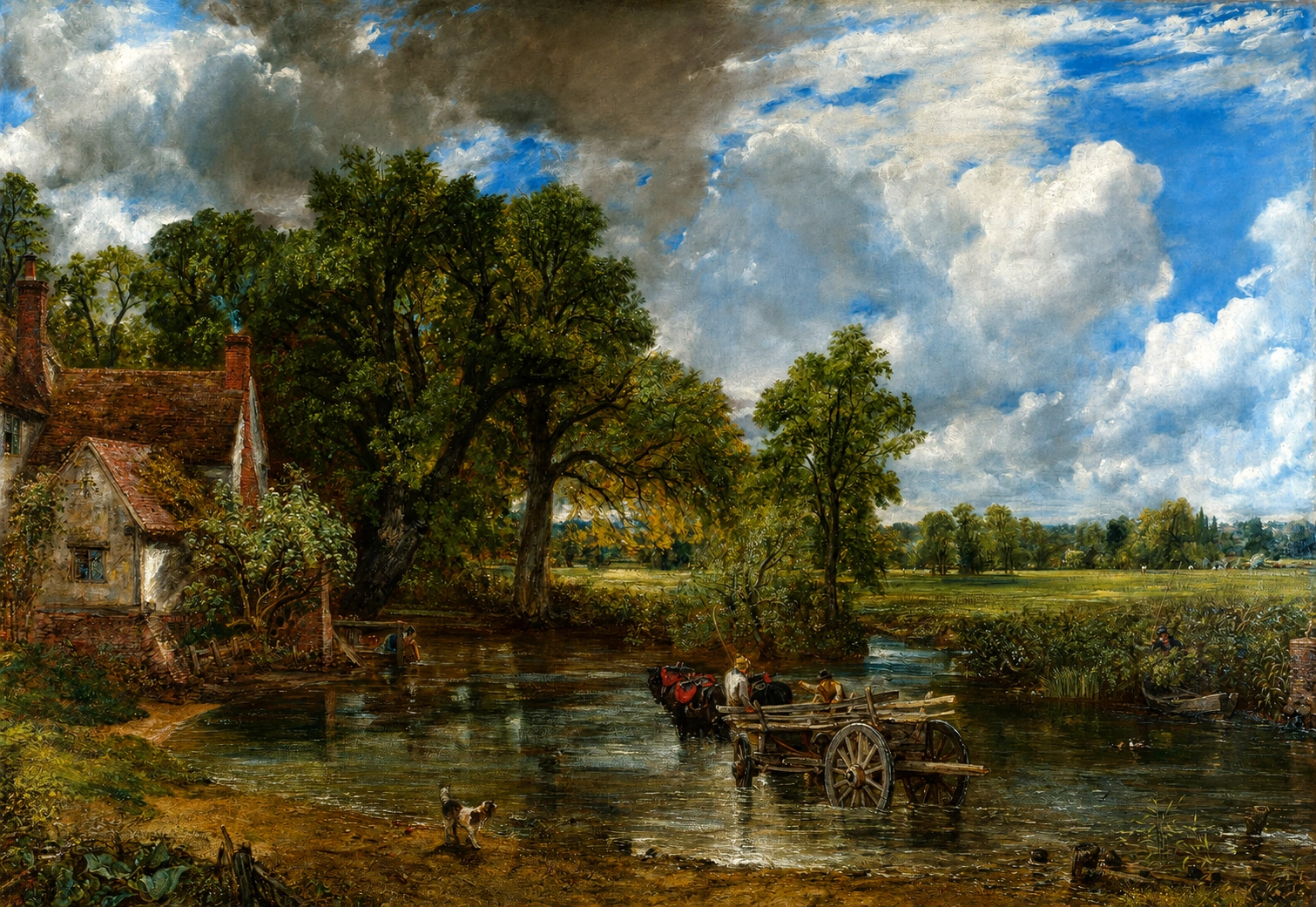
John Constable’s “The Hay Wain,” painted in 1821, is one of the most beloved English landscape paintings of the nineteenth century. At first glance, the scene appears simple: a wooden cart stands in shallow water beside a cottage, horses wait patiently, trees rise heavily over the riverbank, and a wide sky fills the upper half of the canvas. Yet this quiet rural view carries extraordinary emotional depth. Constable transforms an ordinary corner of the English countryside into a vision of memory, labor, weather, and national identity.
The painting shows a location near Flatford Mill in Suffolk, an area closely associated with Constable’s childhood. The white cottage on the left is often identified as Willy Lott’s House, a real building beside the River Stour. Rather than inventing a grand or idealized landscape, Constable turned to a place he knew intimately. This gives “The Hay Wain” its remarkable sense of truth. It feels observed rather than staged, affectionate rather than theatrical.
Composition and the Structure of the Scene
The composition is carefully balanced, even though it appears natural. The cottage and dense trees on the left create a strong vertical mass, while the open fields and sky on the right allow the viewer’s eye to travel into the distance. The hay wain itself sits near the center, slightly low in the composition, anchoring the scene in human activity.
Constable uses the river as a quiet pathway through the painting. Its reflective surface draws the eye from the foreground toward the middle distance, where land, water, and sky seem to merge. The cart, horses, dog, boat, and distant figures all contribute to a sense of rural life unfolding slowly. Nothing feels frozen in a dramatic instant. Instead, the painting captures the rhythm of a working landscape, where people, animals, buildings, trees, and weather all belong to the same living environment.
The left side of the painting is darker, denser, and more enclosed. The cottage is partly shaded, the trees are deep green and brown, and the water near the bank is shadowed. The right side is more open and luminous, with broad fields and a brighter sky. This contrast gives the painting movement and depth. It also creates an emotional transition from the intimate shelter of home toward the openness of the countryside.
Light, Weather, and the Living Sky
One of the greatest achievements of “The Hay Wain” is its sky. Constable believed that the sky was essential to landscape painting, and here it becomes almost a character in the scene. Large clouds drift across the canvas, some white and sunlit, others heavy and gray. The weather feels changeable, as if rain has recently passed or may soon return.
This shifting atmosphere gives the painting freshness and realism. The landscape does not appear polished into timeless perfection. It feels alive in a specific moment. Sunlight breaks through the clouds and touches parts of the water, the fields, and the foliage. Other areas remain in shade. This uneven light creates a natural complexity that makes the scene believable.
The sky also affects the mood of the painting. It prevents the countryside from becoming merely picturesque. There is beauty here, but also weight and uncertainty. The clouds suggest time passing, seasons changing, and rural life continuing under forces beyond human control. Constable’s England is not a fantasy of endless sunshine. It is a real place, shaped by weather, work, and memory.
Color and Brushwork
The color palette of “The Hay Wain” is rich but restrained. Constable relies on earthy greens, browns, grays, creams, and muted blues. These colors give the painting a grounded, natural feeling. The white walls of the cottage and the pale clouds brighten the composition, while the dark trees and water provide depth.
Constable’s brushwork is especially important. Up close, many areas are lively and textured. Leaves, clouds, reflections, and grasses are built through varied touches of paint rather than smooth academic finish. This gives the landscape vitality. The trees do not feel like decorative shapes; they feel dense, irregular, and full of movement. The water is not a flat mirror; it is broken by reflections, ripples, and muddy shallows.
This painterly surface helped make Constable’s work feel modern. He was not simply recording details. He was translating the sensation of being outdoors. The painting invites the viewer to feel damp air, moving clouds, soft mud, cool shade, and scattered sunlight. Its realism comes not only from accuracy but from atmosphere.
Rural Labor and Everyday Life
Although “The Hay Wain” is often admired for its peaceful beauty, it is also a painting about work. The cart is not a decorative object. It belongs to the practical world of farming and transport. The horses stand in the shallow river, likely cooling themselves or crossing near the mill. Nearby figures go about their tasks. In the distance, small signs of human labor appear across the fields.
Constable presents rural labor without drama or sentimentality. The people are small within the landscape, but they are essential to it. Their presence reminds us that this countryside is not untouched wilderness. It is cultivated, inhabited, and sustained by daily work. The painting respects ordinary life by making it part of a grand visual harmony.
At the same time, there is a nostalgic quality to the scene. By 1821, Britain was changing rapidly through industrialization and urban growth. “The Hay Wain” looks back toward a rural world rooted in tradition, local knowledge, and slow rhythms. Constable does not turn this world into a fantasy, but he does present it with deep affection. The painting becomes a memory of place as much as a record of place.
Emotional Meaning and Legacy
The enduring power of “The Hay Wain” comes from its combination of realism and feeling. It does not rely on mythological subjects, heroic figures, or dramatic ruins. Its subject is a familiar rural corner, painted with seriousness and love. Constable shows that a landscape can carry emotional meaning without needing an obvious narrative.
The painting also helped elevate English landscape painting. Earlier traditions often favored classical scenery or dramatic wilderness, but Constable gave dignity to the local and familiar. He painted the countryside he knew best, proving that personal attachment could become universal art. Viewers who have never visited Suffolk can still recognize the feeling of belonging to a place, remembering a landscape, or finding beauty in ordinary surroundings.
“The Hay Wain” remains powerful because it feels both specific and timeless. It is about a real location, a real rural economy, and a real moment in English art. Yet it also speaks to broader human experiences: home, labor, weather, memory, and the passage of time. The painting asks us to slow down and look carefully at what might otherwise seem ordinary. In doing so, it reveals the quiet grandeur of everyday life.