The Swing by Jean-Honoré Fragonard: Vibrant Color Edit
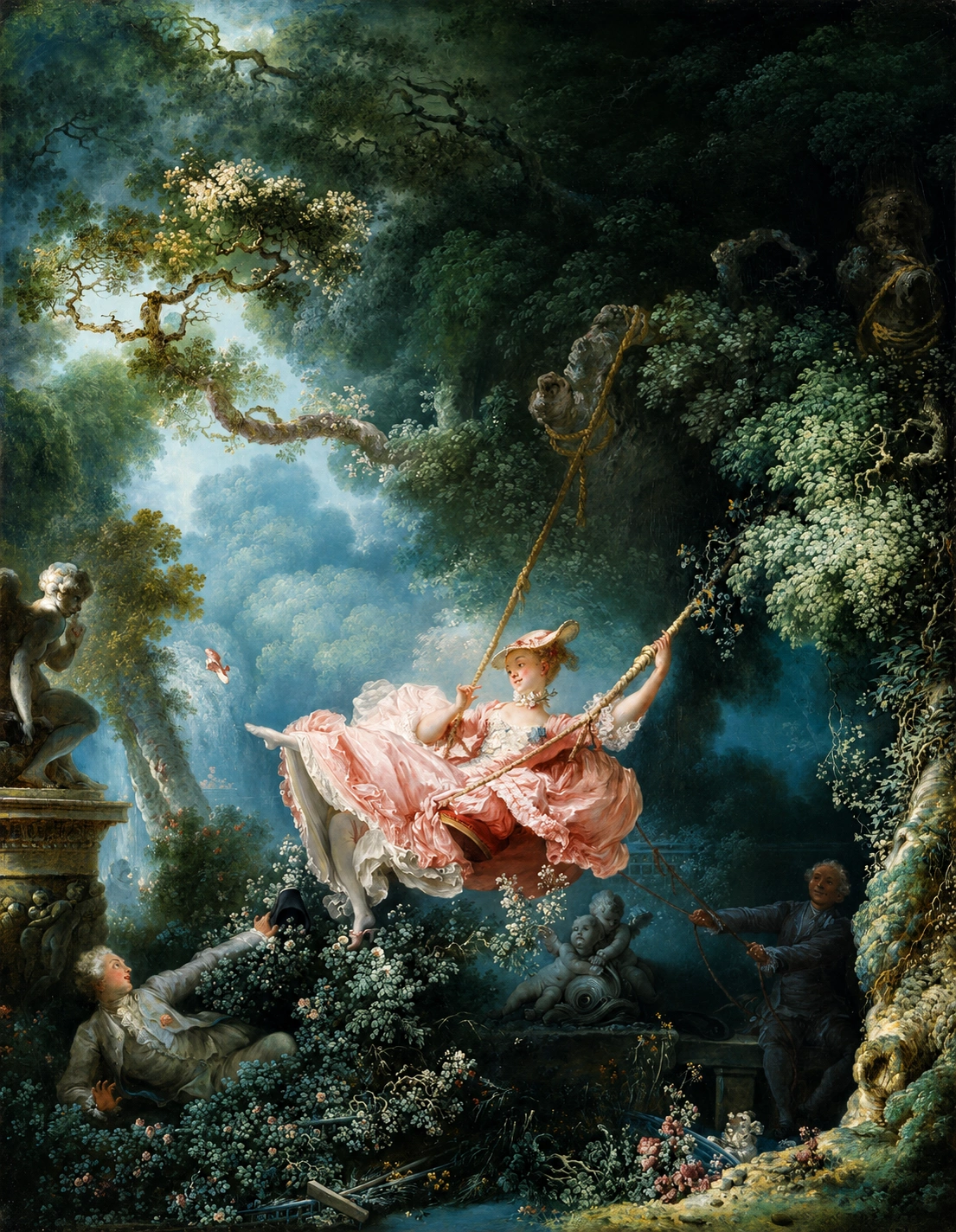
Free to Download & Reuse: You are welcome to use this image! If you republish or share it online, you must include a direct link back to this webpage for attribution.
Original Image Source: wikiart.org
The Playful World of “The Swing”
Jean-Honoré Fragonard’s “The Swing,” painted in 1767, is one of the most recognizable images of the French Rococo. It captures a young woman floating through a lush garden on a swing, her pink dress billowing like a cloud of silk and lace. Around her, the foliage is dense, theatrical, and shadowed, creating a private world of pleasure, secrecy, and fantasy. The painting is not simply a charming garden scene. It is a carefully staged image of aristocratic leisure, flirtation, and sensual play, made at a moment when French art was fascinated by intimacy, elegance, and refined pleasure.
The central figure is the young woman, who appears suspended between earth and air. Her body leans back with graceful confidence, while one foot extends forward and sends her shoe flying into the air. This small detail gives the painting its sense of movement and mischief. The swing becomes more than a garden amusement. It becomes a symbol of freedom, risk, and desire. Fragonard turns a simple action into a scene of visual excitement, where every element seems to move with the same lightness as the woman’s dress.
Composition and Movement
The composition of “The Swing” is built around curves, diagonals, and theatrical concealment. The ropes of the swing form strong diagonal lines that pull the eye upward into the trees, while the woman’s body creates a bright, floating center within the darker garden. Her pale pink gown stands out against the deep greens and blue-gray shadows of the surrounding vegetation. This contrast makes her appear almost illuminated, as though the garden itself has opened to reveal a secret performance.
Fragonard carefully arranges the figures around her. At the lower left, a young man reclines among the flowers and bushes, looking up at her from a hidden position. His pose suggests surprise, admiration, and delight. On the right, an older man, partly obscured by shadow, pulls the swing’s ropes. He seems unaware of the full meaning of the scene unfolding before him. This arrangement creates a playful triangle between the woman, the admirer, and the man controlling the swing.
The viewer is placed in a similar position to the hidden admirer. We look into the scene as though discovering something private. This is part of the painting’s charm, but also part of its cleverness. Fragonard makes the viewer participate in the secrecy of the garden. The composition does not feel public or formal. It feels intimate, enclosed, and carefully hidden from the ordinary world.
Color, Light, and Rococo Elegance
Color is one of the great pleasures of “The Swing.” The woman’s dress is painted in soft, glowing pinks, with touches of white, cream, and rose. The fabric seems weightless, expanding outward in delicate folds that catch the light. Fragonard’s brushwork gives the gown a lively texture, suggesting silk, lace, ribbons, and motion without describing every detail too rigidly.
The surrounding garden is darker and cooler. Its greens, blues, and grays create a misty atmosphere that makes the pink dress appear even more radiant. Light enters the painting in patches, glimmering through leaves, flowers, and clouds of foliage. This soft, filtered lighting is typical of the Rococo taste for atmosphere and fantasy. Nothing here feels harsh or fixed. Everything seems touched by air, movement, and suggestion.
The color palette also helps express the painting’s emotional tone. The pink dress conveys youth, charm, and pleasure. The shadowed garden suggests secrecy and mystery. The pale flowers echo the delicacy of the dress, while the darker trees create a stage-like background. Fragonard balances sweetness with theatrical tension, making the painting feel both decorative and charged with meaning.
Symbolism and Hidden Meaning
“The Swing” is filled with symbols that would have been easily understood by an eighteenth-century audience. The flying shoe is one of the most famous details. In the context of Rococo imagery, the lost shoe can suggest playful abandon and flirtation. The swing itself also carries symbolic meaning. Its back-and-forth motion can imply instability, excitement, and emotional uncertainty. The woman is literally suspended between two men, which turns the garden game into a visual metaphor for romantic intrigue.
The small statue on the left adds another layer of meaning. It appears to gesture toward silence, reinforcing the sense that this is a secret scene. The garden is not just a natural setting, but a space of concealment. Bushes, branches, flowers, and shadows hide the figures from one another and from the outside world. Fragonard uses nature as a screen for private pleasure.
At the same time, the painting avoids heaviness. Its symbolism is witty rather than moralizing. Fragonard does not present the scene as a lesson or a warning. Instead, he creates a world of refined play, where suggestion is more important than direct statement. This lightness is central to the Rococo spirit. The painting delights in beauty, charm, and ambiguity.
The Rococo Style at Its Height
“The Swing” is often seen as one of the defining works of the Rococo style. Rococo art favored elegance, intimacy, soft colors, curving forms, and scenes of leisure. Unlike the grand historical paintings that dominated academic art, Rococo works often focused on private moments, garden settings, flirtation, music, and aristocratic amusement. Fragonard was especially skilled at turning these subjects into lively, imaginative compositions.
In “The Swing,” the Rococo style appears in the fluid brushwork, the playful subject, the decorative richness, and the sense of fantasy. The garden does not look like a carefully mapped outdoor space. It feels like an enchanted setting designed for pleasure. The trees twist and curl, the flowers bloom in soft clusters, and the atmosphere is full of misty light. Nature becomes ornamental, theatrical, and emotionally expressive.
Fragonard’s technique adds to this effect. He paints with quick, energetic strokes that suggest texture and movement rather than polished stillness. The painting feels alive because it does not freeze the moment completely. The swing is still moving, the dress is still floating, and the shoe is still flying. The entire image seems to exist in a single sparkling instant.
The Lasting Appeal of “The Swing”
Part of the lasting fascination of “The Swing” comes from its balance between innocence and sophistication. At first glance, it appears lighthearted and beautiful, a charming image of a young woman in a garden. With closer attention, it becomes a clever scene of hidden glances, social roles, and private desire. Fragonard gives the viewer both immediate visual pleasure and deeper layers of interpretation.
The painting also captures the elegance and fragility of the world that produced it. Created in the decades before the French Revolution, “The Swing” reflects the leisure and luxury associated with the aristocratic culture of eighteenth-century France. Its beauty is undeniable, but it also shows a society absorbed in pleasure, theatricality, and refinement. This makes the painting historically revealing as well as visually enchanting.
“The Swing” remains powerful because it transforms a fleeting moment into an unforgettable image. The young woman, lifted into the air, becomes a symbol of Rococo grace itself: light, playful, decorative, and full of motion. Fragonard’s mastery lies in making the scene feel effortless while arranging every detail with extraordinary intelligence. The result is a painting that continues to feel fresh, mischievous, and luminous more than two centuries after it was made.