The Japanese Bridge by Claude Monet: Vibrant Color Edit
Free to Download & Reuse: You are welcome to use this image! If you republish or share it online, you must include a direct link back to this webpage for attribution.
Original Image Source: wikiart.org
The Japanese Bridge as a Vision of Giverny
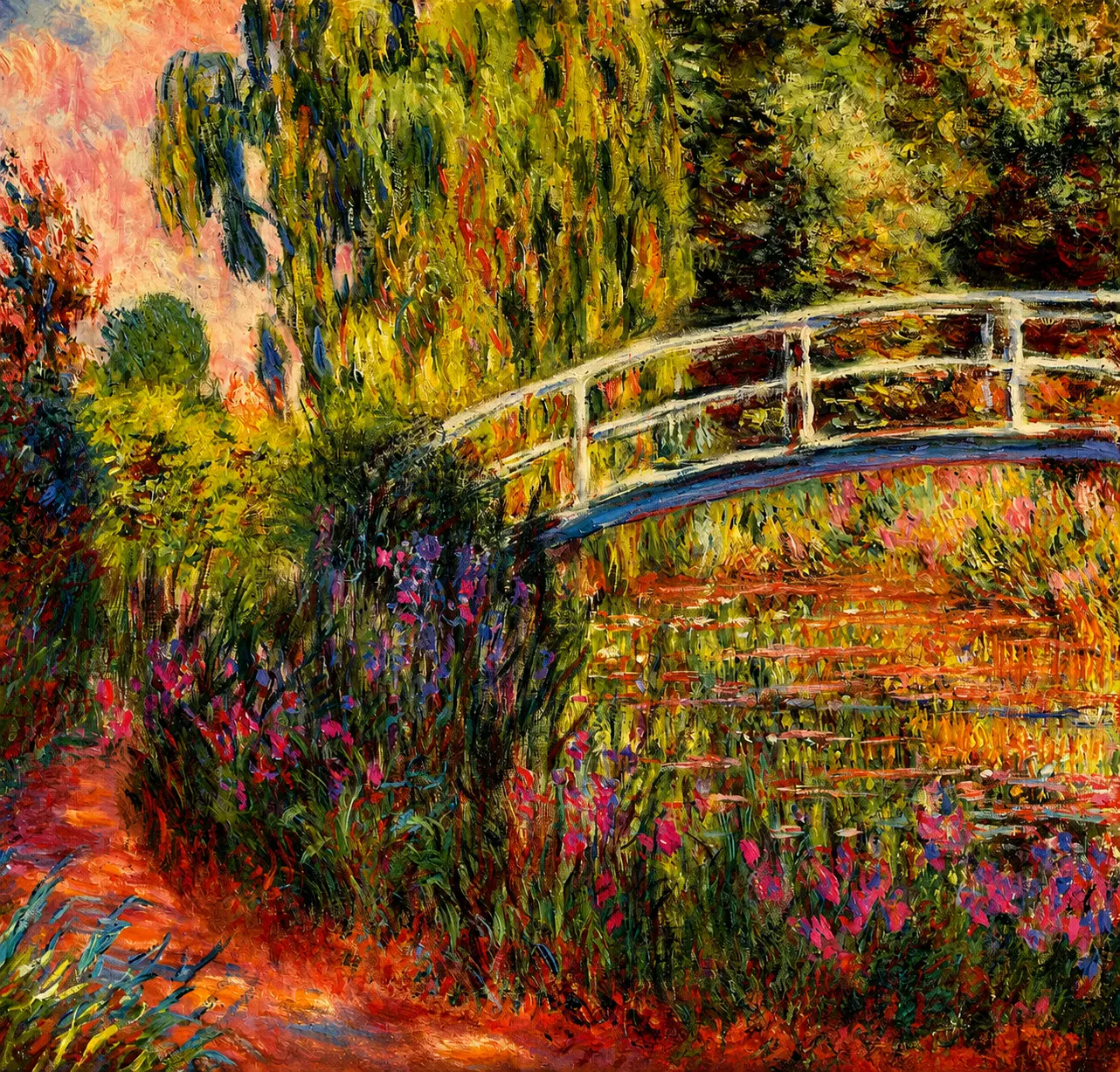
Claude Monet’s “The Japanese Bridge” from 1900 is one of the most recognizable images from the artist’s celebrated Giverny garden series. The painting presents a view of the arched footbridge that Monet built over his water lily pond, surrounded by dense vegetation, reflected light, irises, willow branches, and shimmering color. Although the subject is a real place, the painting does not feel like a simple record of a garden. It feels like a world made from sensation, memory, and atmosphere.
The bridge curves gently across the upper right portion of the composition, its pale railing standing out against the thick mass of green, red, yellow, and violet foliage. Beneath it, the pond glows with reflections that seem to dissolve solid forms into color. The water is not painted as a flat surface. It becomes a field of movement, where flowers, shadows, plants, and sky mingle together. Monet transforms the garden into an immersive experience, inviting the viewer to feel surrounded by nature rather than merely looking at it from a distance.
Composition and Structure
The composition is carefully balanced even though it appears spontaneous at first glance. The Japanese bridge provides the main architectural structure, creating a graceful arc that guides the eye from the center toward the right side of the painting. Its curve contrasts with the vertical descent of the willow branches and the upright growth of the irises and reeds. This relationship between curve, vertical line, and irregular brushwork gives the image its rhythm.
Monet does not use a traditional horizon line. Instead, the space is compressed and layered. The viewer sees the pond, the bridge, the flowers, and the surrounding foliage all at once, with little empty space. This creates a sense of abundance. The garden seems to press forward, filling the picture with life. The lack of a distant view also makes the scene feel private and enclosed, as though the viewer has stepped into a hidden corner of Monet’s own world.
The left side of the painting is especially intense, with warm reds and pinks spreading through the path and surrounding plants. These colors balance the cooler greens and blues of the bridge and foliage. The result is not a calm, neutral garden scene, but a vibrant and emotionally charged vision of nature.
Color, Light, and Atmosphere
Color is the true subject of “The Japanese Bridge.” Monet uses color not simply to describe objects, but to convey the feeling of light passing through leaves, reflecting on water, and changing the appearance of everything it touches. Greens are mixed with yellows, blues, reds, and oranges, giving the vegetation a living, flickering quality. The pond contains streaks of red, pink, violet, green, and gold, suggesting reflections rather than fixed forms.
The palette is rich and almost dreamlike. The pinkish sky or atmospheric glow in the upper left gives the painting a warm, radiant mood. The bridge, though painted in pale tones, is not sharply outlined. It seems to vibrate within the surrounding color. This is typical of Monet’s mature Impressionist approach, where objects are not isolated by hard contours but are absorbed into the overall effect of light.
The painting captures a moment that feels both immediate and timeless. Nothing appears still, yet nothing appears hurried. The brushstrokes create the sensation of air, water, and foliage shifting gently. Monet’s garden becomes a place where perception itself is changing.
Brushwork and Surface Texture
Monet’s brushwork is energetic, layered, and expressive. Short strokes, dabs, and dragging marks build up the surface, allowing the viewer to sense the physical act of painting. The flowers in the foreground are not described petal by petal. Instead, they appear as clusters of vivid purple, red, and pink marks. The foliage is similarly suggested through overlapping strokes of green, yellow, and dark blue.
This loose handling does not weaken the image. It makes it more alive. From a distance, the scene gathers itself into a recognizable garden. Up close, it becomes an abstract arrangement of paint. This dual quality is one of the painting’s great strengths. Monet allows the viewer to move between illusion and surface, between the world of the garden and the material reality of pigment.
The texture also contributes to the feeling of natural density. The garden is not smooth or polished. It is tangled, thick, and overflowing. The brushwork mirrors the growth of plants, the shimmer of water, and the instability of reflected light.
The Influence of Japanese Art
The bridge itself reflects Monet’s fascination with Japanese design, a major influence on many European artists in the late nineteenth century. Monet collected Japanese prints and admired their unusual compositions, flattened spaces, decorative rhythms, and close attention to nature. In “The Japanese Bridge,” this influence appears in the arched form of the bridge, the compressed perspective, and the ornamental arrangement of plants and water.
Rather than copying Japanese art directly, Monet absorbed its principles into his own vision. The bridge becomes both a real garden feature and a symbol of artistic exchange. It connects Western Impressionism with the aesthetics of Japan, especially the idea that nature can be arranged as a poetic visual experience.
The painting’s flattened space is especially important. Instead of leading the viewer deep into the background, Monet keeps the eye moving across the surface. The pond, bridge, flowers, and foliage form a decorative pattern, similar to the way Japanese prints often combine depth with flat design.
Meaning and Emotional Impact
“The Japanese Bridge” can be read as a painting about retreat, beauty, and perception. By 1900, Monet had made Giverny not just his home, but his artistic universe. The garden was carefully designed so that he could study color, light, reflection, and seasonal change. In this painting, the bridge is not simply a structure over water. It becomes a passage into a private dream of nature.
There is also a sense of transformation. The garden is real, yet Monet’s handling turns it into something almost visionary. The water reflects the world above it, but those reflections are unstable and fragmented. The flowers bloom in brilliant patches, but they seem to merge with shadow and light. The bridge offers order, but the vegetation threatens to overwhelm it. This tension gives the painting emotional depth.
The image suggests that nature is never fixed. It is always changing according to light, weather, time of day, and the viewer’s own perception. Monet’s genius lies in making this instability beautiful.
Place in Monet’s Career
This painting belongs to one of the most important phases of Monet’s career. In his later years, he increasingly focused on his garden at Giverny, especially the water lily pond and Japanese bridge. These works helped move painting toward a more modern understanding of color and abstraction. While Monet remained committed to the observation of nature, his late garden paintings often reduce the world to rhythm, color, and sensation.
“The Japanese Bridge” from 1900 still preserves a clear subject, yet it already points toward the more immersive water lily paintings that would follow. The bridge provides structure, but the real drama lies in the surrounding atmosphere. The viewer is encouraged to see the world not as a set of separate objects, but as a continuous field of light and color.
Conclusion
Claude Monet’s “The Japanese Bridge” is a masterful image of the artist’s Giverny garden and one of the defining works of his mature Impressionist style. Through its arched bridge, glowing pond, dense foliage, and vibrant surface, the painting captures the sensation of standing inside a living landscape. Monet does not simply describe the garden. He recreates the experience of seeing it through shifting light, reflection, and color.
The painting remains powerful because it feels both intimate and expansive. It shows a small corner of a private garden, yet it opens onto larger questions about vision, time, beauty, and the relationship between nature and art. In “The Japanese Bridge,” Monet turns a familiar garden view into a radiant world of perception, where every brushstroke seems alive with movement and light.