The Japanese Bridge by Claude Monet: Vibrant Color Edit
Free to Download & Reuse: You are welcome to use this image! If you republish or share it online, you must include a direct link back to this webpage for attribution.
Original Image Source: wikiart.org
A Garden Transformed Into Pure Sensation
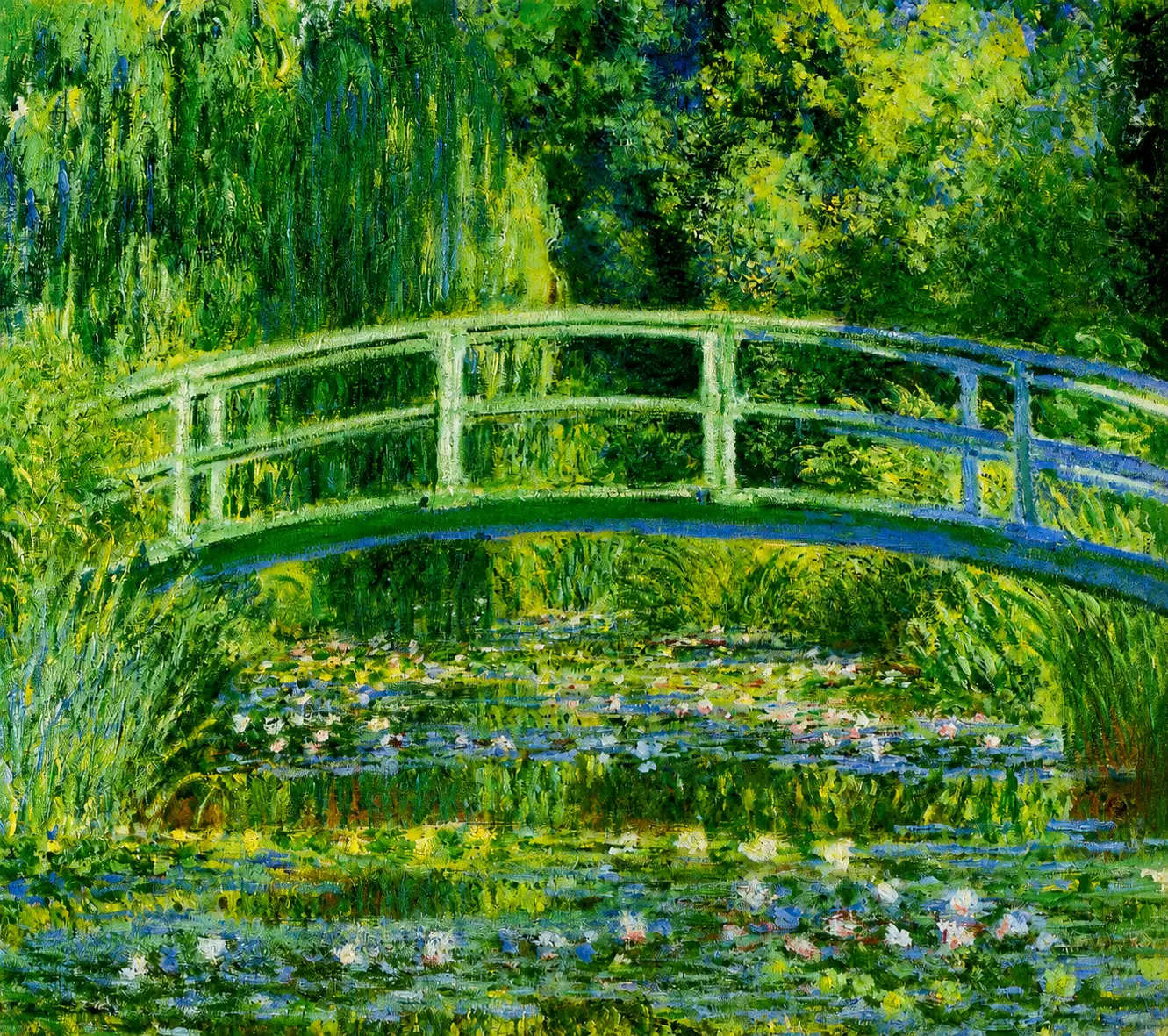
Claude Monet’s “The Japanese Bridge,” painted in 1899, is one of the most recognizable works from his famous garden at Giverny. The painting shows a pale green arched bridge crossing a pond filled with water lilies, surrounded by dense foliage, reflected light, and shifting color. At first glance, the subject seems simple: a bridge, water, plants, and sunlight. Yet Monet turns this quiet garden scene into a complete visual world, one where atmosphere matters more than exact detail and where nature appears alive with movement.
The Japanese bridge was part of Monet’s own garden, which he carefully designed after moving to Giverny. Rather than searching for subjects in distant landscapes, Monet created a private environment that could give him endless variations of light, reflection, color, and season. In this painting, the bridge is not just an architectural feature. It becomes the center of a carefully balanced composition, joining the upper world of trees and leaves with the lower world of water and reflection.
The Composition of “The Japanese Bridge”
The composition is built around the sweeping curve of the bridge. Its pale green form stretches horizontally across the painting, creating a strong visual anchor in the middle of the canvas. The arch gives the image structure, but it also feels soft and organic because Monet paints it with broken brushstrokes rather than sharp outlines. The bridge bends gently across the pond, almost like a natural growth within the garden rather than a separate human object.
Below the bridge, the water opens into a shimmering field of greens, blues, yellows, whites, and pinks. The water lilies are scattered across the pond, but they do not form a rigid pattern. They appear as floating touches of color, catching light and breaking up the surface. The viewer’s eye moves from the bridge down into the water, then back into the dense vegetation behind it. There is no empty space. Every part of the canvas is filled with life, texture, and color.
The trees and plants surrounding the bridge create a sense of enclosure. Monet does not show a horizon line or distant sky in the usual landscape tradition. Instead, he places the viewer inside the garden, surrounded by leaves and reflections. This makes the painting feel intimate and immersive. The garden is not presented as scenery to be viewed from afar. It is a place to enter visually, slowly, and emotionally.
Color, Light, and Atmosphere
Color is the true subject of “The Japanese Bridge.” Monet uses a rich range of greens, from deep shadowy tones to bright yellow greens touched by sunlight. The bridge itself is a pale, almost mint green, which allows it to stand out while still belonging to the natural setting. Around it, darker greens create depth, especially in the dense trees and hanging willow branches.
Blue plays an important role in the painting. It appears in the shadows of the bridge, in the water, and in small flashes among the foliage. These blues cool the composition and prevent the greens from becoming too heavy. They also suggest reflected sky, even though the sky itself is barely visible. Monet’s water is not simply a flat surface. It is a mirror, a moving field, and a color experiment all at once.
The flowers of the water lilies bring delicate accents of white, pink, lavender, and pale yellow. These touches of lighter color soften the scene and give the eye places to rest. They also create rhythm across the lower half of the painting. Instead of describing each lily in detail, Monet suggests them through small marks of paint. This makes the flowers feel fleeting, as if they are flickering in and out of view with the movement of the water.
Light in this painting is diffused rather than dramatic. There is no single spotlight or harsh contrast. Instead, light seems to filter through leaves, scatter across the bridge, and dissolve into the water. This gives the painting its dreamlike quality. Monet captures not a fixed moment but a changing sensation, the feeling of looking at a garden while light, air, and reflection constantly shift.
Brushwork and Impressionist Technique
Monet’s brushwork is loose, layered, and energetic. The surface of the painting is made of many visible strokes that describe texture without becoming overly detailed. The bridge is recognizable, but it is not painted with architectural precision. Its railings and supports are softened by light and atmosphere. This choice is central to Monet’s Impressionist style. He is less interested in the exact construction of the bridge than in how it appears at a particular moment.
The foliage is painted with short, varied strokes that suggest leaves, branches, and depth. Some areas feel thick and dense, while others seem airy and flickering. The hanging willow on the left side is especially important, with its vertical strokes contrasting against the horizontal curve of the bridge. These downward lines help frame the scene and lead the eye toward the pond.
In the water, Monet’s brushwork becomes even more abstract. Reflections, lilies, shadows, and ripples blend together. The viewer can identify the pond, but the painting also approaches pure color and movement. This balance between representation and abstraction is one of the reasons “The Japanese Bridge” remains so powerful. It shows a real place, but it also shows how vision itself can transform reality.
The Influence of Japanese Art
The bridge reflects Monet’s deep interest in Japanese art and design. Like many artists in nineteenth-century France, Monet admired Japanese prints, especially their asymmetrical compositions, decorative surfaces, and unusual viewpoints. The arched bridge in his garden was inspired by Japanese models, and he used it as a central motif in several paintings.
In “The Japanese Bridge,” the influence appears not only in the subject but also in the composition. The scene is flattened in certain areas, with foliage and water creating decorative patterns across the canvas. The bridge cuts across the picture in a graceful curve, while the pond below becomes a surface of repeated colors and shapes. Rather than constructing a traditional deep perspective, Monet creates a layered visual experience.
The result is both natural and designed. The garden feels spontaneous, yet the painting is carefully arranged. This tension between wild growth and artistic control is one of the work’s great strengths. Monet’s garden was not untouched nature. It was a living artwork, planned so that water, flowers, trees, and reflections could become material for painting.
The Meaning of the Garden at Giverny
By 1899, Monet had moved beyond many of the urban and rural subjects of his earlier career. His garden at Giverny became a private universe where he could study the same motifs repeatedly. “The Japanese Bridge” belongs to this mature phase of his art, when his attention turned increasingly toward reflection, atmosphere, and the instability of perception.
The painting suggests peace, but it is not static. Everything seems to breathe and vibrate. The bridge holds the scene together, yet the surrounding plants appear to grow around it and almost absorb it. This creates a feeling of harmony between human design and nature. The bridge does not dominate the pond. It belongs to it.
There is also a sense of quiet escape. The painting contains no people, no buildings beyond the bridge, and no sign of modern life. It offers a world of green shade, floating flowers, and softened light. Yet it is not merely decorative. Monet’s treatment of the scene asks the viewer to look slowly and attentively. The painting becomes an invitation to notice how color changes with light, how reflections complicate reality, and how a familiar place can become endlessly new.
Why “The Japanese Bridge” Remains Important
“The Japanese Bridge” is important because it brings together many of Monet’s greatest concerns: water, light, reflection, garden design, and the emotional power of color. It is both a landscape and a meditation on seeing. The subject is stable, but the visual experience feels fluid. The bridge is solid, but its painted form seems to shimmer. The pond is still, yet its surface is alive with motion.
This painting also points toward the more abstract direction Monet’s later water lily works would take. In later years, he would move even closer to the surface of the pond, often removing the bridge and the surrounding landscape entirely. Here, the bridge still gives the viewer a clear point of entry. It connects the recognizable world with the increasingly immersive world of color and reflection that would define Monet’s late art.
Claude Monet’s “The Japanese Bridge” from 1899 remains one of the great images of Impressionism because it transforms a garden scene into a complete sensory experience. It is not only about a bridge over a pond. It is about the way nature appears when seen through light, memory, and feeling. Through broken brushwork, luminous color, and delicate balance, Monet turns his Giverny garden into a vision of quiet beauty that still feels fresh, intimate, and alive.