Water Lilies by Claude Monet: Vibrant Color Edit
Free to Download & Reuse: You are welcome to use this image! If you republish or share it online, you must include a direct link back to this webpage for attribution.
Original Image Source: wikiart.org
A Complete Analysis of ''Water Lilies'' by Claude Monet
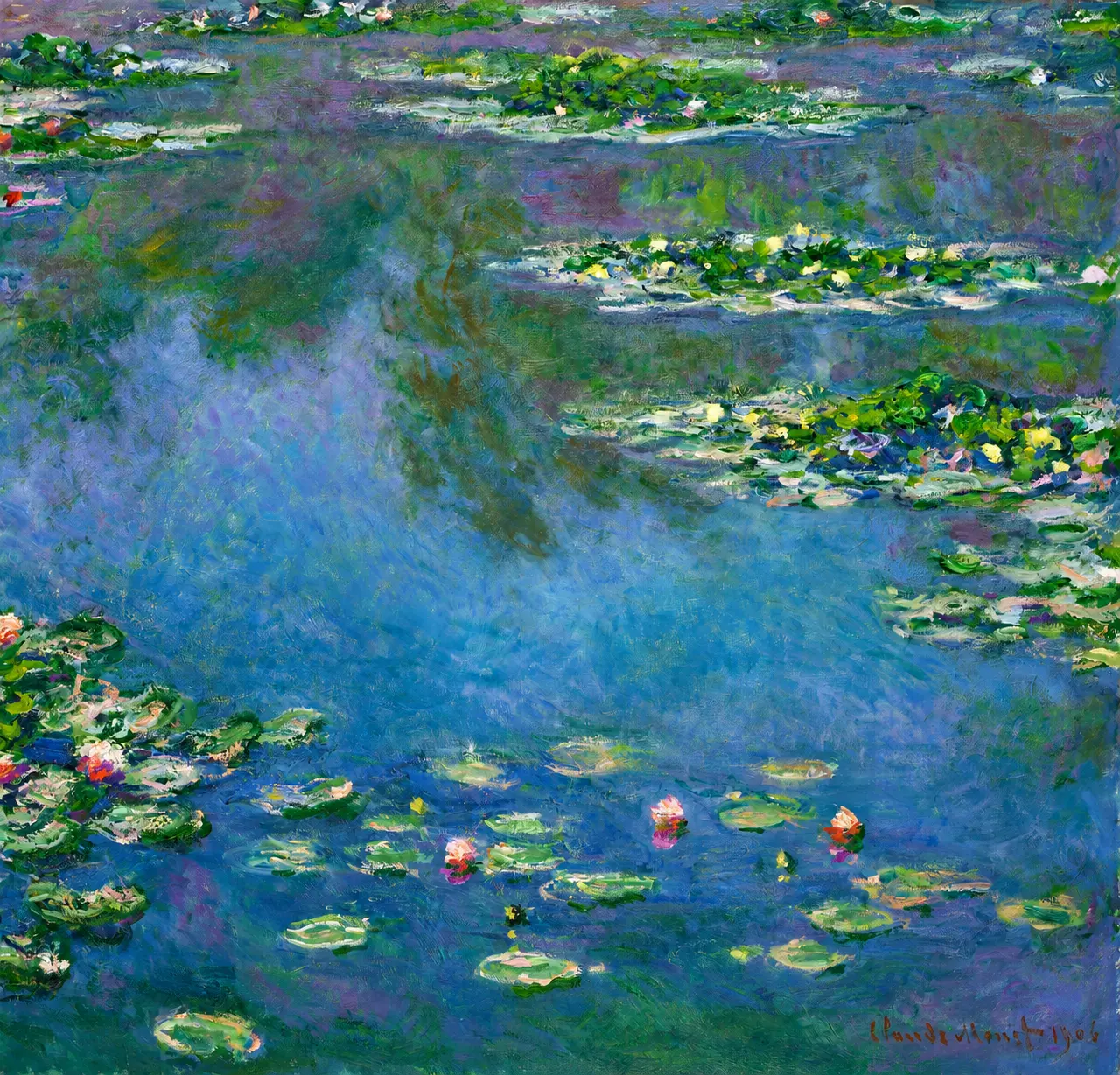
Claude Monet’s ”Water Lilies” is one of the most recognizable subjects in modern painting, yet each version of the theme has its own atmosphere, rhythm, and emotional temperature. In this image, Monet gives us the surface of his pond at Giverny as a world unto itself. There is no visible horizon, no firm shoreline, and no human figure to guide the eye. Instead, the viewer is placed directly above or beside a shifting field of water, lilies, reflections, and broken color. The painting becomes less a landscape in the traditional sense than an immersive meditation on seeing itself.
The composition is built around a broad expanse of blue, green, violet, and misty gray water. Lily pads gather in floating clusters, especially along the left edge, the upper band, and the right side, while smaller pads and blossoms appear across the lower half. This arrangement creates a delicate balance between openness and density. The center of the painting remains comparatively spacious, allowing the eye to drift through the cool, reflective water before returning to the textured plant forms around it. Monet avoids a single dramatic focal point. Instead, attention moves slowly from one color note to another, as though following ripples across the pond.
The Pond as a Living Surface
What makes this ”Water Lilies” so powerful is the way Monet treats the pond as both subject and space. The water is not merely a background for flowers. It is the main event, a living surface that absorbs sky, light, shadow, and vegetation. The blues in the center suggest reflected sky, but they are softened by green and violet undertones, making the surface feel deep and atmospheric. At the same time, Monet’s brushwork reminds us that this depth is an illusion created by paint.
The lily pads are painted with short, varied strokes of green, white, lavender, and yellow. Some are clearly defined, while others seem to dissolve into the water around them. This slight instability is essential to Monet’s late style. He does not present nature as fixed or sharply outlined. He presents it as something continuously changing under the pressure of light. The pond appears calm, but it is never still. Every mark suggests movement, reflection, or vibration.
The blossoms add small but important accents of pink, red, and pale yellow. Their placement across the lower portion of the painting creates a quiet visual rhythm. These flowers do not dominate the scene. They flicker within it, like brief notes of warmth inside a cool harmony. Their softness gives the painting a lyrical quality, while their scattered arrangement keeps the scene natural rather than decorative.
Color, Light, and Impressionist Vision
Color is the emotional engine of this painting. Monet’s palette is cool and aquatic, with blue and green forming the dominant structure. Yet the painting never feels flat because these colors are constantly modified. The blues shift from turquoise to slate, from misty sky blue to deeper teal. The greens range from dark emerald to yellow green, often touched with white or lavender. Violet shadows run through the water and help create a sense of depth without relying on traditional linear perspective.
This approach reflects Monet’s lifelong interest in the fleeting effects of light. Rather than painting objects as stable forms, he paints the visual experience of encountering them at a particular moment. The water lilies are not rendered with botanical precision, but they feel true to the way the eye perceives floating plants in reflected light. Edges blur, colors merge, and solid things seem to tremble.
The absence of a conventional horizon is especially important. Earlier landscape painting often organized nature into foreground, middle ground, and background. Monet removes that structure. The viewer is not asked to look across a landscape, but into a field of sensations. This creates a modern, almost abstract effect. The painting still represents a real pond, but its organization is closer to music than narrative. It is made from intervals of color, repeated motifs, and subtle variations.
Brushwork and Texture
The brushwork in ”Water Lilies” is loose, layered, and highly expressive. Monet’s marks vary in direction and density. In the lily clusters, the strokes are thicker and more broken, creating a textured buildup that suggests leaves, flowers, and reflected highlights. In the open water, the brushwork becomes smoother and more atmospheric, though it remains visibly active. These differences help distinguish plant from reflection without requiring hard outlines.
The texture also gives the painting a strong physical presence. Monet is not hiding the act of painting. The surface reveals the artist’s hand in every area, from the small dabs of pale pigment on the lily pads to the broader, more sweeping passages of blue water. This visible brushwork is part of the painting’s meaning. It shows nature as something translated through perception, memory, and touch.
The lower right signature, with the date, places the work within Monet’s mature period, when the water garden at Giverny had become one of his central artistic obsessions. By this stage, Monet was moving beyond Impressionism as it had been understood in the 1870s. His concern was no longer simply to capture outdoor light quickly. He was building entire pictorial worlds from repeated observation, returning to the same motif again and again until it became a vehicle for deeper visual experimentation.
The Meaning of Monet's Water Lilies
The meaning of ”Water Lilies” lies partly in its refusal to tell a story. There are no mythological figures, no historical event, no moral lesson, and no dramatic action. Instead, Monet asks the viewer to slow down and enter the visual life of the pond. This makes the painting feel contemplative. It is about attention, patience, and the quiet richness of ordinary natural phenomena.
At the same time, the painting has a radical quality. By flattening space and filling the canvas with floating forms, Monet anticipates later developments in modern art. The lily pads can be read as natural objects, but they also function as abstract shapes. The water can be read as a reflective pond, but it also becomes a field of color. This tension between representation and abstraction is one reason the Water Lilies series remains so influential.
The painting also reflects Monet’s personal garden as a constructed paradise. Giverny was not untouched wilderness. It was a carefully designed environment, shaped by the artist’s eye. In painting the pond, Monet was painting a world he had cultivated, observed, and transformed into art. The result is intimate and expansive at once. It shows a specific place, but it also suggests a universal experience of looking at water, light, and flowers.
Why ''Water Lilies'' Still Feels Modern
More than a century after Monet painted his water garden, ”Water Lilies” still feels fresh because it invites active looking. The image does not reveal itself all at once. From a distance, it appears peaceful and unified. Up close, it becomes a complex network of strokes, colors, and textures. This dual experience is central to Monet’s achievement. He creates the illusion of nature while also celebrating the material reality of paint.
The painting’s beauty is not based on perfect clarity. It comes from uncertainty, softness, and change. Forms appear, fade, and reappear. Reflections mingle with plants. Cool tones are warmed by small blossoms. The viewer is drawn into a space where vision itself feels fluid.
Claude Monet’s ”Water Lilies” is therefore more than a garden scene. It is a study of perception, a late Impressionist masterpiece, and a bridge toward modern abstraction. Through water, flowers, and reflected light, Monet turns a quiet pond into an entire visual universe.