View at Rouelles, Le Havre by Claude Monet: Vibrant Color Edit
Free to Download & Reuse: You are welcome to use this image! If you republish or share it online, you must include a direct link back to this webpage for attribution.
View at Rouelles, Le Havre by Claude Monet
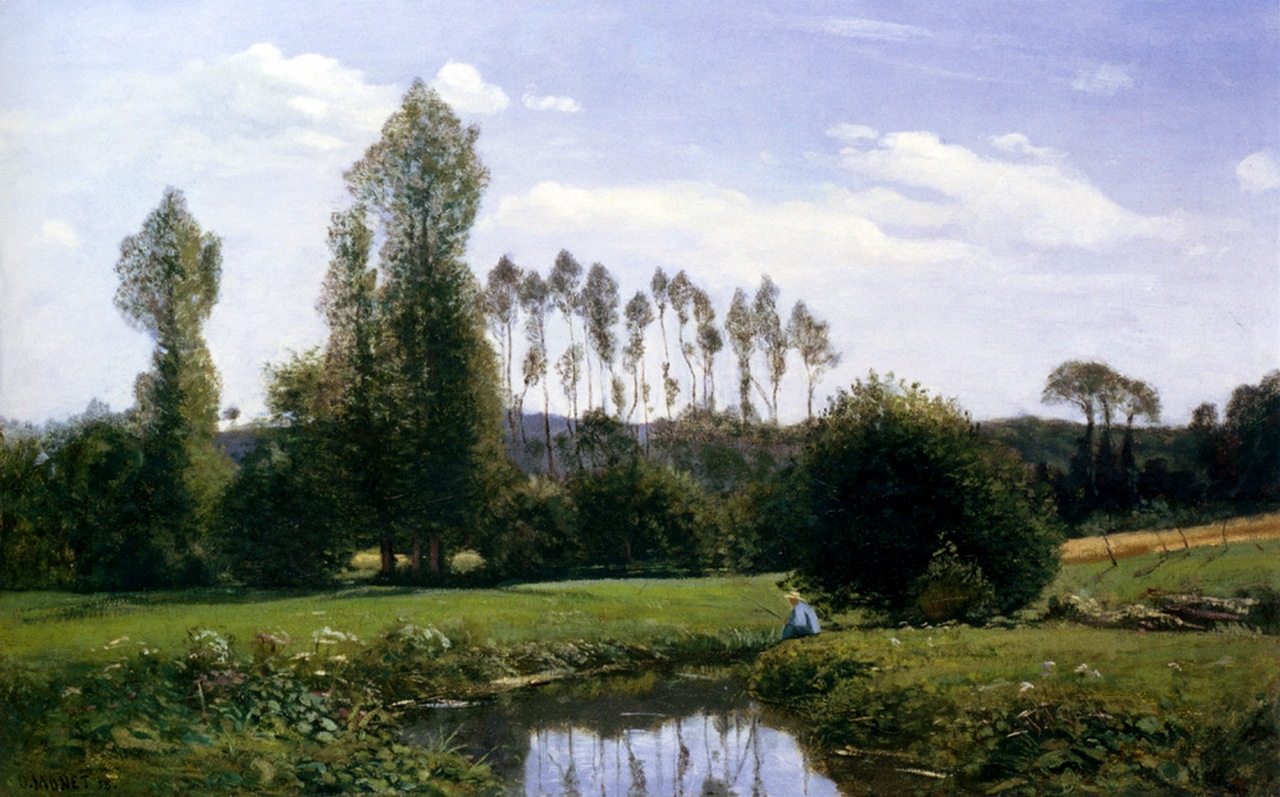
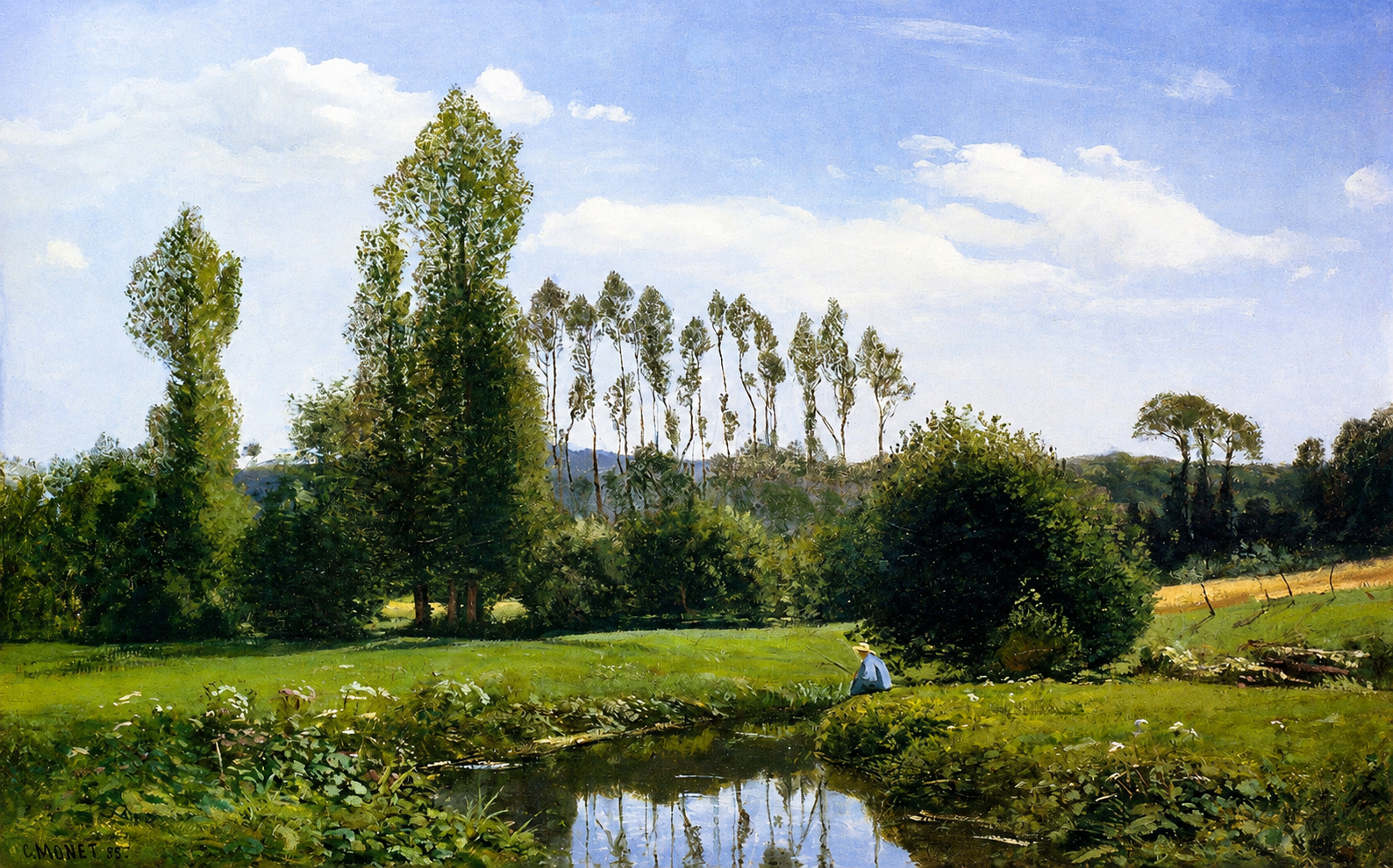
Claude Monet’s View at Rouelles, Le Havre, painted in 1858, is one of the most revealing works from the artist’s youth. Long before Monet became the central figure of French Impressionism, he was already looking closely at the living surface of nature. This painting shows a quiet rural landscape near Le Havre, with trees, meadow, water, sky, and a small seated figure absorbed into the calm of the scene. At first glance, it may seem like a traditional countryside view, but the painting already contains many of the qualities that would later define Monet’s art: sensitivity to changing light, interest in reflection, love of open air, and a preference for atmosphere over strict narrative.
What makes View at Rouelles, Le Havre especially fascinating is its early date. Monet was still a teenager when he made it, yet the picture shows a remarkably mature understanding of landscape. The composition is not arranged like a dramatic historical scene or a polished academic ideal. Instead, it feels observed directly, as though Monet wanted to preserve a moment of ordinary outdoor life. This attention to the immediate visual experience would become the foundation of his later career.
A Peaceful Rural Scene Near Le Havre
The painting presents a green landscape with a small pond or stream in the foreground. The water reflects the pale blue of the sky and the vertical forms of the surrounding trees. Across the middle ground, a field stretches horizontally, creating a restful band of green that leads the eye deeper into the image. Tall trees rise on the left and center, while darker clusters of bushes and foliage occupy the right side. A small human figure sits near the water, almost hidden within the natural environment.
This figure is important because it gives the scene a sense of scale and quiet intimacy. Monet does not make the person the subject of the painting in a dramatic way. Instead, the figure becomes part of the landscape, suggesting a peaceful relationship between human presence and nature. The person appears still, contemplative, and absorbed by the surroundings. This choice helps the painting feel less like a staged view and more like a private glimpse of a real place.
The title connects the image to Rouelles, a village near Le Havre, where Monet spent part of his early life. Le Havre was important to his development because it exposed him to coastal light, changing skies, water, and outdoor subjects. Even though this painting is not a seascape, it shows the same fascination with air and moisture that would later appear in his harbor views, river scenes, and garden paintings.
Light, Atmosphere, and the Young Monet
One of the most beautiful aspects of View at Rouelles, Le Havre is its treatment of light. The sunlight is soft rather than harsh. It falls across the meadow, touches the water, and filters through the trees without creating a strong theatrical effect. Monet is not trying to impress the viewer with dramatic contrast. He is more interested in the gentle balance between illumination and shade.
The sky occupies a large part of the canvas, and its pale blues, whites, and lavender tones create a sense of open air. The clouds are loose and delicate, giving the painting a fresh, breathable quality. This sky is not just a background. It helps establish the mood of the entire scene. The cool brightness above contrasts with the deep greens below, making the landscape feel alive and expansive.
The reflections in the water are also significant. Monet would later become famous for painting reflections in rivers, ponds, and lily pools, but here we can already see his interest in the visual instability of water. The pond does not simply mirror the world with perfect clarity. It breaks the forms into softened shapes and wavering colors. This small passage anticipates the painter Monet would become, the artist who would spend decades studying how light changes when it touches water.
Composition and Visual Balance
The composition of View at Rouelles, Le Havre is carefully balanced, even though it feels natural and unforced. The tall trees on the left give the painting vertical strength, while the open meadow and distant horizon provide a horizontal calm. The central group of slender trees creates rhythm, their thin trunks rising like delicate lines against the sky. On the right, darker foliage anchors the scene and prevents the composition from feeling too empty.
The foreground water leads the viewer inward. It acts almost like an entrance into the painting, inviting the eye to move from the reflective surface toward the fields and trees beyond. Monet uses this quiet curve of water to create depth without relying on rigid perspective. The landscape opens gradually, with each area connected through color and light.
The small figure near the pond also helps guide the eye. Because the figure is placed off center, the painting avoids stiffness. The person becomes a point of visual interest, but not a distraction. This is one of the reasons the image feels so calm. Monet allows the landscape to remain dominant.
Color and Natural Harmony
The color palette of View at Rouelles, Le Havre is built around greens, blues, soft whites, and dark earthy tones. The greens vary from bright grass to shadowed foliage, giving the scene depth and texture. The sky introduces cool blue and violet notes, while the water repeats these colors in a softer way. The result is a unified harmony between earth, sky, and reflection.
Although the painting is more controlled than Monet’s later Impressionist works, it already shows his sensitivity to color relationships. He does not treat green as a single flat color. The trees and grass are built from many tones, some warm, some cool, some dense, some airy. This variety makes the landscape feel observed rather than invented.
The darker masses of foliage are especially important because they make the lighter field and sky appear more luminous. Monet uses shadow not merely to describe form, but to intensify the feeling of light. This approach would become central to his mature style.
An Early Sign of Impressionism
Because View at Rouelles, Le Havre was painted in 1858, it belongs to a period before Impressionism officially emerged. Still, the painting is valuable because it shows the beginnings of Monet’s future direction. The subject is ordinary. The mood is immediate. The light is natural. The outdoor setting feels more important than any story or symbolic message.
Monet’s later masterpieces would become looser, brighter, and more daring in their brushwork, but the essential vision is already present here. He is not painting nature as a fixed object. He is painting nature as something seen at a particular moment, under particular light, with air and atmosphere shaping every form. That concern would later define works such as his haystacks, poplars, Rouen Cathedral series, and water lilies.
View at Rouelles, Le Havre is therefore more than a youthful landscape. It is a quiet beginning. It shows Monet discovering that the simplest outdoor scene could contain endless visual richness. The painting does not announce revolution loudly. Instead, it whispers the first signs of one.
Why View at Rouelles, Le Havre Still Matters
This painting matters because it allows us to see Monet before fame, before the fully developed Impressionist style, and before the great series paintings that made him one of the most influential artists in modern art. Here, the young Monet is already attentive, patient, and deeply responsive to nature. He looks at a pond, a field, a sky, and a row of trees, then turns them into a scene of lasting quiet beauty.
The charm of View at Rouelles, Le Havre lies in its honesty. It does not depend on grandeur. It finds poetry in a modest rural view. The viewer is invited to pause, breathe, and notice the soft movement of light across land and water. In that sense, the painting already contains the emotional power of Monet’s mature work: the belief that nature is never still, never empty, and never ordinary when truly seen.