Water Lilies by Claude Monet: Vibrant Color Edit
Free to Download & Reuse: You are welcome to use this image! If you republish or share it online, you must include a direct link back to this webpage for attribution.
Original Image Source: wikiart.org
Water Lilies by Claude Monet: A Vision of Surface, Light, and Reflection
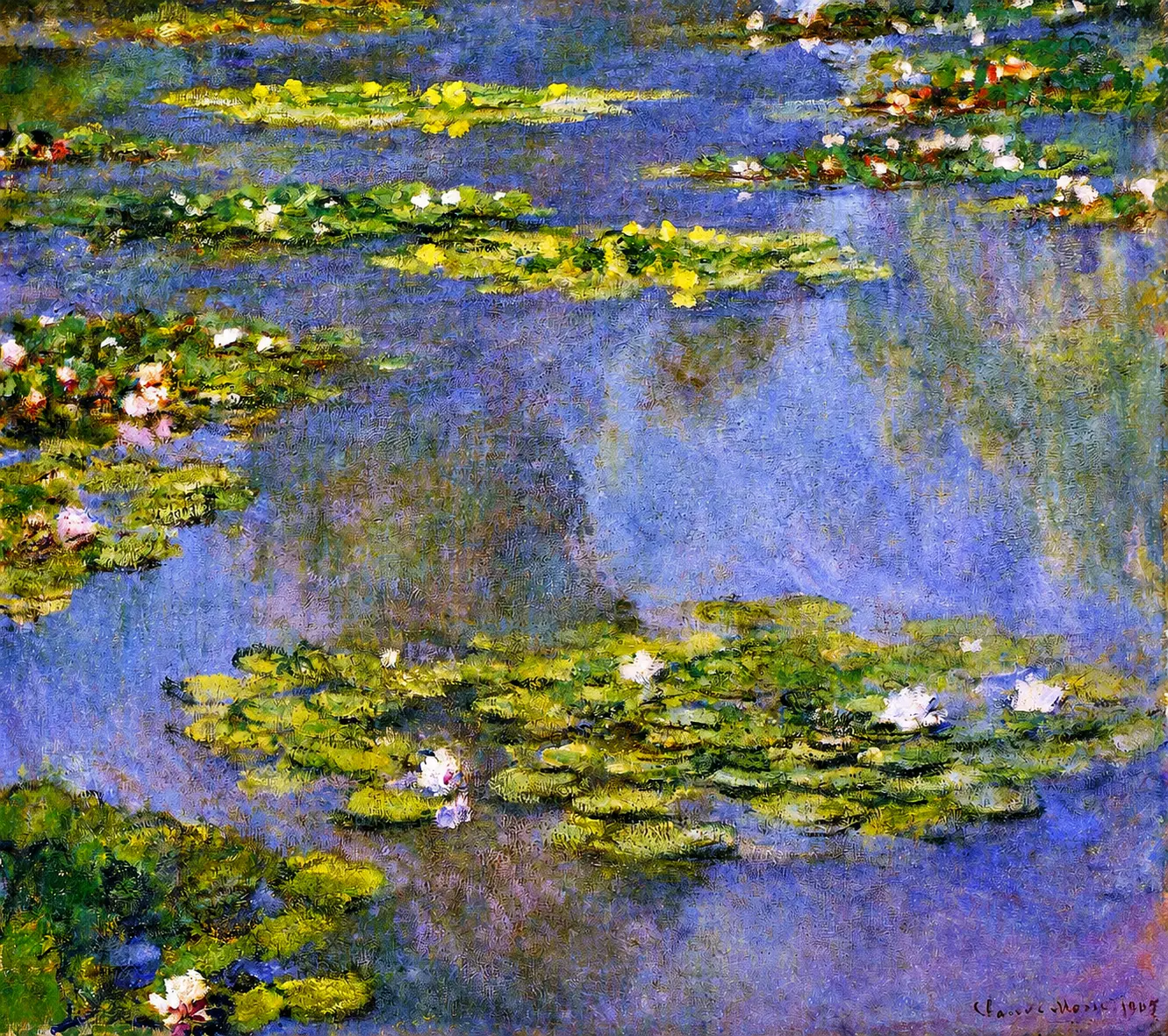
Claude Monet’s “Water Lilies” from 1905 belongs to one of the most famous and ambitious bodies of work in modern art. Painted at his garden in Giverny, the work shows a pond scattered with floating lily pads, delicate blossoms, and shimmering reflections. At first glance, the painting appears simple: a view of water, plants, and light. Yet the longer one looks, the more complex it becomes. Monet transforms the pond into a living field of color, where sky, water, vegetation, and atmosphere merge into a single visual experience.
Unlike a traditional landscape, this painting gives no clear horizon line, no stable bank, and no obvious human presence. Monet does not guide the viewer through a conventional foreground, middle ground, and background. Instead, he brings the viewer close to the water’s surface. The result is immersive and intimate. We are not looking across a landscape. We are looking into a moving, reflective world where nature seems to dissolve into color and sensation.
The Composition and Floating Structure
The composition of “Water Lilies” is built around horizontal movement. Clusters of lily pads drift across the surface, creating gentle rhythms from left to right. These green and yellow forms act like islands of texture within the blue and violet water. They are loosely arranged, but they still create balance. The larger cluster near the lower center gives weight to the foreground, while smaller groups toward the top and sides keep the eye moving through the painting.
Monet’s framing is especially important. By cropping out the shore and removing the horizon, he makes the pond feel almost endless. The viewer has no firm point of orientation. This gives the painting a modern quality, because it treats the canvas less like a window onto a scene and more like a complete visual field. The water fills the entire image, becoming both subject and setting.
The floating lily pads create a soft pattern, but they never become decorative in a flat or mechanical way. Each cluster has its own density and direction. Some pads appear bright and sunlit, while others are darker and more submerged. The flowers, painted in touches of white, pink, and pale violet, add small moments of brightness. They feel fragile, almost temporary, as if they might shift or disappear with the next ripple.
Color and Atmosphere
Color is the heart of Monet’s “Water Lilies.” The pond is not simply blue. It contains lavender, gray, green, violet, gold, and soft brown. These colors suggest water, sky, reflected trees, shadow, and light all at once. Monet’s genius lies in refusing to separate these elements too clearly. He understood that reflections are unstable, and he painted them as a mixture of visual impressions rather than fixed objects.
The blue and purple tones in the water create a cool, quiet atmosphere. Against them, the yellow green lily pads feel warm and luminous. This contrast gives the painting its gentle energy. Nothing feels harsh or dramatic. Instead, the colors vibrate softly, creating the sensation of sunlight filtered through air and reflected on moving water.
The white blossoms are especially effective because they appear in small, scattered accents. They brighten the surface without dominating it. Their placement gives the painting a sense of natural irregularity. Monet does not arrange the flowers like a formal bouquet. He lets them appear as part of the pond’s living rhythm.
Brushwork and Texture
The brushwork in “Water Lilies” is loose, layered, and expressive. Monet does not describe every leaf or flower with precise detail. Instead, he uses short strokes, broken marks, and textured patches to suggest form. The lily pads are built from touches of green, yellow, olive, and dark blue. The water is made of softer, more blended strokes that shift between reflection and depth.
This handling of paint is central to the painting’s power. Monet’s brushwork allows the scene to remain alive. The surface seems to shimmer because the marks are visible and active. The viewer becomes aware not only of the pond but also of the act of painting itself. This is one reason Monet’s late work became so important for later modern artists. His images move away from exact description and toward sensation, atmosphere, and abstraction.
The texture also gives the painting a physical presence. The lilies are not just represented. They are constructed through paint. The roughness of the strokes makes the surface feel tactile, echoing the natural irregularity of leaves, petals, and water.
Monet’s Garden at Giverny
Monet’s garden at Giverny was not just a place he painted. It was a world he carefully shaped. The water garden, with its pond, lilies, and reflections, became one of the central subjects of his later career. By 1905, Monet had already spent years observing how the pond changed under different weather, seasons, and times of day.
This painting reflects that deep familiarity. It does not feel like a quick view of a random scene. It feels like the result of prolonged looking. Monet understood how the same pond could become many different paintings depending on light and atmosphere. In “Water Lilies,” he captures a moment that feels both specific and timeless. The flowers are in bloom, the surface is calm, and the reflections create a dreamlike space.
The garden also allowed Monet to explore nature as an artistic environment. He was not simply painting wilderness. He was painting a cultivated place where natural growth and human design met. Yet in the final image, that design almost disappears. What remains is the sensation of water, light, and organic movement.
Reflection and the Dissolving World
One of the most fascinating qualities of “Water Lilies” is the way it confuses surface and depth. The lily pads float on top of the pond, but the reflections seem to pull the eye downward and outward. Pale vertical forms in the water suggest reflected trees or sky, but they are not firmly defined. They appear like shadows or memories of forms rather than solid things.
This creates a poetic uncertainty. The viewer cannot always tell what is above the water, what is reflected in it, and what lies beneath it. Monet turns this ambiguity into beauty. The painting becomes a meditation on perception itself. It shows that seeing is not always about clear outlines or stable facts. Sometimes vision is made of shifting relationships between light, color, and movement.
The absence of a horizon strengthens this effect. Without a fixed distance, the painting becomes almost weightless. The pond is both shallow and infinite. It is a real place, but it also feels like a dream space.
The Importance of “Water Lilies” in Monet’s Art
“Water Lilies” represents Monet’s mature vision as an Impressionist painter. Earlier Impressionism often focused on modern life, outdoor leisure, city scenes, and fleeting natural effects. In the water lily paintings, Monet pushes those interests further. He reduces the world to light, color, and reflection, creating images that feel peaceful but also radically experimental.
The 1905 painting is especially compelling because it balances representation and abstraction. The viewer can recognize the pond, the lilies, and the blossoms, but the forms are loose enough to become patterns of color. This balance gives the work its lasting appeal. It is accessible as a beautiful garden scene, yet it is also sophisticated as a study of perception and painterly freedom.
Monet’s “Water Lilies” continues to resonate because it invites slow looking. It does not depend on dramatic storytelling or symbolic figures. Its subject is the quiet transformation of nature through light. In this painting, Monet shows that a pond can become an entire universe when seen with enough attention.