Water Lilies by Claude Monet: Vibrant Color Edit
Free to Download & Reuse: You are welcome to use this image! If you republish or share it online, you must include a direct link back to this webpage for attribution.
Original Image source: wikiart.org
Water Lilies by Claude Monet: A Floating World of Color and Reflection
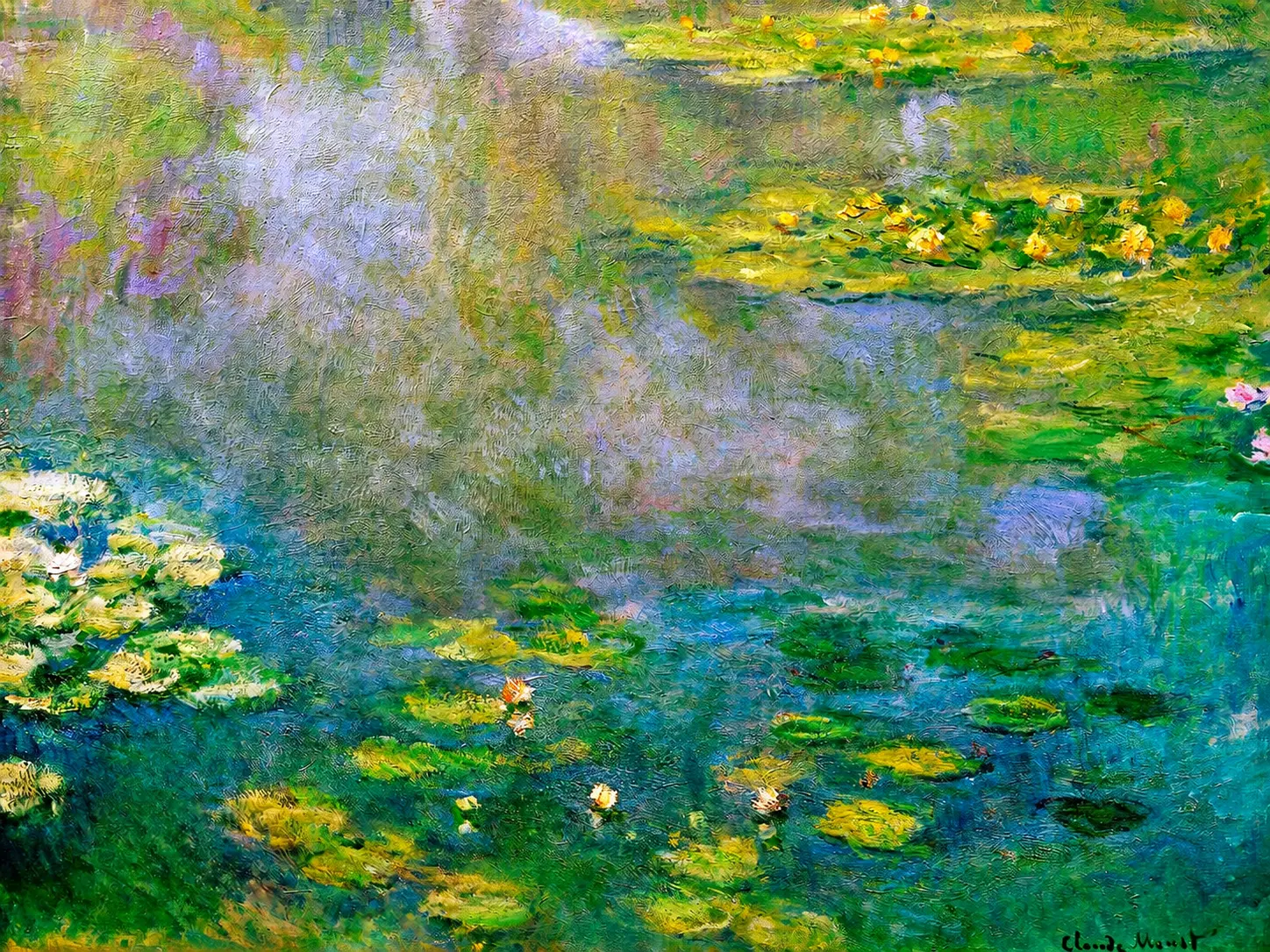
Claude Monet’s “Water Lilies” from 1906 is a luminous example of the artist’s late fascination with the pond at his garden in Giverny. Rather than presenting a traditional landscape with a clear horizon, distant trees, or architectural framing, Monet draws the viewer directly into the surface of the water. The painting becomes a world of reflection, color, movement, and atmosphere. What appears at first to be a quiet pond slowly reveals itself as a complex study of light and perception, where water, flowers, sky, and foliage merge into one shimmering field.
The composition is striking because it removes many of the visual anchors normally used to organize a landscape. There is no firm shoreline, no human figure, and no fixed viewpoint. Instead, Monet presents the pond as an immersive surface. The viewer seems to look downward and across the water at the same time, caught between depth and flatness. Lily pads float across the lower half of the image, while clusters of pale blossoms gather at the left and right edges. Near the upper section, soft bands of green and yellow suggest reflected vegetation, but they never fully become solid forms. Everything remains fluid, unstable, and open to the eye.
The Beauty of Monet’s Giverny Pond
By 1906, Monet had spent years transforming his garden at Giverny into both a living environment and an artistic subject. His water garden, with its pond, aquatic plants, and carefully cultivated views, gave him a private world where he could study nature under changing conditions of light. “Water Lilies” belongs to this deeply personal period, when the garden was not simply scenery but the foundation of a new kind of painting.
In this image, Monet does not treat the water lilies as botanical details to be described precisely. Instead, they become points of color and light within a larger visual rhythm. Some lily pads are clear enough to be recognized, while others dissolve into green, gold, and blue patches. The flowers appear as soft accents of white, pink, and yellow, adding delicate brightness to the richer tones of the pond. This balance between recognizability and abstraction is central to the painting’s power. Monet allows the subject to remain visible, yet he also lets it become pure sensation.
Color, Light, and Atmosphere
The palette of “Water Lilies” is rich but never harsh. Blues, greens, violets, and golds mingle across the surface, creating a cool, watery atmosphere warmed by flashes of yellow and cream. The lower portion of the painting is especially vibrant, with turquoise and deep green suggesting the density of the pond. The upper and central areas are softer, filled with lavender, gray, and muted green tones that evoke reflected sky and shadow.
Monet’s handling of color shows his extraordinary sensitivity to light. He does not simply paint water as blue or plants as green. Instead, he observes how colors change when they are reflected, broken, and absorbed by the pond’s surface. A patch of violet may suggest shadow, but it may also suggest sky. A green stroke may be a lily pad, a reflection, or a submerged plant. This uncertainty is not a weakness of the painting. It is the very subject of the work. Monet is showing how vision operates when forms are softened by light and water.
The painting also has a remarkable sense of depth, even though it avoids conventional perspective. The surface appears flat in places, almost decorative, yet the viewer can also sense the pond’s hidden layers. Some areas seem to float on top, while others seem to sink below. This creates a visual experience that feels meditative and alive, as though the painting is constantly shifting before the viewer’s eyes.
Brushwork and Surface Texture
Monet’s brushwork is loose, varied, and expressive. The surface is built from short strokes, dragged textures, soft patches, and thicker accents of paint. These marks do not aim for smooth illusion. Instead, they preserve the act of seeing and painting. The viewer can sense Monet’s hand moving across the canvas, responding to the changing appearance of the pond.
The texture is especially important because it echoes the physical qualities of water. Some strokes ripple horizontally, suggesting the gentle movement of the pond. Others are more clustered and tactile, giving substance to the lily pads and flowers. The rougher passages of paint make the image feel both natural and constructed. Monet does not hide the painted surface. He uses it to remind us that perception itself is layered, active, and constantly changing.
This method also places “Water Lilies” close to the edge of abstraction. The painting still represents a real place, but it is less concerned with describing that place in a literal way than with capturing the experience of looking. Forms blur, colors overlap, and the distinction between object and reflection becomes uncertain. The result is a painting that feels modern, even though it is rooted in direct observation.
A Landscape Without a Horizon
One of the most important features of “Water Lilies” is the absence of a horizon line. Traditional landscapes often guide the eye from foreground to background, creating a clear relationship between earth, sky, and distance. Monet removes that structure. The entire canvas becomes a field of water and reflected light.
This choice changes the viewer’s relationship to the painting. Instead of standing outside the scene and looking into it, we seem to hover over it. The pond fills our vision. The lack of a horizon makes the image feel endless, as though the water continues beyond the edges of the canvas. This sense of expansion is one reason Monet’s water lily paintings remain so powerful. They are intimate garden views, yet they feel vast and almost cosmic.
The painting’s edges also play an important role. The blossoms and lily pads are not centered in a formal arrangement. They appear partially cropped and irregularly placed, as they would be in nature. This gives the work a spontaneous quality, as though Monet has captured a passing moment rather than arranged a static scene.
The Meaning of the Water Lilies
“Water Lilies” can be understood as a painting about stillness, but it is not a motionless image. Its quietness comes from subtle movement: the drift of floating leaves, the shimmer of reflected light, the trembling boundary between surface and depth. Monet creates a mood of contemplation, inviting the viewer to slow down and look carefully.
The water lilies themselves suggest beauty that is delicate and temporary. They rest lightly on the pond, open to the air and light, yet surrounded by shifting reflections. In Monet’s hands, they become more than flowers. They become signs of perception, memory, and the passing nature of visual experience. The painting does not tell a story in the traditional sense. Its meaning comes through mood, color, and the act of sustained attention.
Why “Water Lilies” Still Feels Modern
Monet’s 1906 “Water Lilies” remains compelling because it bridges Impressionism and modern abstraction. It comes from the Impressionist desire to capture light and atmosphere, but it also moves toward a more radical vision in which the subject nearly dissolves into color and texture. The painting encourages viewers to experience nature not as a fixed scene, but as a changing relationship between eye, light, and surface.
The work’s beauty lies in its openness. It does not force a single interpretation or a single focal point. Instead, it allows the eye to wander, rest, and return. Each area offers a different sensation: cool blue water, pale blossoms, green pads, lavender reflections, and golden highlights. Together, they form a poetic image of nature as something both visible and mysterious.
Claude Monet’s “Water Lilies” is not merely a picture of a pond. It is a meditation on seeing. Through color, brushwork, reflection, and atmosphere, Monet transforms a garden subject into an immersive visual experience. The painting captures the fleeting appearance of light on water while also suggesting something timeless: the quiet, shifting beauty of the natural world.