Basket of Apples by Paul Cezanne: Vibrant Color Edit
Free to Download & Reuse: You are welcome to use this image! If you republish or share it online, you must include a direct link back to this webpage for attribution.
Original Image Source: wikiart.org
Basket of Apples by Paul Cezanne: A Study in Still Life and Modern Vision
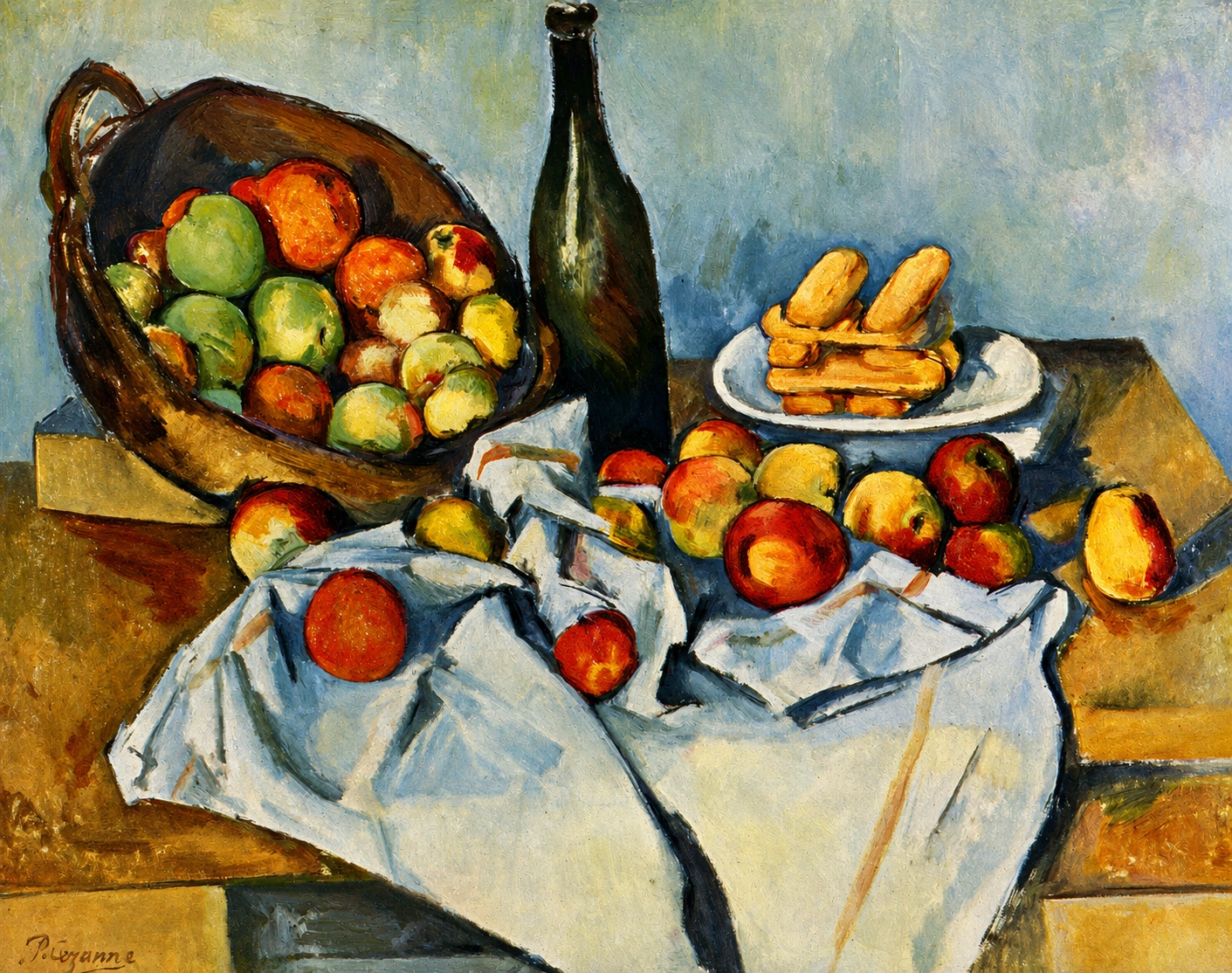
Paul Cezanne’s “Basket of Apples” from 1895 is one of the most important still life paintings of the late nineteenth century. At first glance, the subject appears simple: a basket full of apples, a dark bottle, scattered fruit, folded white cloth, and a plate of biscuits arranged across a tabletop. Yet the painting is far more radical than its familiar objects suggest. Cezanne transforms an ordinary domestic scene into a complex meditation on form, color, balance, and perception. The result is a still life that feels both solid and unstable, traditional and modern, carefully arranged and strangely alive.
Cezanne was deeply interested in how painting could represent the world without simply copying it. In “Basket of Apples,” he does not try to create a perfectly realistic illusion. Instead, he shows how objects are experienced through looking, shifting attention, and visual reconstruction. The table tilts forward, the basket leans at an impossible angle, and the lines of the composition do not align in a conventional way. These distortions are not mistakes. They are central to the painting’s power. Cezanne is asking the viewer to see still life not as a fixed arrangement, but as an active visual experience.
The Composition and Its Controlled Instability
The composition of “Basket of Apples” is built around tension. The large basket on the left dominates the scene, tipping forward as if it might spill its fruit onto the table. Its curved handle and rounded body create a sweeping movement that contrasts with the vertical darkness of the bottle near the center. On the right, the plate of biscuits forms a quieter but important counterweight, balancing the visual heaviness of the basket.
The tabletop itself is one of the most striking parts of the painting. Instead of receding smoothly into space, it seems fractured into different angles. The front edge, the cloth, and the right side of the table do not follow a single perspective. This gives the scene a slightly dislocated feeling, as if the viewer is seeing the objects from more than one viewpoint at once. Cezanne breaks away from the rules of Renaissance perspective and replaces them with a more personal, searching form of vision.
This instability creates energy. The painting does not sit calmly before the viewer. It shifts, leans, and presses forward. The apples seem to roll across the surface, while the cloth forms sharp folds that guide the eye through the composition. Every object has weight, but the whole arrangement feels suspended in delicate balance.
Color, Light, and the Material Presence of Objects
Color is one of the great strengths of “Basket of Apples.” Cezanne uses warm reds, oranges, yellows, and greens to give the fruit a rich physical presence. The apples are not polished or decorative in a conventional sense. They are built from patches of color, each one carrying light, shadow, and structure. A red apple may contain touches of yellow, green, brown, and white, allowing it to feel rounded without being smoothly finished.
The contrast between the fruit and the white cloth is especially important. The cloth is not simply white. It contains blue, gray, cream, and pale green tones, which make it feel cool beside the warmer fruit. These color relationships create depth and rhythm across the painting. The apples glow because they are surrounded by softer, cooler tones.
The dark bottle at the center adds another layer of contrast. Its deep green and black surface anchors the painting, rising upward like a vertical column. It divides the composition while also connecting the left and right sides. Against the lighter wall behind it, the bottle appears both heavy and mysterious. It is one of the simplest objects in the scene, yet it plays a major structural role.
The Basket as a Symbol of Abundance and Disorder
The basket in “Basket of Apples” is more than a container. It is the emotional and visual heart of the painting. Filled with fruit, it suggests abundance, domestic comfort, and the traditional pleasures of still life painting. Still life had long been associated with everyday beauty, food, prosperity, and the passage of time. Cezanne inherits this tradition, but he makes it feel new.
The basket also introduces disorder. It tilts forward dramatically, and its contents appear loosely arranged rather than neatly displayed. The apples inside seem compressed together, while others have escaped onto the cloth and table. This gives the painting a sense of movement, even though nothing is actually moving. The objects are still, but the composition is restless.
This combination of abundance and instability is one of the reasons the painting feels so modern. Cezanne does not present nature as perfectly organized. He shows it as something constructed through perception, color, and form. The apples are real, but they are also painterly objects, built from brushstrokes and visual decisions.
Cezanne’s Brushwork and the Construction of Form
Cezanne’s brushwork is firm, visible, and deliberate. He does not hide the act of painting. The surface is made from short, structured strokes that build the objects gradually. The apples are rounded through color planes rather than smooth blending. The basket is shaped through dark outlines, warm browns, and rough highlights. The cloth is created through angular folds that almost resemble a landscape of ridges and valleys.
This method gives the painting a powerful sense of construction. Cezanne famously wanted to treat nature through basic forms, and “Basket of Apples” shows this ambition clearly. Apples become spheres, the bottle becomes a cylinder, the basket becomes a curved volume, and the tabletop becomes a set of angled planes. These forms are not abstract, but they point toward abstraction. They help explain why Cezanne became such an important influence on later modern artists, especially the Cubists.
Why Basket of Apples Matters
“Basket of Apples” matters because it changes what a still life can do. Earlier still life paintings often emphasized realism, symbolic detail, or technical brilliance. Cezanne keeps the everyday subject, but he shifts the purpose of the genre. The painting is not only about fruit, cloth, and tableware. It is about the act of seeing and the structure of painted reality.
The tilted perspective, the heavy outlines, the broken space, and the bold color relationships all make the painting feel ahead of its time. Cezanne bridges Impressionism and modern art, preserving the attention to light and color while moving toward a more analytical treatment of form. In this painting, he shows that a simple arrangement of apples can become a foundation for rethinking the entire language of painting.
“Basket of Apples” remains compelling because it never resolves completely. The viewer keeps returning to the slanted basket, the uneven table, the glowing fruit, and the folded cloth. The painting feels familiar, yet slightly impossible. It invites close looking because its beauty comes from tension, not perfection. Through this modest still life, Paul Cezanne created one of the defining images of modern painting.