Starry Night Over the Rhone by Vincent van Gogh: Vibrant Color Edit
Free to Download & Reuse: You are welcome to use this image! If you republish or share it online, you must include a direct link back to this webpage for attribution.
Original Image Source: wikiart.org
Introduction
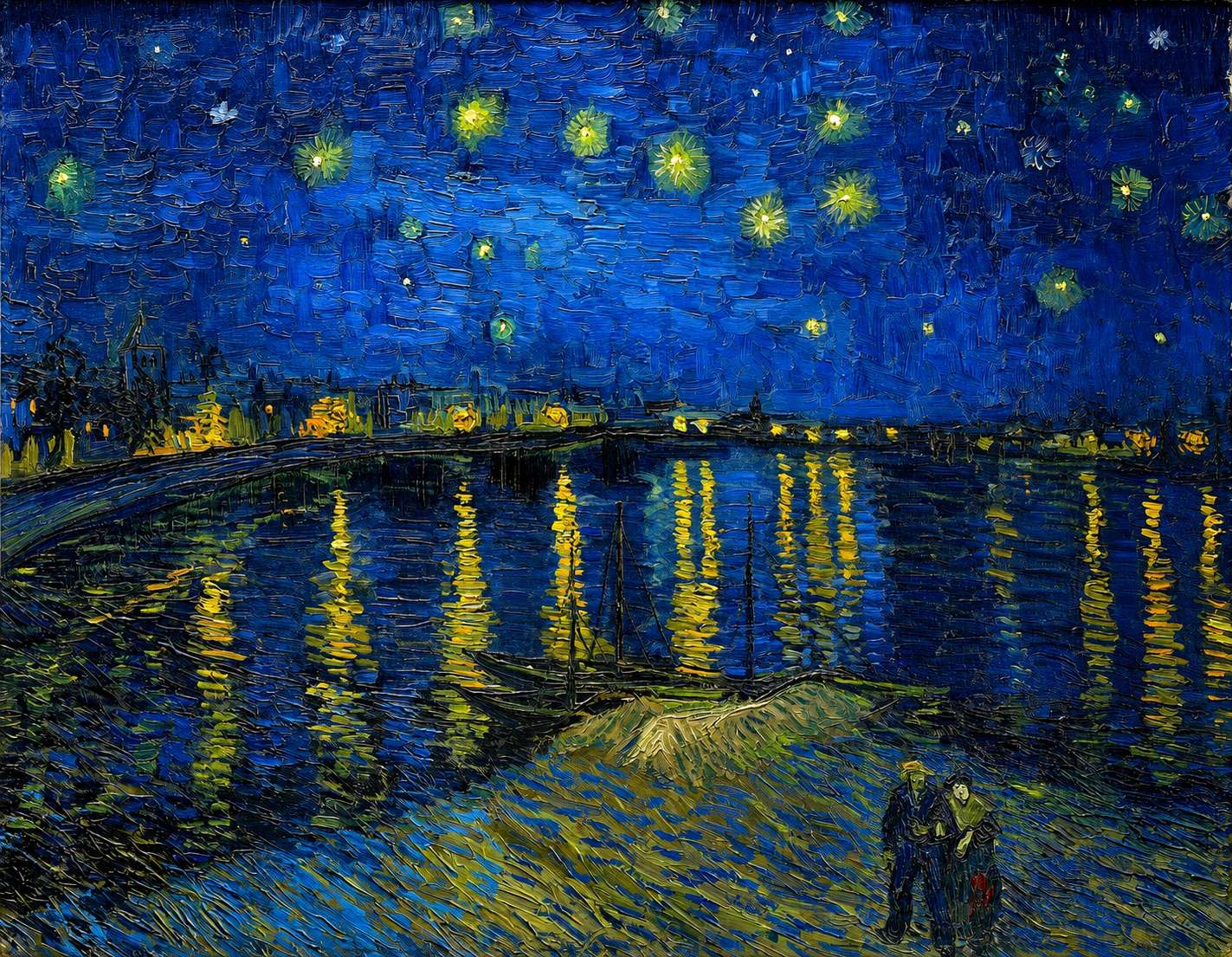
“Starry Night Over the Rhone” by Vincent van Gogh, painted in 1888, is one of the most poetic night scenes of the artist’s career. Created during his stay in Arles, the painting shows the Rhône River beneath a sky filled with glowing stars, while the lights of the town shimmer across the water in long golden reflections. Unlike the more turbulent “The Starry Night” of 1889, this work feels quieter, more intimate, and more grounded in direct observation. Van Gogh was not inventing a dream world here. He was studying a real place at night, transforming it through color, rhythm, and emotion.
The painting captures a moment when the visible world seems to tremble between reality and imagination. The river, the gaslights, the stars, the distant buildings, and the small couple in the foreground all become part of one vibrating harmony. Van Gogh turns the ordinary view of a riverside town into an image of wonder. The scene is calm, yet it is never still. Every brushstroke carries movement, and every color seems alive.
The Night Sky as a Field of Emotion
The sky dominates the upper half of “Starry Night Over the Rhone.” Van Gogh builds it from deep blues, lighter blues, greenish tones, and textured strokes that create a sense of atmospheric depth. The stars do not appear as tiny distant points. They bloom like flowers or lanterns, surrounded by radiant halos of yellow, green, and pale light. Their placement gives the sky a quiet rhythm, as though the heavens are breathing above the river.
Van Gogh was fascinated by the night because it allowed color to behave differently. Instead of painting darkness as black emptiness, he fills it with blues that are rich, layered, and expressive. The night becomes a living presence. It is not merely a background for the town below. It is the emotional heart of the painting.
The stars also suggest a longing for spiritual connection. Van Gogh often treated the natural world as a source of consolation, and here the sky feels both distant and intimate. It stretches above human life, yet it also reflects in the river, joining heaven and earth through light.
Reflections on the Rhône
The river is one of the most striking features of the painting. Van Gogh uses the water as a mirror, but not a smooth or literal one. The reflections of the town lights break into long vertical bands of yellow, orange, and green. These glowing paths ripple downward across the blue surface, creating a dramatic contrast between warm artificial light and cool natural darkness.
The reflections give the painting much of its visual energy. They guide the viewer’s eye from the distant town toward the foreground, pulling us into the scene. The water is painted with short, active strokes that suggest movement without destroying the overall calm. It feels like a river at night, gently disturbed by current and light.
These reflections also deepen the painting’s emotional effect. The stars shine from above, the gaslights shine from the shore, and both kinds of light become transformed by the water. Van Gogh shows the world as interconnected. Sky, town, river, and viewer are drawn into the same luminous experience.
Composition and Depth
The composition of “Starry Night Over the Rhone” is carefully organized, even though the brushwork feels spontaneous. The horizon line sits relatively low, allowing the sky to expand across the scene. The town forms a dark horizontal band, while the river opens broadly in the foreground. This structure gives the painting both balance and depth.
On the left, the curve of the riverbank leads the eye into the distance. The bridge and town lights create a sense of place, while the boats and figures in the foreground anchor the scene in human scale. The small couple at the lower right is especially important. They are not the main subject, yet they change the mood of the painting. Their presence makes the night feel personal rather than empty.
The couple seems absorbed in the quiet atmosphere. They stand close together, almost swallowed by the vastness of sky and water. Through them, Van Gogh introduces tenderness and solitude at the same time. The viewer becomes aware of human smallness, but also of human intimacy within the larger beauty of the world.
Color and Contrast
Color is the true language of this painting. Van Gogh creates a powerful contrast between blue and yellow, one of his favorite combinations. The blues suggest depth, coolness, mystery, and night. The yellows suggest warmth, life, and illumination. Instead of blending these colors smoothly, he places them side by side so they intensify each other.
The result is a scene that glows from within. The yellow reflections appear brighter because they are surrounded by deep blue water. The stars seem more radiant because they shine against the dark sky. Even the small lights along the shore become emotionally charged, as if they are signs of human life resisting the darkness.
This use of color shows Van Gogh’s move beyond naturalism. He is not simply recording what the night looked like. He is painting how it felt. The colors carry sensation, memory, and feeling. They make the painting recognizable as a real location, while also turning it into an inner landscape.
Brushwork and Texture
The surface of “Starry Night Over the Rhone” is full of visible brushwork. Van Gogh’s strokes are thick, directional, and expressive. In the sky, the strokes form rough waves and currents. In the river, they become shorter, more broken, and more reflective. Along the buildings and shore, they become darker and more linear.
This variation in brushwork gives the painting its physical intensity. The viewer can almost feel the movement of the artist’s hand. The paint does not disappear behind the image. It remains present as material, making the scene more immediate and alive.
The texture also helps unite the painting. Sky and water are different, but both are made from energetic strokes. The whole scene seems to vibrate. Van Gogh’s technique suggests that the world is not fixed or silent, but constantly moving with hidden force.
A Different Kind of Starry Night
Many viewers compare this painting to Van Gogh’s later “The Starry Night,” painted in Saint-Rémy in 1889. The comparison is useful because it shows how different “Starry Night Over the Rhone” really is. The later work is more visionary, with swirling forms and an almost cosmic drama. The 1888 Rhône painting is more observational, quieter, and more connected to a specific place.
Yet it is still deeply emotional. Its beauty comes from the balance between reality and feeling. Van Gogh looked at the river, the town lights, and the stars, then intensified them through color and brushwork. He did not need to distort the scene dramatically to make it powerful. The magic is already present in the observed world.
Meaning and Lasting Appeal
“Starry Night Over the Rhone” remains one of Van Gogh’s most beloved paintings because it combines grandeur with intimacy. It gives the viewer a vast sky, a glowing river, and a peaceful town, but it also includes the fragile human presence of two figures walking at night. The painting feels universal because it captures an experience many people know: standing beneath the night sky and feeling both small and strangely comforted.
The work also reveals Van Gogh’s extraordinary ability to find beauty in ordinary modern life. Gaslights, riverbanks, boats, and town silhouettes become part of a luminous vision. He does not separate human-made light from natural starlight. Instead, he lets them echo each other across the water.
In “Starry Night Over the Rhone,” Van Gogh paints night not as darkness, but as revelation. The scene glows with quiet emotion, transforming the Rhône into a place of reflection, longing, and wonder. More than a view of Arles, it is a meditation on light itself, and on the human desire to find meaning beneath the stars.