Branches with Almond Blossom by Vincent van Gogh: Vibrant Color Edit
Free to Download & Reuse: You are welcome to use this image! If you republish or share it online, you must include a direct link back to this webpage for attribution.
Original Image Source: wikiart.org
Branches with Almond Blossom by Vincent van Gogh
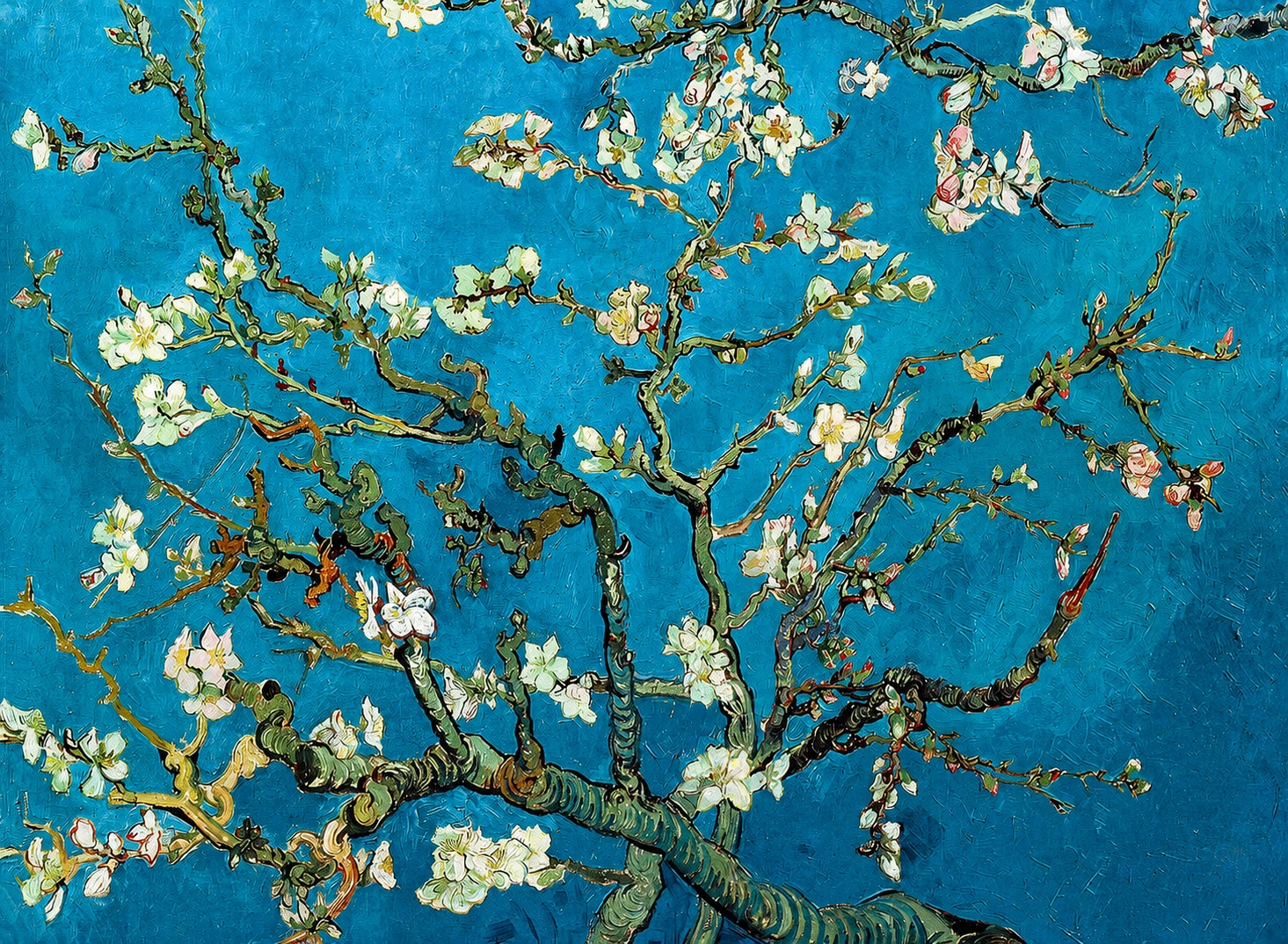
Vincent van Gogh’s “Branches with Almond Blossom,” painted in 1890, is one of the artist’s most radiant and hopeful images. Unlike many of his more turbulent landscapes and portraits, this painting feels open, airy, and almost weightless. A flowering almond tree stretches its dark, twisting branches across a vivid blue background, filling the surface with white blossoms, green shoots, and delicate pink accents. The composition is simple at first glance, yet it is full of movement, rhythm, and emotional meaning. Van Gogh turns a natural subject into a symbol of renewal, tenderness, and fragile beauty.
The painting was made near the end of Van Gogh’s life, at a moment when he was still struggling with illness but also capable of extraordinary clarity and invention. Almond blossoms are among the earliest flowers to appear in spring, so they naturally suggest rebirth and new beginnings. This meaning was deeply personal for Van Gogh. The image is often associated with the birth of his brother Theo’s son, who was named Vincent. Because of that connection, the painting can be understood not only as a study of flowers and branches, but also as a loving gift, a visual blessing, and a statement of hope.
Composition and Perspective
The composition of “Branches with Almond Blossom” is striking because it avoids a traditional horizon, landscape setting, or deep background space. Instead of placing the tree in a garden or orchard, Van Gogh brings the viewer very close to the branches. The almond limbs appear to rise from below and extend outward in every direction, creating a dynamic network across the canvas. This close viewpoint makes the painting feel intimate, as though the viewer is looking upward from beneath the tree into a bright spring sky.
The absence of a ground line gives the image a floating quality. The branches seem suspended in blue, and the blossoms appear almost like stars scattered across the surface. Van Gogh uses this flattened arrangement to emphasize pattern and rhythm rather than realistic depth. The branches cross, bend, and split in irregular directions, but the painting never feels chaotic. Each line leads the eye toward another blossom, another curve, another small burst of light.
This unusual perspective shows Van Gogh’s interest in Japanese prints, which often used cropped compositions, flattened space, and strong outlines. In “Branches with Almond Blossom,” the influence is clear but not merely decorative. Van Gogh absorbs that visual language and transforms it into something deeply personal. The painting feels both modern and timeless, both carefully arranged and full of natural vitality.
Color and Light
Color is one of the most powerful elements in this painting. The blue background is luminous and intense, creating a sense of fresh air and clear daylight. It does not function as a realistic sky alone. It also becomes an emotional field, a bright space of calm and possibility. Against this blue, the pale blossoms stand out with remarkable freshness. Their whites, creams, soft greens, and hints of pink seem to glow.
The contrast between the dark branches and the light blossoms gives the painting its structure. The branches are painted with deep greens, browns, and blue-black outlines, making them feel sturdy and alive. They twist across the canvas with muscular energy, while the blossoms soften their force. This balance between strength and delicacy is central to the painting’s emotional effect. The tree is not weak or sentimental. It is resilient, rooted, and growing.
Van Gogh does not use smooth, invisible brushwork. Instead, he lets the surface remain active. The blue background contains visible strokes and subtle variations, so the sky itself feels alive. The blossoms are built from expressive touches of paint, giving them both decorative charm and physical presence. The result is a painting that feels still and moving at the same time. It captures a moment of bloom, but it also suggests the living process behind that bloom.
The Meaning of Almond Blossoms
Almond blossoms carry a natural symbolism because they appear early in the season, often before many other signs of spring. In this painting, they represent awakening, promise, and the return of life. Van Gogh uses the subject to express hope without making the image overly dramatic. There are no figures, no narrative scene, and no obvious religious symbols. Yet the painting feels quietly spiritual because it presents nature as a source of renewal.
The blossoms are fragile, but they are not passive. They emerge from rough, twisting branches, suggesting that beauty often comes from endurance. This idea fits Van Gogh’s broader artistic vision. Again and again, he found emotional meaning in ordinary subjects: sunflowers, wheat fields, cypress trees, chairs, shoes, bedrooms, and flowers. He believed that simple things could carry profound feeling when seen with intensity and compassion.
In “Branches with Almond Blossom,” the blooming tree becomes a sign of life continuing. The painting’s association with a newborn child adds tenderness to this symbolism. It is not just a picture of spring, but a picture of beginning. The blossoms seem to open toward the future.
Brushwork and Surface
Van Gogh’s brushwork gives the painting its unmistakable vitality. The branches are outlined with dark, confident strokes that create strong contours. These lines are not perfectly smooth. They twist, thicken, and shift, making the branches feel organic and expressive. The bark is described through curved strokes and layered colors, so the tree seems to pulse with energy.
The blossoms are painted with looser, lighter touches. Some flowers are fully open, while others remain buds. This variety makes the painting feel natural rather than mechanical. Van Gogh does not repeat the same flower shape endlessly. Each blossom has its own small variation, creating a sense of living growth.
The background is also important. The blue is not flat in a lifeless way. It contains visible movement, with brushstrokes that subtly echo the curves of the branches. This creates unity between subject and space. The sky does not merely sit behind the tree. It participates in the painting’s atmosphere.
A Painting of Hope
What makes “Branches with Almond Blossom” so memorable is its emotional purity. Van Gogh’s art is often discussed through the lens of suffering, but this painting reminds us that his work also contains joy, tenderness, and hope. The image is bright without being shallow. Its beauty feels hard won, as though it comes from someone who understood fragility very deeply.
The painting’s openness is especially moving. The branches reach outward, the blossoms unfold, and the blue background seems endless. Nothing feels closed or heavy. Even the dark outlines serve the brightness rather than overpowering it. Van Gogh creates a vision of life at the moment of renewal, when the world appears fresh again.
“Branches with Almond Blossom” remains one of Van Gogh’s most beloved works because it speaks in a language that is immediately understandable. It does not require a complicated story to be powerful. A tree blooms against a blue sky, and through that simple image, Van Gogh expresses affection, resilience, and the fragile promise of new life.