Vincent’s Bedroom in Arles by Vincent van Gogh: Vibrant Color Edit
Free to Download & Reuse: You are welcome to use this image! If you republish or share it online, you must include a direct link back to this webpage for attribution.
Original Image Source: wikiart.org
Vincent’s Bedroom in Arles by Vincent van Gogh
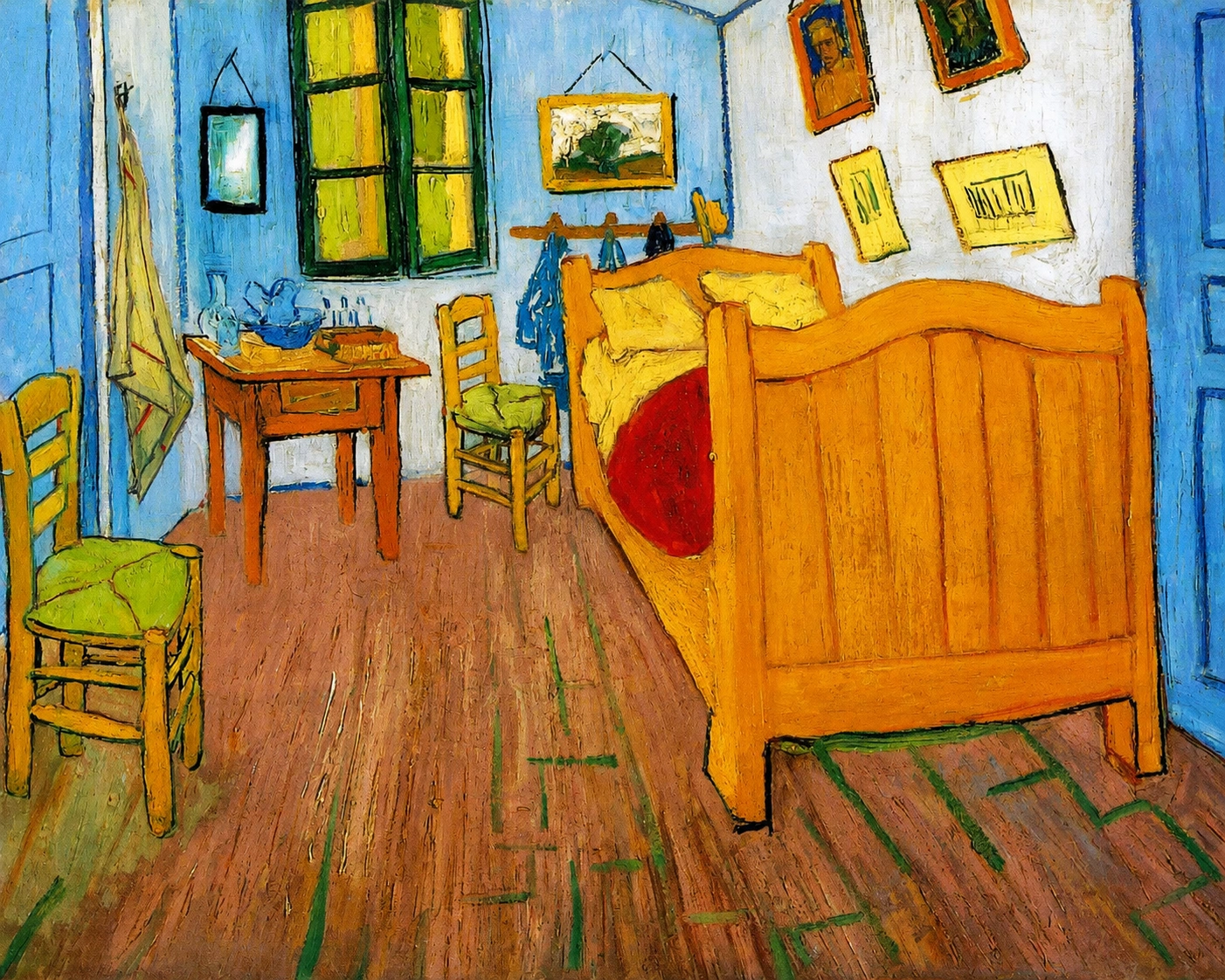
Vincent van Gogh’s “Vincent’s Bedroom in Arles,” painted in 1888, is one of the most recognizable interior scenes in modern art. At first glance, the painting appears simple: a bed, two chairs, a small table, a window, a towel, and a few pictures on the wall. Yet this apparent simplicity is exactly what gives the work its lasting power. Van Gogh transforms an ordinary bedroom into a psychological portrait, a place where color, line, perspective, and personal symbolism reveal his search for rest, stability, and belonging.
The painting shows Van Gogh’s room in the Yellow House in Arles, the town in southern France where he hoped to build a community of artists. Rather than presenting the room with strict realism, he uses bold outlines, flattened forms, and intense color to create an image that feels both intimate and dreamlike. The result is not merely a record of furniture and walls. It is a vision of domestic peace imagined by an artist who desperately wanted calm in his life.
A Room Made of Color
Color is the emotional foundation of “Vincent’s Bedroom in Arles.” Van Gogh does not rely on subtle shadows or careful modeling to create depth. Instead, he builds the room through strong contrasts between blue, yellow, orange, green, red, and lavender. The bed dominates the composition with its warm yellow and orange tones, making it the emotional center of the room. Its color suggests warmth, rest, and human comfort, even though the room itself is empty.
The walls are pale blue and violet, creating a cool atmosphere around the hotter colors of the bed, chairs, floor, and table. This contrast gives the painting its special tension. The room seems peaceful, but it is not quiet in a conventional way. The colors vibrate against one another. The yellow furniture presses forward, the blue walls recede, and the red blanket adds a note of intensity. Van Gogh wanted color to express feeling directly, and here the palette gives the room an emotional pulse.
The green shutters, green chair seats, and green strokes in the floor create another layer of harmony. They connect different parts of the composition and keep the painting from becoming purely warm or purely cool. The room feels carefully balanced, even though the drawing appears unstable. This balance between calm color harmony and nervous line is one of the reasons the painting remains so fascinating.
The Meaning of the Bedroom
A bedroom is one of the most private subjects an artist can paint. It is not a public space, a grand landscape, or a dramatic historical scene. It is a place of sleep, solitude, vulnerability, and personal routine. By painting his bedroom, Van Gogh invites the viewer into a deeply personal environment. The room becomes a substitute self-portrait.
There is no figure in the painting, but Van Gogh’s presence is everywhere. The two chairs suggest companionship, but they are empty. The bed suggests rest, but its exaggerated shape and intense color make it feel active rather than still. The small portraits on the wall suggest relationships and memory, while the closed-in space creates a feeling of isolation. The room is both welcoming and lonely.
This tension reflects Van Gogh’s situation in Arles. He dreamed of creating a stable home and a shared artistic life, especially through the Yellow House. “Vincent’s Bedroom in Arles” can therefore be read as an image of hope. The room is modest, but it is his own. It represents a place where art, friendship, and peace might finally come together. At the same time, the tilted perspective and restless brushwork suggest that this peace is fragile.
Perspective and Emotional Distortion
One of the most striking features of the painting is its unusual perspective. The floor tilts upward, the bed seems to press toward the viewer, the walls lean at odd angles, and the furniture does not sit in a perfectly logical space. The room is recognizable, but it is not mathematically correct. Van Gogh bends the structure of the interior to match emotional experience.
This distortion gives the painting a sense of immediacy. The viewer does not feel like a detached observer standing outside the room. Instead, we feel pulled into the space. The bed looms large, the chairs appear slightly unstable, and the walls seem to close around the scene. The room becomes psychological rather than purely architectural.
Van Gogh’s use of outline strengthens this effect. Nearly every object is edged with dark, expressive lines. These outlines give the furniture a handmade, almost animated quality. The bed, chairs, and table seem to have personalities of their own. They are ordinary objects, but they feel charged with feeling. This is one of Van Gogh’s great achievements: he makes everyday things emotionally alive.
Simplicity and Modernity
“Vincent’s Bedroom in Arles” is also important because of its radical simplicity. Van Gogh reduces the room to broad areas of color and clear shapes. He does not fill the scene with decorative detail. Instead, he chooses a few essential objects and gives them symbolic weight. The plain wooden bed, the simple chairs, the washstand, and the bare floor all contribute to a vision of humble domestic life.
This simplicity connects the painting to modern art. Van Gogh is not trying to imitate visual reality perfectly. He is using color and form as expressive tools. The flattened space, bold outlines, and emotional palette anticipate later developments in Post-Impressionism, Expressionism, and Fauvism. Artists after Van Gogh would increasingly treat color as a language of feeling rather than a tool for natural description.
The painting also shows Van Gogh’s admiration for Japanese prints, especially in its flat color fields, strong contours, and decorative clarity. Like many artists of his generation, he saw Japanese art as a way to move beyond traditional European perspective and shading. In “Vincent’s Bedroom in Arles,” that influence helps create an image that feels direct, simple, and unforgettable.
Why the Painting Remains So Powerful
The lasting appeal of “Vincent’s Bedroom in Arles” comes from the way it turns a private room into a universal image. Most viewers understand the emotional meaning of a bedroom. It is where a person retreats from the world. It is where rest is supposed to happen. It is also where loneliness can feel strongest. Van Gogh captures all of these associations without showing a single human figure.
The painting is warm but uneasy, cheerful but solitary, simple but psychologically rich. Its colors promise comfort, while its tilted space suggests instability. Its empty chairs imply absence, while its carefully arranged objects imply a desire for order. Van Gogh gives the viewer a room that feels loved, needed, and intensely personal.
“Vincent’s Bedroom in Arles” is not just a painting of furniture. It is a painting about the human need for shelter, peace, and emotional belonging. Through a few humble objects and a daring arrangement of color, Van Gogh created one of the most intimate images in the history of art. The room may be empty, but it speaks with remarkable force. It shows how a simple interior can become a portrait of the soul.