Incredulity of Saint Thomas by Caravaggio: Vibrant Color Edit
Free to Download & Reuse: You are welcome to use this image! If you republish or share it online, you must include a direct link back to this webpage for attribution.
Original Image Source: wikiart.org
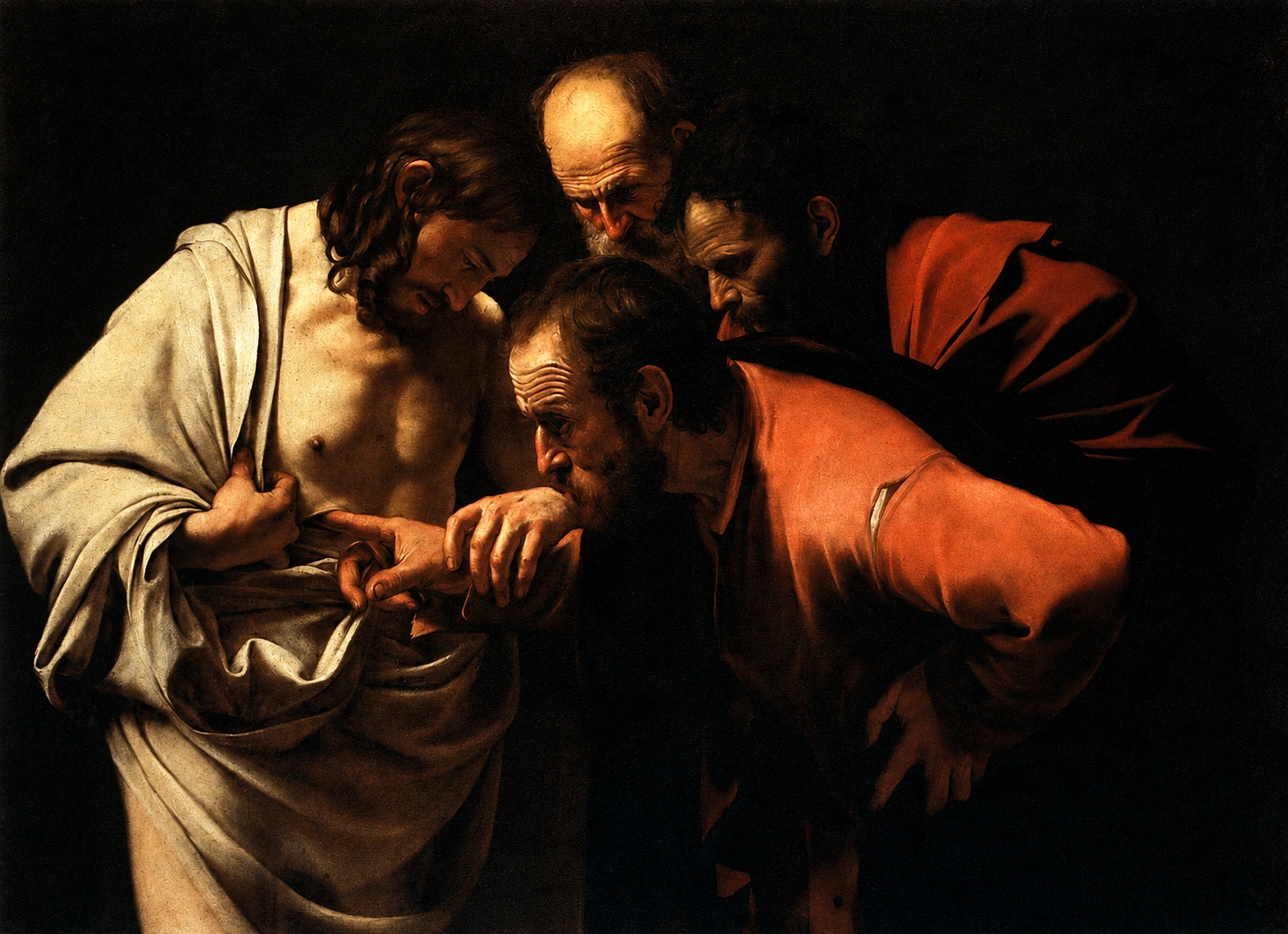
“Incredulity of Saint Thomas” by Caravaggio
Caravaggio’s “Incredulity of Saint Thomas,” painted around 1602, is one of the most powerful images of doubt, faith, and physical proof in Baroque art. The painting depicts the biblical moment after Christ’s resurrection when the apostle Thomas refuses to believe that Christ has returned unless he can see and touch the marks of the Passion. Caravaggio turns this sacred episode into an intensely human encounter. Instead of presenting the scene with heavenly distance or idealized serenity, he brings the viewer close to the figures, close enough to feel the tension of discovery.
The painting is famous because it captures faith at the exact moment it passes through doubt. Thomas is not shown as a villain or a fool. He is shown as a man who needs evidence. Caravaggio understands this need with remarkable sympathy. The result is a painting that feels both religious and psychological, both dramatic and intimate. “Incredulity of Saint Thomas” remains one of the clearest examples of Caravaggio’s ability to make sacred history feel immediate, physical, and emotionally real.
The Biblical Moment Made Human
The subject comes from the Gospel of John, where Thomas is absent when the resurrected Christ first appears to the disciples. When the others tell him what they have seen, Thomas says he will not believe unless he can see and touch Christ’s wounds. Eight days later, Christ appears again and invites Thomas to do exactly that. The story ends with Thomas recognizing Christ and confessing his faith.
Caravaggio chooses the most dramatic instant of the episode. Thomas bends forward, his brow wrinkled, his face absorbed in concentration. Christ calmly guides his hand, allowing doubt to meet proof. Two other apostles lean in from behind, watching closely. No halos, angels, clouds, or golden architecture appear. The scene is stripped down to bodies, faces, hands, light, and shadow.
This simplicity is what makes the painting so unforgettable. Caravaggio does not decorate the miracle. He concentrates it. The viewer is not asked to admire a distant theological symbol, but to witness a private encounter between belief and evidence. The painting suggests that faith is not always effortless. It may begin in uncertainty, hesitation, and the desire to understand.
Composition and Dramatic Focus
The composition of “Incredulity of Saint Thomas” is tightly organized around the contact between Thomas and Christ. Every head, hand, and gaze pulls the viewer toward the central action. Christ stands on the left, his pale body partly covered by a white robe. Thomas and the other apostles form a dense group on the right, their darker clothing and shadowed faces pressing into the light.
This arrangement creates a strong visual contrast. Christ is calm, open, and illuminated. Thomas is tense, bent forward, and searching. The apostles behind him deepen the sense of collective attention. They are not passive witnesses. They seem just as eager to understand what Thomas is seeing. Their heads create a curved rhythm that leads the eye downward toward the meeting of hand and body.
Caravaggio removes almost all background detail, placing the figures against darkness. This dark background is not empty. It works like a stage, forcing the viewer to focus on the figures. The absence of setting makes the event feel timeless. It could be a sacred moment from Scripture, but it also feels like a scene unfolding directly before us.
Light, Shadow, and Baroque Realism
Caravaggio’s use of chiaroscuro is central to the painting’s emotional force. A strong light falls from the left, illuminating Christ’s torso, Thomas’s hand, and the concentrated faces of the apostles. The rest of the scene sinks into deep shadow. This contrast creates drama, but it also gives the painting a spiritual meaning. Light becomes a form of revelation.
The figures emerge from darkness as if truth itself is being uncovered. Thomas’s doubt is not mocked. It is brought into the light. Christ does not recoil from his questioning. Instead, he guides him gently. The illumination of the scene suggests that faith can include inquiry. Light does not erase doubt instantly. It reveals what doubt seeks.
The realism is equally important. Thomas has rough hands, weathered skin, and a torn seam in his garment. The apostles are ordinary men, not idealized saints. Their faces are lined and serious. Christ himself is beautiful but not distant. His body has weight and presence. This physical realism was one of Caravaggio’s great innovations. He made religious painting feel grounded in lived experience.
Thomas as a Figure of Doubt and Recognition
Thomas is the emotional center of the painting. His face shows intense concentration rather than simple disbelief. He is not looking away. He is not resisting. He is fully absorbed in the moment of recognition. His doubt has brought him closer to Christ, not farther away.
Caravaggio’s portrayal of Thomas is deeply modern in feeling. Many viewers can understand him because he represents the human need for certainty. He wants faith, but he cannot accept it secondhand. He must encounter it directly. This makes the painting more than a religious illustration. It becomes a study of how people come to believe.
The title, “Incredulity of Saint Thomas,” can sound like a criticism, but the painting itself is more compassionate. Thomas’s incredulity is treated as part of his path toward understanding. Caravaggio shows that doubt can be serious, honest, and even reverent. Thomas leans in because the truth matters to him.
Christ’s Calm Authority
Christ’s presence contrasts with the urgency of the apostles. He does not appear triumphant in a theatrical way. He is quiet, patient, and composed. His head tilts gently downward as he guides Thomas’s hand. This gesture is central to the painting’s meaning. Christ is not merely allowing examination. He is actively helping Thomas understand.
The white robe around Christ adds to his visual importance. Its folds catch the light and frame his body. White often suggests purity and resurrection, but Caravaggio avoids making it decorative. The cloth feels heavy and real. This balance between symbolic meaning and physical reality is one of the painting’s greatest strengths.
Christ’s calmness also gives the scene emotional depth. He meets doubt not with anger, but with generosity. The painting therefore presents divine truth as something that can withstand questioning. It is a remarkably tender idea, expressed through a dramatic and physical image.
The Power of Hands
Hands play a major role in the painting. Thomas’s hand reaches forward. Christ’s hand guides it. Another apostle’s hands appear close by, adding to the compressed energy of the scene. These hands are not elegant abstractions. They are strong, aged, and human.
Caravaggio often used hands to express action and meaning. Here, hands become instruments of revelation. The moment is not only seen, but touched. This gives the painting its unforgettable directness. Faith is presented not as a vague emotion, but as an encounter with reality.
The emphasis on touch also reflects Caravaggio’s larger artistic method. His paintings often insist on the physical presence of sacred events. He makes the viewer feel that the divine enters the world through bodies, gestures, and light.
Why the Painting Still Matters
“Incredulity of Saint Thomas” remains compelling because it speaks to a universal experience. Everyone knows what it means to doubt, to seek proof, and to struggle between trust and uncertainty. Caravaggio transforms that inner struggle into a visible drama. He does not simplify belief. He shows it as something that can be reached through confrontation, attention, and grace.
The painting is also a masterpiece of Baroque composition. Its tight grouping, dramatic light, realistic figures, and emotional immediacy make it one of Caravaggio’s most memorable works. The viewer is placed almost inside the circle of apostles, invited to share their astonishment.
More than four centuries after it was painted, “Incredulity of Saint Thomas” still feels startlingly alive. Its power lies in the way it joins the sacred with the ordinary. Caravaggio shows a miracle, but he paints it through human faces, rough hands, and concentrated silence. In doing so, he creates one of the most profound images of doubt becoming faith in the history of Western art.