The Lady with an Ermine by Leonardo da Vinci: Vibrant Color Edit
Free to Download & Reuse: You are welcome to use this image! If you republish or share it online, you must include a direct link back to this webpage for attribution.
Original Image Source: wikiart.org
Introduction
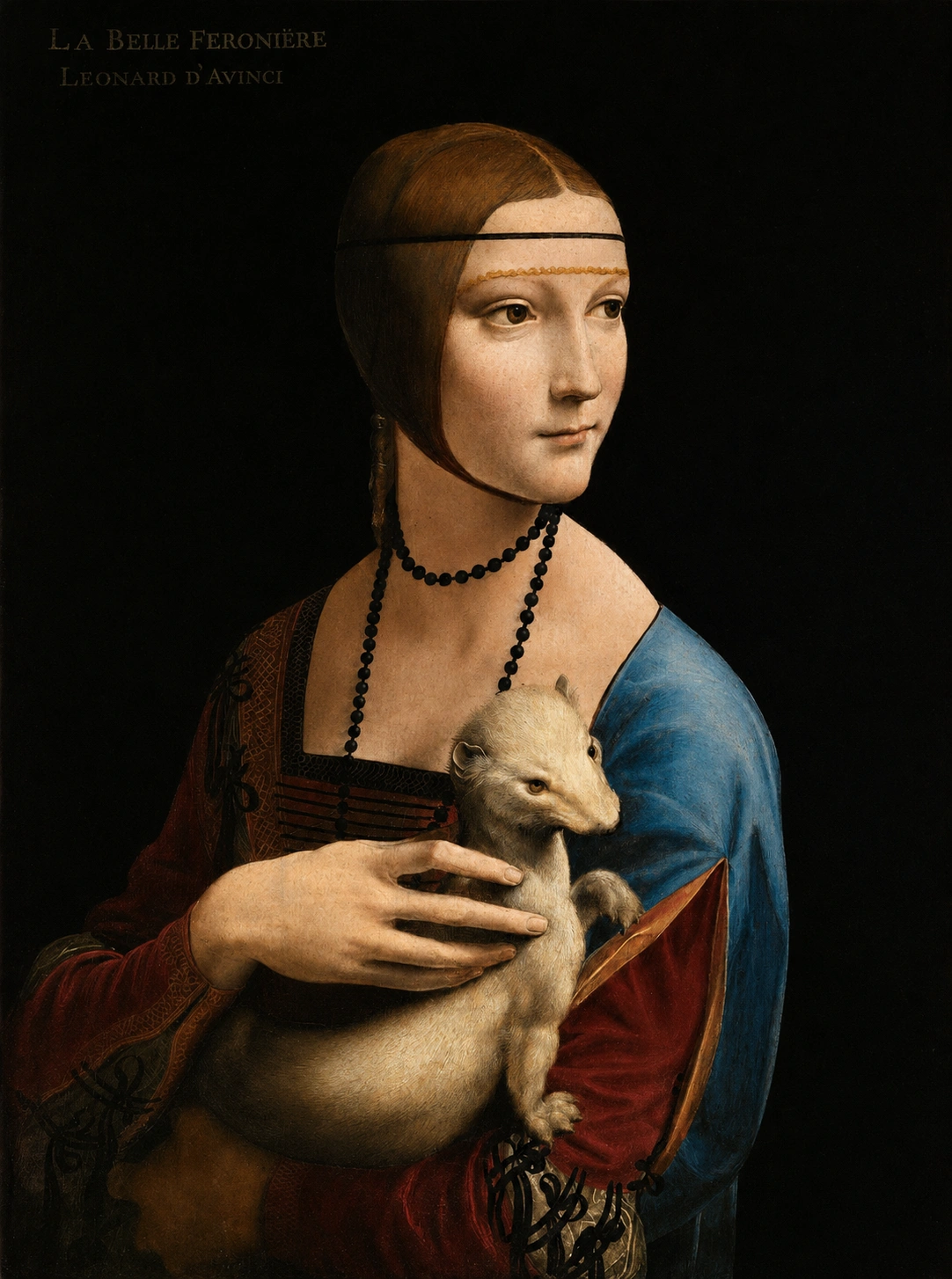
Leonardo da Vinci’s “The Lady with an Ermine,” painted around 1490, is one of the most psychologically compelling portraits of the Italian Renaissance. The painting presents a young woman holding a white ermine against a nearly black background. Although the composition appears simple, Leonardo transforms the scene into a complex study of movement, personality, symbolism, and courtly identity.
The woman is generally identified as Cecilia Gallerani, a cultured young woman associated with the court of Ludovico Sforza, Duke of Milan. Rather than depicting her in a rigid, ceremonial pose, Leonardo shows her reacting to something beyond the edge of the painting. Her body turns in one direction while her face shifts farther to the side, creating a feeling of spontaneous movement. The ermine follows the same motion, giving the portrait an unusual sense of alertness and life.
Cecilia Gallerani and the Milanese Court
Cecilia Gallerani was known for her intelligence, education, and literary interests. She belonged to the sophisticated cultural environment surrounding the Milanese court, where artists, poets, musicians, and scholars gathered under the patronage of Ludovico Sforza.
Leonardo does not emphasize wealth through elaborate jewelry or an excessively decorative setting. Instead, Cecilia’s refinement appears through her composed expression, carefully arranged clothing, and graceful posture. Her dark necklace frames the pale skin of her neck and chest, while her dress combines deep red, brown, and blue fabrics. These restrained details suggest elegance without distracting from her face.
Her expression is calm but attentive. The slight lift at the corners of her mouth suggests intelligence and private awareness rather than an obvious smile. Leonardo presents Cecilia as a thinking person whose attention has been captured by something outside the viewer’s sight.
A Composition Filled with Movement
One of the painting’s most innovative qualities is its twisting composition. Cecilia’s torso faces partly toward the viewer, but her head turns sharply toward the right. Her gaze continues this movement, leading the eye beyond the picture frame.
The ermine mirrors her pose. Its body rests across her arms while its head turns in the same direction. This repeated motion creates a visual connection between the woman and the animal. They appear to respond to the same sound, person, or event.
Leonardo’s use of movement separates the portrait from more traditional Renaissance images in which sitters appear frontal or in strict profile. Cecilia seems to have been captured during a passing moment. The viewer feels that she has just turned and might move again. This sense of change gives the painting an almost cinematic quality.
The dark background intensifies the effect. With no architecture, landscape, or furniture to define the setting, Cecilia and the ermine emerge as the only points of attention. Their pale faces and bodies appear illuminated within a surrounding darkness.
The Meaning of the Ermine
The ermine is the most distinctive symbol in the portrait. In Renaissance culture, the animal was associated with purity, moderation, and nobility. According to traditional beliefs, the ermine valued the cleanliness of its white fur so highly that it would rather be captured than enter muddy water.
The animal may also refer to Ludovico Sforza, who was connected with the Order of the Ermine. Its presence could therefore link Cecilia to the duke while preserving the outward dignity of the portrait.
There may also be a wordplay involving Cecilia’s surname. The ancient Greek word for ermine, “galē,” resembles “Gallerani.” Renaissance artists and patrons often enjoyed visual puns, symbolic references, and layered meanings. The ermine could therefore function as a personal emblem as well as a symbol of virtue and courtly association.
There may also be a wordplay involving Cecilia’s surname. The ancient Greek word for ermine, “galē,” resembles “Gallerani.” Renaissance artists and patrons often enjoyed visual puns, symbolic references, and layered meanings. The ermine could therefore function as a personal emblem as well as a symbol of virtue and courtly association.
The Expressive Power of the Hands
Cecilia’s right hand is one of the most beautifully observed elements in the painting. Her long fingers rest across the ermine’s body with controlled delicacy. The hand does not grip the animal tightly. Instead, it gently contains its movement.
The fingers repeat the elegant curves found throughout the composition. Their length and placement guide the viewer’s eye toward the animal’s head and then upward toward Cecilia’s face. This creates a flowing rhythm connecting the sitter, the ermine, and the unseen object of their attention.
Leonardo understood that hands could reveal character. Cecilia’s gesture suggests refinement, confidence, and tenderness. At the same time, the firm positioning of her fingers indicates control. The contrast between the woman’s graceful hand and the animal’s visible claws introduces a subtle tension between gentleness and contained energy.
Light, Color, and Texture
Leonardo uses light to shape Cecilia’s face, neck, hand, and the body of the ermine. The illumination is soft rather than dramatic. Gradual transitions between light and shadow give the figures a rounded, sculptural appearance.
The pale skin of Cecilia and the creamy fur of the animal stand out against the dark background. Their similar tones strengthen their visual relationship. However, Leonardo distinguishes them through texture. Cecilia’s skin appears smooth and carefully modeled, while the ermine’s fur is suggested through fine shifts in tone and delicate brushwork.
The blue sleeve provides the strongest area of color. Its cool tone contrasts with the warmer red and brown fabrics of the dress. These colors remain deep and controlled, preserving the portrait’s quiet atmosphere.
Leonardo’s subtle shading softens hard outlines. The face does not appear cut out from the background. Instead, its edges gradually merge with surrounding shadow. This approach anticipates the technique known as sfumato, in which forms are modeled through delicate layers of tone rather than sharp boundaries.
A Psychological Portrait
“The Lady with an Ermine” is remarkable because it creates the impression of an inner life. Cecilia is not merely displaying her social position. She appears to be listening, observing, and thinking.
The unseen presence outside the frame becomes an important part of the painting. Viewers may wonder who has attracted her attention. It could be someone entering the room, a familiar voice, or an important figure at court. Leonardo provides no answer, allowing the moment to remain open and mysterious.
Cecilia’s expression is restrained, but it is not emotionally empty. Her wide eyes, slightly raised brows, and gentle mouth suggest recognition and interest. Leonardo avoids exaggeration, making the portrait feel more believable and intimate.
The ermine intensifies this psychological effect. Because both figures look in the same direction, the animal seems almost like an extension of Cecilia’s awareness. Its alertness reflects her own, creating a shared emotional response.
Renaissance Beauty and Individual Identity
Cecilia’s smooth complexion, high forehead, carefully parted hair, and controlled posture reflect Renaissance ideals of courtly beauty. Yet Leonardo does not reduce her to an idealized type. Small asymmetries in her expression and the specificity of her features preserve her individuality.
Her hairstyle is especially distinctive. The hair is parted in the center and drawn close to the head, with a thin band crossing the forehead. Long sections frame the sides of her face. This controlled arrangement emphasizes the clear geometry of her head and directs attention toward her eyes.
The portrait balances ideal beauty with personal presence. Cecilia appears graceful enough to represent courtly refinement, but alert and individual enough to feel like a real person encountered at a particular moment.
Leonardo’s Achievement
Leonardo transforms a court portrait into an exploration of perception, movement, and character. The painting’s power does not depend on elaborate scenery or obvious drama. Instead, it comes from the relationship between two living beings who suddenly turn toward something outside the image.
The dark background removes distractions, while the twisting poses create energy. The ermine introduces several layers of symbolism without losing its identity as a believable animal. Cecilia’s hand unites the composition through its graceful gesture, and her expression gives the portrait its enduring mystery.
“The Lady with an Ermine” demonstrates Leonardo’s ability to combine scientific observation with poetic suggestion. Anatomy, light, texture, gesture, and psychology work together so naturally that the portrait feels both carefully constructed and spontaneously alive.
Conclusion
“The Lady with an Ermine” remains one of Leonardo da Vinci’s most memorable portraits because it presents identity as something active rather than fixed. Cecilia Gallerani is not simply seated for observation. She is responding to the world beyond the frame.
Her turning body, attentive gaze, and gentle control of the alert ermine create a scene filled with quiet tension. Symbolism connects her to purity, nobility, intelligence, and the Milanese court, while Leonardo’s delicate modeling gives her a vivid physical and psychological presence.
The portrait captures a brief instant that seems capable of continuing. Cecilia may turn farther, speak, smile, or release the animal from her arms. By suggesting what might happen next, Leonardo gives the painting a life beyond its surface.