The Marriage of the Virgin by Raphael: Vibrant Color Edit
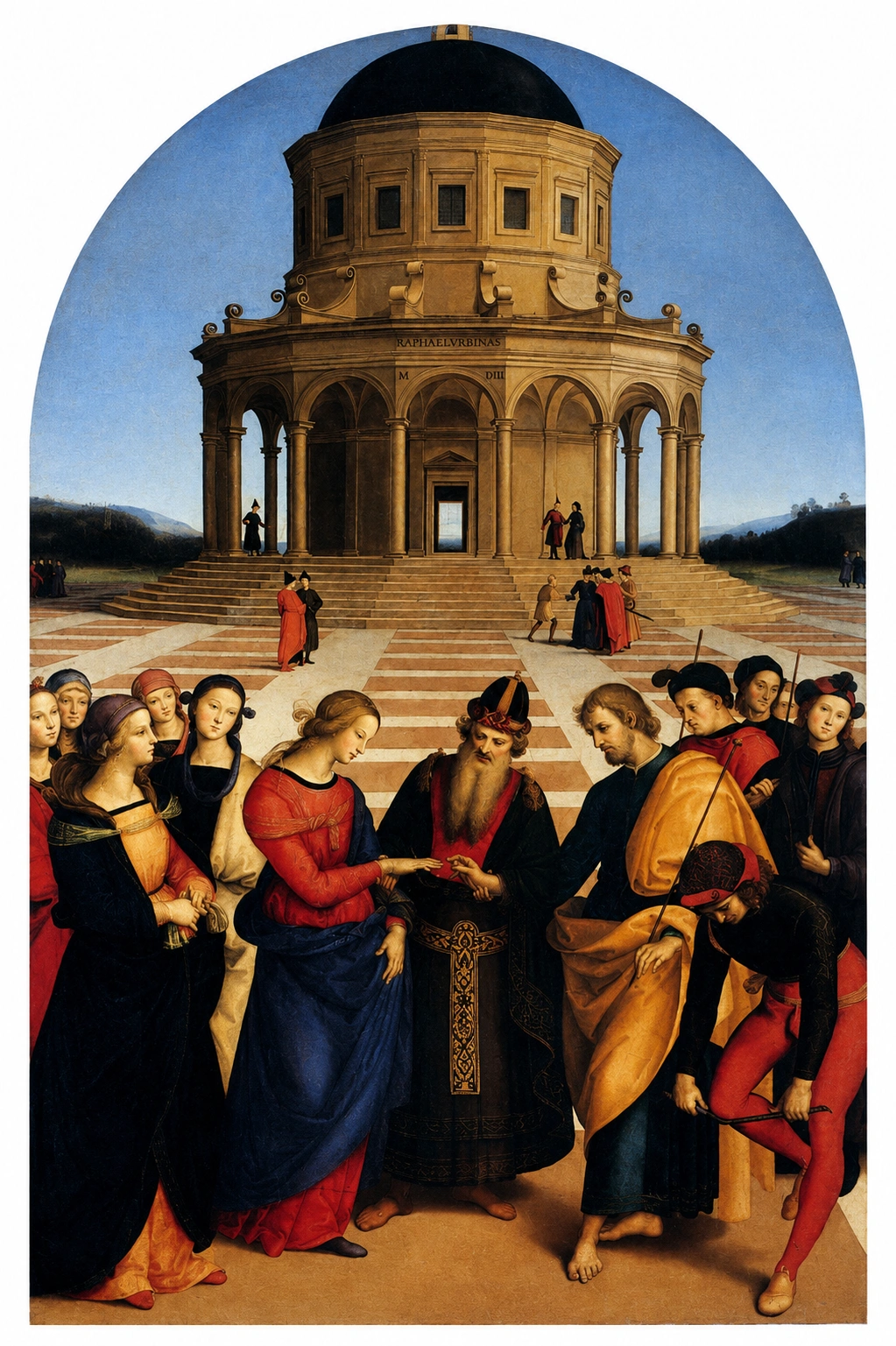
Free to Download & Reuse: You are welcome to use this image! If you republish or share it online, you must include a direct link back to this webpage for attribution.
Original Image Source: wikiart.org
Introduction to “The Marriage of the Virgin” by Raphael
Painted in 1504, “The Marriage of the Virgin” is one of Raphael’s most important early masterpieces. Created when the artist was only about twenty-one years old, the painting reveals both his exceptional technical skill and his growing independence from the artistic traditions that shaped his training. Its carefully balanced figures, luminous colors, precise perspective, and graceful architecture anticipate the harmony that would define Raphael’s mature work.
The scene represents the marriage of the Virgin Mary and Saint Joseph. Raphael transforms the religious event into an ideal vision of order, beauty, and spiritual unity. Every person, gesture, line, and architectural feature contributes to the painting’s calm sense of balance. Although the composition is highly organized, it never feels rigid. Instead, the figures move naturally within a spacious setting that appears both believable and timeless.
The Biblical Story Behind the Painting
The central event is the formal union of Mary and Joseph. A priest stands between them, guiding Joseph’s hand as he places a ring on Mary’s finger. Their marriage is presented not simply as a social ceremony, but as a sacred moment within the Christian story.
Mary stands on the left side of the priest, surrounded by a group of young women. Joseph stands on the right among several male suitors. According to Christian tradition, the men had presented rods as part of a test to determine who would become Mary’s husband. Joseph’s rod miraculously blossomed, indicating that he had been divinely chosen.
Raphael includes this detail by showing Joseph holding a flowering rod. The other men carry rods that have not blossomed. One disappointed suitor bends forward and breaks his rod across his knee. This small but expressive action introduces human frustration into an otherwise serene scene. It also emphasizes the contrast between divine selection and personal desire.
The Central Marriage Ceremony
Mary, Joseph, and the priest form the emotional and visual center of the painting. Their hands meet near the middle of the composition, drawing attention to the exchange of the ring. Raphael makes this quiet gesture more important than any dramatic expression.
Mary lowers her eyes with modesty and composure. Her red dress and dark blue mantle give her a strong visual presence while connecting her to traditional representations of the Virgin. The red suggests love, sacrifice, and earthly life, while the blue is often associated with purity, faith, and heavenly dignity.
Joseph appears older than Mary, as was customary in Renaissance depictions of the subject. His face is thoughtful, and his posture is respectful. He does not dominate the ceremony. Instead, he participates with humility, reinforcing his role as a faithful protector within the Christian narrative.
The priest, positioned directly between the couple, joins their hands and oversees the marriage. His dark, richly decorated robe creates a strong vertical shape at the center. His long beard, elaborate clothing, and ceremonial authority distinguish him from the younger figures surrounding him.
Raphael’s Masterful Use of Composition
The composition of “The Marriage of the Virgin” is built around symmetry, but Raphael avoids making the scene feel mechanical. The priest occupies the central axis, while Mary and Joseph balance each other on either side. The groups of women and men extend outward, creating a broad semicircle across the foreground.
The figures are arranged at different angles rather than standing in a straight line. Some turn toward the ceremony, while others look at their companions or lower their heads. These variations create a natural rhythm and prevent the gathering from appearing frozen.
The central line continues from the priest through the open doorway of the temple and upward toward the building’s dome. This alignment connects the human ceremony in the foreground with the ideal architecture in the background. Raphael suggests that the marriage is part of a larger spiritual order.
The open space between the figures and the temple is equally important. Rather than filling the entire surface with bodies, Raphael allows the plaza to expand into the distance. This gives the sacred event a sense of clarity and calm.
The Temple and Linear Perspective
The circular temple is one of the painting’s most striking features. It rises above the ceremony and dominates the upper half of the composition. Its rounded form, graceful columns, arches, steps, and dome reflect Renaissance interest in ideal architecture.
Raphael uses the temple as the central destination of the painting’s perspective. The lines created by the pavement, steps, and buildings lead toward the open doorway. This doorway marks the vanishing point, creating a convincing illusion of depth.
The geometric design of the plaza demonstrates Raphael’s command of linear perspective. The paving stones gradually become smaller as they approach the temple, while the distant figures are reduced in scale. These techniques create a spacious environment in which architecture and human beings exist in perfect proportion.
The temple may also symbolize spiritual perfection. Its circular plan suggests completeness, eternity, and divine harmony. The building’s open doorway allows the viewer to see the pale sky beyond it, creating the impression that the structure leads toward an infinite spiritual realm.
Color and Light
Raphael’s colors are rich without becoming overwhelming. The strongest reds, blues, yellows, and blacks appear in the foreground, where they help separate the principal figures from one another. Mary’s clothing is especially important, as the combination of red and blue immediately identifies her as the focus of the event.
Joseph’s golden mantle provides a warm contrast to Mary’s cooler blue garment. The priest’s dark robe anchors the center, while the surrounding figures introduce smaller areas of crimson, orange, green, and violet.
The colors become softer toward the background. The temple is painted in warm beige and golden-brown tones, while the sky is a clear, gentle blue. This transition from strong foreground colors to quieter background hues strengthens the impression of distance.
The light is even and controlled. Raphael avoids sharp shadows or dramatic contrasts. This soft illumination allows every important feature to remain visible and contributes to the painting’s peaceful atmosphere.
Gesture, Movement, and Human Emotion
Although the scene is governed by order, Raphael includes subtle expressions of personality. The women beside Mary observe the ceremony with quiet attention. Their tilted heads, delicate faces, and gently folded hands create a mood of reverence.
On Joseph’s side, the rejected suitors respond more actively. Several hold their unsuccessful rods, while the figure breaking his rod displays visible disappointment. His bent posture contrasts with the upright dignity of Mary, Joseph, and the priest.
This moment of frustration prevents the painting from becoming emotionally distant. Raphael acknowledges ordinary human reactions while keeping them subordinate to the sacred ceremony. The rejected man’s movement also helps guide the eye back toward Joseph’s blossoming rod and the divine meaning of his selection.
Raphael and the Influence of Perugino
Raphael’s early style was strongly influenced by Pietro Perugino, one of the leading painters of central Italy. Perugino had created his own version of “The Marriage of the Virgin,” using a similar arrangement of foreground figures, a paved plaza, and a centrally positioned temple.
Raphael adopted this basic structure but made it more unified and convincing. His temple feels more solid, his perspective is more precise, and his figures interact with greater naturalism. The composition also possesses a stronger sense of circular movement.
Rather than simply copying an established model, Raphael refined it. He brought architecture, landscape, and human action into a more complete harmony. The painting therefore marks an important stage in his development from a gifted student into an independent master.
Renaissance Ideals of Harmony and Beauty
“The Marriage of the Virgin” reflects the Renaissance belief that beauty could express divine order. Raphael presents religion through clarity rather than mystery and through harmony rather than emotional intensity.
The mathematical perspective, balanced architecture, graceful figures, and controlled colors all contribute to an ideal world. Human beings are shown as dignified participants in a rational and meaningful universe.
Raphael’s figures are beautiful, but they do not appear artificial. Their beauty comes from proportion, calm expression, and graceful movement. The sacred story becomes emotionally accessible because it is presented through recognizable gestures and relationships.
The painting also unites the earthly and the heavenly. The marriage takes place in a public plaza among ordinary witnesses, yet the architectural setting and perfect composition elevate the event beyond everyday life.
The Lasting Importance of the Painting
“The Marriage of the Virgin” represents a turning point in Raphael’s career. It demonstrates his ability to absorb the lessons of earlier artists while transforming them through his own sense of balance, elegance, and spatial unity.
The painting’s appeal lies in its combination of storytelling and structure. The viewer can appreciate the biblical narrative, the individual reactions of the figures, the beauty of the clothing, and the precision of the architecture. At the same time, all these elements belong to a single harmonious design.
Raphael does not rely on dramatic action to communicate spiritual significance. Instead, he creates a world in which every detail appears measured and purposeful. The joining of Mary and Joseph’s hands becomes the center of an entire visual universe organized around faith, order, and divine intention.
Through its graceful figures, radiant colors, ideal temple, and extraordinary perspective, “The Marriage of the Virgin” announces Raphael’s emergence as one of the defining artists of the Italian Renaissance.