Water Lilies by Claude Monet: Vibrant Color Edit
Free to Download & Reuse: You are welcome to use this image! If you republish or share it online, you must include a direct link back to this webpage for attribution.
Original Image Source: wikiart.org
A Complete Analysis of “Water Lilies” by Claude Monet
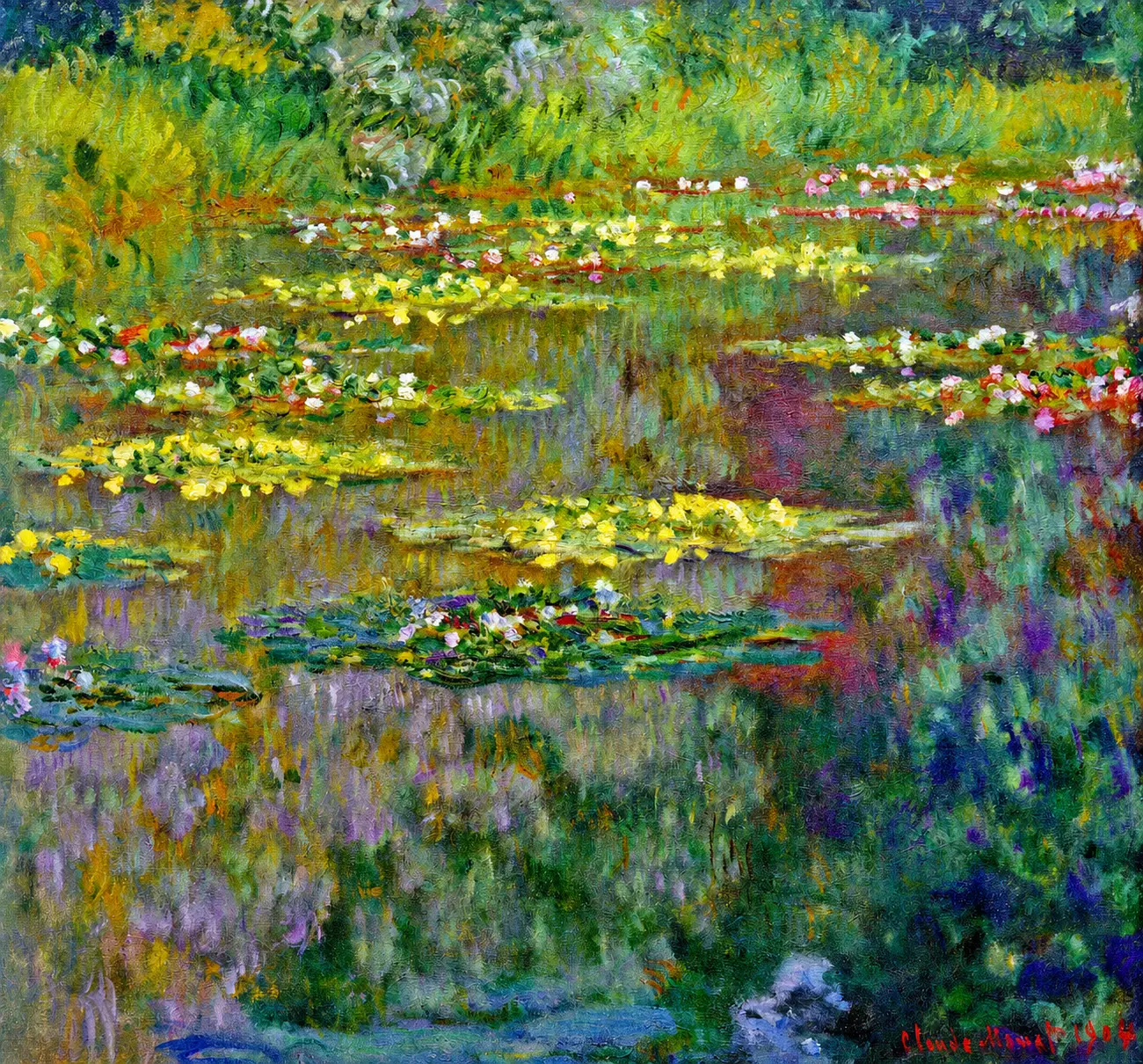
Claude Monet’s “Water Lilies” from 1904 is a radiant example of the artist’s late Impressionist vision, where nature is not simply described but transformed into a field of color, reflection, atmosphere, and sensation. Painted in the garden at Giverny, the work belongs to one of Monet’s most famous and sustained artistic projects: the repeated study of his lily pond. Rather than treating the pond as a conventional landscape with a clear horizon, solid banks, or distant perspective, Monet brings the viewer close to the surface of the water. The painting becomes an intimate encounter with reflected light, floating flowers, and the shifting textures of a living garden.
At first glance, “Water Lilies” appears almost dreamlike. The pond fills the entire composition, and the viewer is not given a stable place to stand. There is no obvious foreground path, no figure, and no architectural marker to organize the scene. Instead, Monet immerses us directly in the watery surface. The lilies drift horizontally across the canvas in irregular bands, while reflections of foliage, sky, and shadow ripple beneath them. This creates a subtle tension between depth and flatness. The water seems to recede into space, yet the brushwork constantly reminds us that we are looking at paint layered across canvas.
Color, Light, and Reflection
The color palette of this 1904 “Water Lilies” is especially lush. Greens, violets, blues, yellows, pinks, and whites move across the image in delicate variations. Monet avoids rigid outlines, allowing colors to blend, vibrate, and dissolve into one another. The greens of the surrounding vegetation are not uniform; they shift from cool turquoise to mossy olive, from pale yellow-green to darker blue-green. These variations suggest both the plants themselves and their reflection in the pond.
The water is not painted as a single transparent surface. It is a complex mirror that captures fragments of the garden above and around it. Lavender and violet tones suggest reflected sky or shadowed foliage, while warmer golds and oranges bring a sense of sunlight filtering through leaves. The water lilies themselves appear as small, bright accents, often touched with white, pink, or yellow. They punctuate the surface like living notes in a visual melody.
Monet’s treatment of light is central to the painting’s emotional effect. Nothing feels fixed. The pond seems to shimmer in real time, as if a breeze, passing cloud, or changing angle of sunlight might alter the entire scene. This sensitivity to fleeting perception is one of the defining qualities of Impressionism, but in Monet’s late work it becomes even more immersive. He is not only painting what he sees; he is painting the experience of seeing as it unfolds moment by moment.
Composition and Space
The composition of “Water Lilies” is striking because it removes many traditional landscape conventions. Earlier landscape painting often relied on a horizon line, a deep recession into the distance, and a balanced arrangement of land, sky, and figures. Monet rejects those expectations here. The pond occupies nearly everything. The upper area is filled with dense reflected greenery, while the lower area becomes more mysterious and abstract, full of darker blues, purples, and soft vertical strokes.
The lily pads form loose horizontal rhythms across the painting. Some appear as clustered islands, while others dissolve into small flecks of color. This structure gives the image movement without making it feel chaotic. The eye travels from one patch of flowers to another, then slips into the reflections between them. The result is a composition that feels open, fluid, and continuous, as though the scene extends beyond the edges of the canvas.
This lack of a single focal point is important. Monet encourages the viewer to look slowly rather than search for one central subject. The entire painting is the subject. The lilies, reflections, colors, and brushstrokes work together to create an environment. In this sense, “Water Lilies” anticipates later developments in modern art, especially the move toward all-over composition and abstraction. Yet the painting remains rooted in direct observation of nature.
Brushwork and Texture
The brushwork in “Water Lilies” is energetic but controlled. Monet uses short touches, soft dabs, sweeping marks, and layered strokes to suggest the changing surface of the pond. In some areas, the paint appears thick and textured, especially where flowers or bright reflections catch the light. In other areas, the strokes are more diffuse, creating a misty sense of depth.
The lower right area of the painting contains darker, cooler tones that contrast beautifully with the brighter lily clusters. These shadowed passages prevent the painting from becoming merely decorative. They give the water a sense of depth and mystery. The viewer senses that beneath the luminous surface there is another world of submerged plants, reflected branches, and shifting darkness.
Monet’s brushwork also helps blur the difference between object and reflection. A lily pad may be partly defined by green paint, but it may also merge into surrounding strokes of blue or violet. A flower may appear as a small white mark, yet that mark gains meaning through its placement among greens and pinks. This is one of Monet’s great achievements in the series: he shows how vision is built from relationships of color and light rather than from hard outlines.
The Garden at Giverny
Monet’s garden at Giverny was not only a place of leisure; it was a living studio. He designed and cultivated the water garden with great care, arranging plants, flowers, and reflections as sources of endless visual discovery. By 1904, the lily pond had become one of his most important subjects. It offered him a world that was both natural and carefully shaped, spontaneous and composed.
In “Water Lilies,” the garden is present without being fully shown. We do not see the entire pond, the bridge, or the surrounding paths. Instead, we experience the garden through its reflected presence. This gives the painting a deeply poetic quality. The visible world appears indirectly, broken and reassembled by water. Monet turns reflection into a subject as important as the flowers themselves.
This approach also changes the mood of the painting. There is no narrative action, yet the image feels alive. Its drama comes from light, color, and perception. The lilies float quietly, but the painting is full of movement. The scene feels peaceful without being still.
Meaning and Artistic Importance
“Water Lilies” by Claude Monet is often admired for its beauty, but its importance goes beyond beauty alone. The painting represents a major shift in how landscape could be understood. Monet does not present nature as a stable view to be possessed. He presents it as an experience that changes with time, weather, light, and attention.
The work also shows Monet’s late style moving toward abstraction while remaining attached to the natural world. The viewer can recognize water lilies, pond reflections, and garden vegetation, but the painting also invites appreciation as a surface of color and rhythm. This balance between representation and abstraction is one reason Monet’s water lily paintings continue to feel modern.
The 1904 “Water Lilies” captures the essence of Monet’s genius: his ability to turn a simple pond into an expansive world of visual sensation. The painting asks us to slow down and notice the subtle instability of beauty. Every reflection is temporary. Every color is affected by the colors around it. Every brushstroke contributes to the feeling of a moment passing before our eyes.
Through this work, Monet transforms the surface of water into a space of meditation. “Water Lilies” is not just a painting of flowers on a pond. It is a painting about light becoming color, nature becoming perception, and vision becoming art.