The Last Judgement by Michelangelo: Vibrant Color Edit
Free to Download & Reuse: You are welcome to use this image! If you republish or share it online, you must include a direct link back to this webpage for attribution.
Original Image Source: wikiart.org
Introduction to “The Last Judgement” by Michelangelo
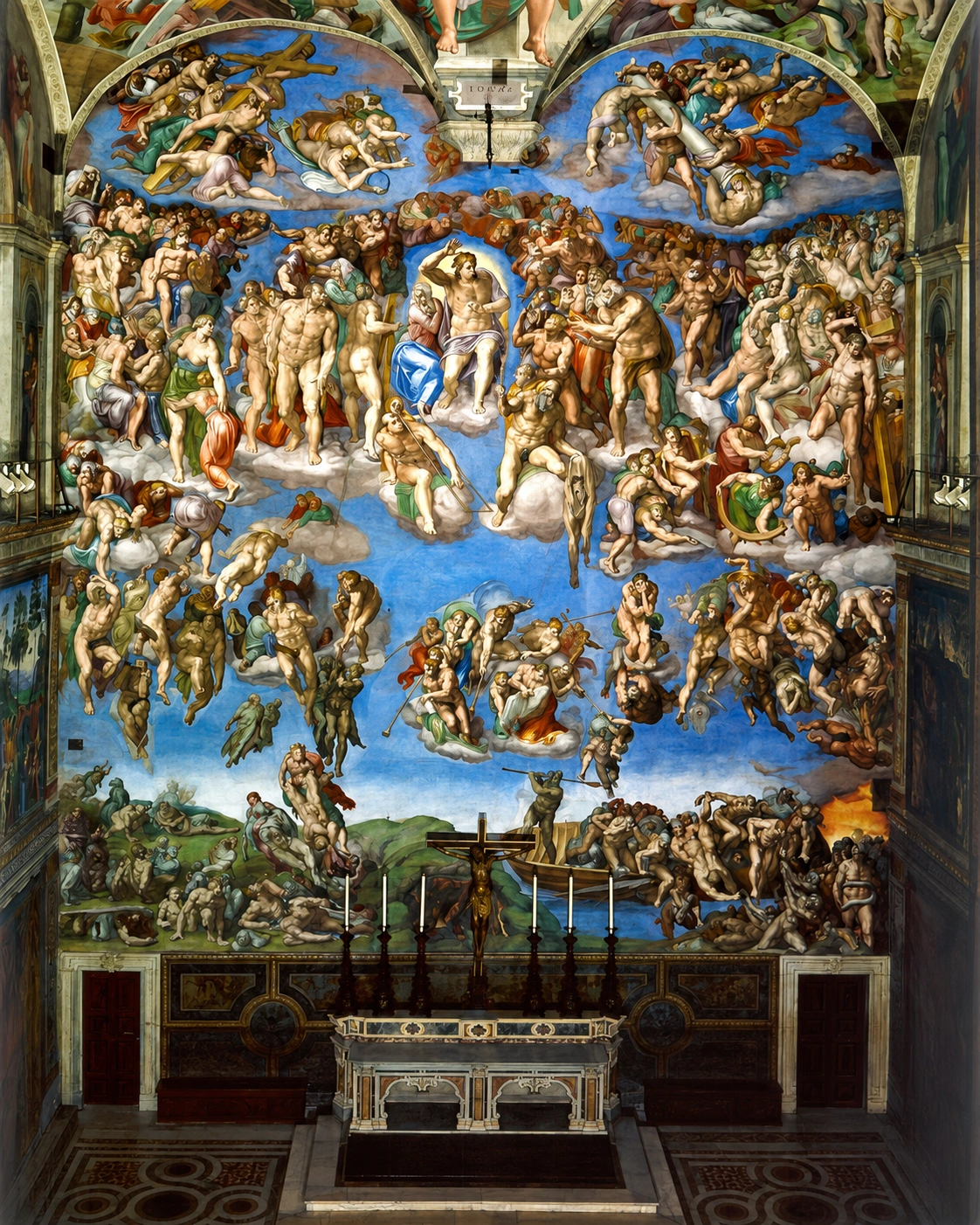
Michelangelo’s “The Last Judgement,” completed in 1541, is one of the most ambitious and emotionally overwhelming works of the Italian Renaissance. Painted across the altar wall of the Sistine Chapel in Vatican City, the enormous fresco presents the final judgment of humanity as described in Christian tradition. Christ appears at the center, summoning the dead, rewarding the saved, and condemning the damned.
Rather than presenting the event as a calm and orderly divine ceremony, Michelangelo created a universe filled with movement, uncertainty, fear, and spiritual tension. Hundreds of human bodies twist, rise, fall, struggle, and cling to one another. The composition feels as though it is being driven by a supernatural force that reaches every corner of the wall.
The painting reflects Michelangelo’s extraordinary understanding of anatomy, but it also reveals his increasingly serious view of religion and mortality. Created decades after the ceiling of the Sistine Chapel, “The Last Judgement” belongs to a later and more troubled period of the artist’s life. Its heroic bodies remain powerful, yet they inhabit a darker world in which salvation is uncertain and divine judgment cannot be avoided.
The Monumental Composition
The composition is organized around the commanding figure of Christ. He stands near the center of the fresco, surrounded by a dense circle of saints, martyrs, angels, and blessed souls. His raised arm suggests that the moment of judgment has already begun. The gesture appears to drive the entire composition, sending some figures upward toward salvation while pushing others downward toward punishment.
Michelangelo avoided using rigid architectural divisions to separate heaven, earth, and hell. Instead, he created a continuous field of bodies against a broad blue background. Clouds provide loose platforms for groups of figures, but the overall scene remains open and unstable. This lack of clear boundaries contributes to the painting’s atmosphere of urgency.
The upper part of the fresco contains angels carrying the instruments associated with Christ’s crucifixion. On the left, angels hold the cross, while those on the right carry the column used during the flagellation. These objects connect the final judgment with Christ’s suffering and sacrifice.
Below Christ, angels sound trumpets to awaken the dead. Figures rise from the ground at the lower left, gradually recovering their bodies as they prepare to face judgment. On the opposite side, condemned souls are dragged downward. The arrangement creates a powerful circular rhythm, with the saved generally rising along the left and the damned falling along the right.
Christ as the Judge of Humanity
Michelangelo’s Christ differs greatly from the gentle and compassionate figure often found in Renaissance religious painting. He is muscular, youthful, and physically commanding. His body resembles that of an ancient hero or classical god, reflecting Michelangelo’s admiration for Greco-Roman sculpture.
Christ’s raised right arm is the most important gesture in the fresco. It appears both protective and threatening. The movement may be interpreted as a declaration of divine authority, a rejection of the damned, or the beginning of the final separation between salvation and punishment. His powerful torso and turning body make him the source of the painting’s energy.
A glowing area of light surrounds Christ, separating him from the crowded figures nearby. He is not seated on a throne, nor does he hold traditional symbols of royal authority. His power is expressed entirely through his body, position, and gesture.
Beside him is the Virgin Mary. She turns inward and lowers her gaze, appearing unable or unwilling to intervene in the judgment. In earlier Christian imagery, Mary often acted as a compassionate intercessor for humanity. Here, however, the time for mercy appears to have passed. Her withdrawn posture reinforces the seriousness and finality of the event.
Saints, Martyrs, and Symbols
The saints surrounding Christ can often be identified by the instruments connected with their martyrdom. These objects are not merely decorative attributes. They remind viewers of the suffering endured by the faithful and of the physical cost of spiritual devotion.
Saint Peter appears near Christ holding the keys to heaven. His presence is especially important within the Vatican, where he was regarded as the first pope and the foundation of papal authority. Other figures display crosses, arrows, wheels, and various instruments associated with their deaths.
One of the most memorable figures is Saint Bartholomew, who holds a knife in one hand and his flayed skin in the other. Michelangelo placed a distorted self-portrait within the hanging skin. The face appears weary, empty, and emotionally vulnerable.
This unusual self-portrait has inspired many interpretations. It may express Michelangelo’s anxiety about death, salvation, and the judgment of his own soul. Rather than representing himself as a heroic artist, he appears as a lifeless outer covering held by a saint. The image introduces an intensely personal note into the vast religious drama.
The Resurrection of the Dead
The lower left section shows the resurrection of the dead. Michelangelo presents the event as a gradual physical transformation. Some figures appear as skeletons, while others are in the process of regaining flesh and strength. Several souls struggle to emerge from the earth, assisted by angels or other resurrected figures.
The scene demonstrates Michelangelo’s ability to communicate spiritual ideas through the human body. Resurrection is not represented through abstract symbols. It becomes a muscular, physical event filled with effort and tension.
One figure is lifted upward by a rosary, suggesting the importance of prayer and faith in achieving salvation. Other souls cling to those already rising, hoping to escape the forces pulling them downward. The saved do not ascend effortlessly. Their movement often requires assistance, reflecting the difficulty and uncertainty of the journey toward heaven.
The bodies vary in pose and emotional state. Some appear confused, others hopeful, and still others astonished. Michelangelo transforms the resurrection into a deeply human experience in which fear and hope exist together.
The Descent of the Damned
The right side of the fresco contains some of its most disturbing scenes. Condemned souls are seized by demons, pulled from clouds, and forced downward. Their muscular bodies struggle violently, but resistance is useless.
One particularly powerful figure covers part of his face while demons surround him. His expression conveys despair rather than physical pain. He seems to understand the permanence of his fate. This psychological awareness makes the scene especially moving.
At the bottom right, Michelangelo included imagery inspired by Dante’s “Divine Comedy.” Charon, the boatman of the underworld, strikes the condemned as he forces them from his boat. Nearby, Minos judges the souls and directs them toward punishment.
Michelangelo gave Minos the features of Biagio da Cesena, a papal official who reportedly criticized the fresco’s nudity. The artist added donkey ears and a serpent to the figure, transforming the critic into a grotesque guardian of hell. This detail reveals Michelangelo’s sharp sense of humor and his willingness to respond to criticism through art.
The Importance of the Human Body
The human body is the primary language of “The Last Judgement.” Michelangelo uses anatomy, gesture, and physical movement to express spiritual conditions. The saved possess strength and energy, while the damned twist in fear and desperation. Every emotional response is communicated through posture and muscular tension.
The abundance of nude figures originally caused controversy. Some viewers believed that such nudity was inappropriate for a sacred chapel. After Michelangelo’s death, sections of drapery were painted over several bodies. These later additions reflected changing religious attitudes during the Counter-Reformation.
Yet the nudity serves an important purpose. Before divine judgment, wealth, status, clothing, and worldly identity no longer matter. Humanity appears exposed and equal before Christ. Kings, saints, ordinary people, and sinners are judged according to their souls rather than their earthly positions.
Michelangelo’s bodies are often exaggerated, with massive muscles and complex poses. This gives the fresco a sculptural quality. The figures appear carved from light and shadow, reflecting the artist’s lifelong belief that sculpture was the highest form of art.
Color, Movement, and Emotional Intensity
The large blue background allows the warm tones of the bodies and clothing to stand out clearly. Areas of red, orange, green, and brilliant blue create visual accents throughout the crowded composition. The Virgin Mary’s deep blue garment, for example, draws attention to her position beside Christ.
Movement is continuous across the surface. No figure appears completely at rest. Bodies turn, bend, reach, fall, and rise. This restless motion creates a sense that the entire universe has been awakened by Christ’s gesture.
The emotional intensity distinguishes the fresco from the more balanced and harmonious ideals associated with the High Renaissance. Michelangelo’s figures are monumental, but they are not peaceful. Their uncertainty anticipates the dramatic distortions and spiritual anxiety of Mannerism.
The Lasting Power of “The Last Judgement”
“The Last Judgement” remains one of Michelangelo’s greatest achievements because it combines monumental scale with profound emotional complexity. It is both a public statement of Christian belief and a personal meditation on mortality.
The fresco does not offer an easy vision of salvation. Even the blessed appear anxious, while Christ’s forceful gesture dominates the scene with terrifying authority. Michelangelo presents judgment as a moment when every illusion of control disappears.
Through hundreds of expressive bodies, he created a vision of humanity confronting its final destiny. The result is not simply an illustration of religious doctrine. It is a timeless exploration of fear, hope, guilt, justice, and the desire for redemption.