Water Lilies by Claude Monet: Vibrant Color Edit
Free to Download & Reuse: You are welcome to use this image! If you republish or share it online, you must include a direct link back to this webpage for attribution.
Original Image Source: wikiart.org
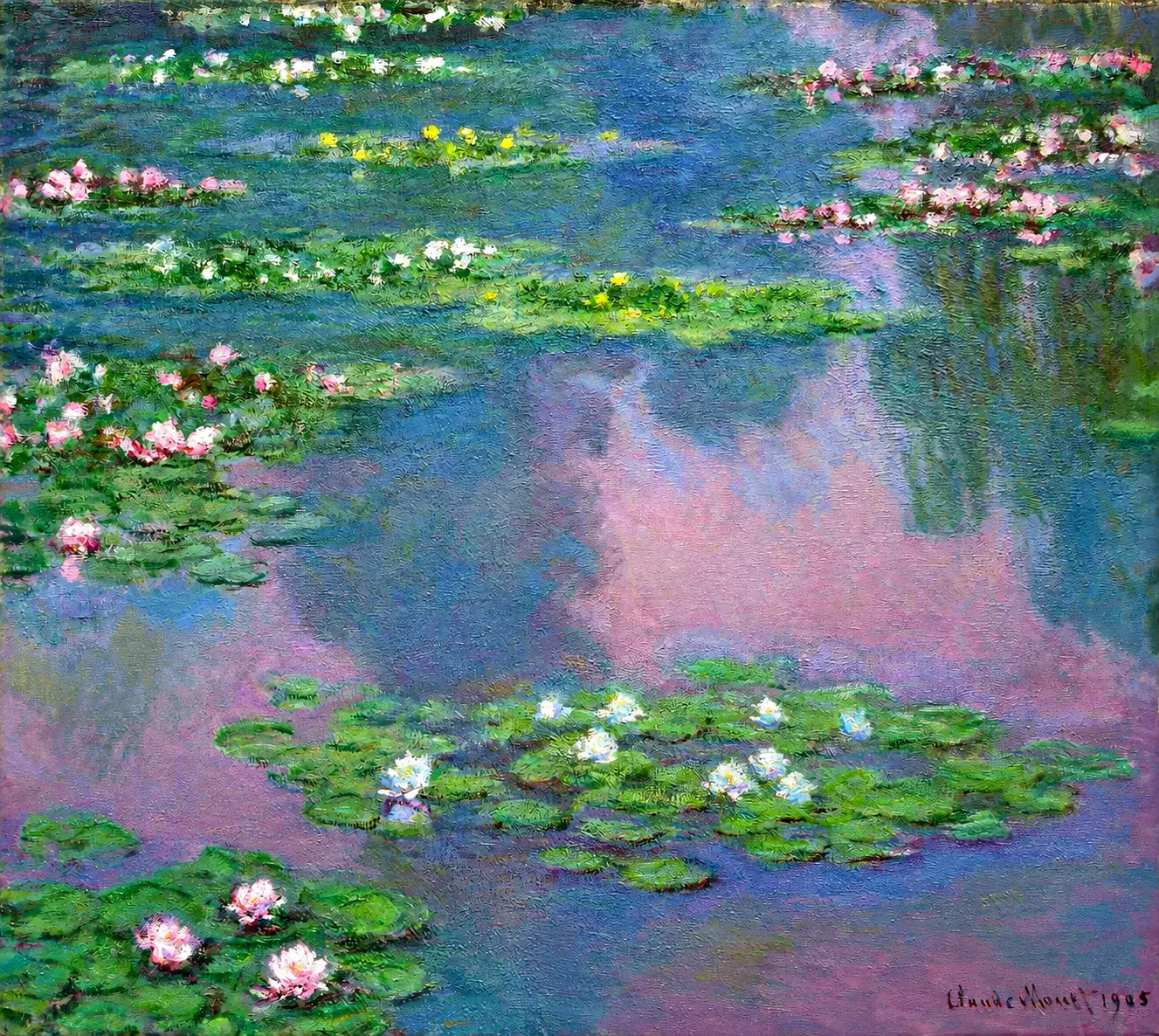
Claude Monet’s “Water Lilies” from 1905
Claude Monet’s “Water Lilies” from 1905 is a luminous example of the artist’s late fascination with the pond at his garden in Giverny. By this point in his career, Monet had moved far beyond the simple recording of a landscape. He was no longer painting a place as a fixed scene seen from a stable distance. Instead, he was painting sensation itself: the shimmer of water, the drifting movement of lilies, the softness of reflected sky, and the changing atmosphere that turns nature into color.
The painting presents a pond covered with clusters of lily pads and blossoms. There is no traditional horizon, no firm bank, and no clear division between earth, water, and sky. The viewer is placed directly above or beside the water’s surface, looking into a space that seems both shallow and infinite. This compositional choice is one of the reasons Monet’s “Water Lilies” paintings feel so modern. Rather than leading the eye toward a distant vanishing point, the image spreads outward across the surface, encouraging slow looking and quiet immersion.
Composition and Visual Structure
The composition is built around horizontal bands of floating vegetation and open water. Lily pads gather in loose clusters across the upper portion, middle distance, and lower foreground. These patches create rhythm without forming a strict pattern. The eye moves from one group of blossoms to another, crossing the pond in a gentle, wandering motion.
The lower left corner contains some of the most solid forms in the painting. The lily pads there are larger, darker, and more clearly defined, giving the viewer a point of entry into the scene. From there, the forms become softer and more atmospheric. In the center, the water opens into a reflective field of pink, lavender, blue, and gray. This open space is essential because it prevents the painting from becoming too crowded. It allows the surface to breathe.
Monet’s refusal to include a conventional shoreline makes the pond feel endless. The painting becomes less a view of a garden and more a fragment of nature enlarged into an entire world. This approach gives “Water Lilies” its meditative power. The viewer is not asked to look at a landscape from outside it, but to enter a floating, reflective environment.
Color, Light, and Reflection
Color is the emotional center of this painting. Monet uses greens, blues, violets, pinks, whites, and soft yellows to capture the unstable beauty of light on water. The greens of the lily pads vary from deep emerald to yellow green, suggesting leaves seen at different angles and under different intensities of light. The blossoms, mostly white and pink, appear like small bursts of brightness across the surface.
The water itself is not painted as a single blue or gray area. It is a complex mixture of reflected sky, shadow, submerged depth, and surface shimmer. Lavender and rose tones dominate the central reflection, giving the pond a dreamy, almost floral atmosphere. These colors may suggest clouds, sky, or nearby vegetation mirrored in the water, but Monet leaves them deliberately ambiguous. Reflection becomes less a literal copy of the world above and more a field of pure visual sensation.
The painting’s beauty comes from this uncertainty. We are never completely sure whether we are looking at the surface of the pond, the depths beneath it, or the world reflected upon it. Monet turns water into a meeting place between reality and perception.
Brushwork and Texture
Monet’s brushwork is loose, layered, and expressive. The strokes remain visible throughout the painting, reminding us that this image is not a polished illusion but a painted surface. The lily pads are formed through quick, broken marks of green, blue, yellow, and dark accents. The flowers are built with small touches of white, pink, and violet, often appearing as flickers rather than carefully outlined botanical forms.
This technique reflects Monet’s Impressionist roots, but by 1905 his handling had become freer and more atmospheric. The brushstrokes do not merely describe objects. They create movement, vibration, and light. Some areas feel almost abstract, especially in the central reflection where the forms dissolve into soft vertical veils and hazy color transitions.
The visible canvas texture also adds to the effect. It gives the water a tactile quality, even though water itself is fluid and unstable. This tension between material paint and immaterial light is one of the great achievements of Monet’s late work. He uses thickened texture and broken color to suggest something that cannot be held still.
The Giverny Garden as Artistic World
Monet’s water lily pond at Giverny was not simply a natural subject he discovered. It was an environment he helped create. He designed and cultivated the garden with extraordinary care, shaping it into a living studio where he could study water, flowers, reflections, and seasonal change. The pond became one of the central subjects of his later life.
In “Water Lilies” from 1905, the garden is not presented as a decorative setting. It becomes a complete artistic universe. Monet is not interested in showing paths, figures, architecture, or anecdotal details. He removes anything that might distract from the act of seeing. What remains is the pond’s surface, transformed into a field of light and color.
This focus gives the painting a quiet intensity. Nothing dramatic is happening, yet everything is changing. The water shifts, the flowers float, the reflections blur, and the colors seem to breathe. Monet captures a moment that feels temporary, but he also gives it a timeless quality.
Impressionism Moving Toward Abstraction
Although Monet is one of the central figures of Impressionism, “Water Lilies” from 1905 points beyond Impressionism toward modern abstraction. The painting still represents a recognizable subject, but the subject is no longer organized according to traditional landscape rules. There is no deep recession, no central figure, and no narrative. Instead, the painting emphasizes surface, rhythm, color, and visual experience.
This is why Monet’s late water lily paintings were so influential for later modern artists. Their all-over compositions and atmospheric fields of color anticipated concerns that would become important in twentieth-century painting. In this work, the pond is both real and nearly abstract. The lily pads give the viewer enough visual information to recognize the scene, while the reflections invite the eye into a more poetic and less literal space.
The result is a painting that feels calm but radical. Monet does not need dramatic distortion to modernize landscape painting. He simply changes the way the viewer sees.
Mood and Meaning
The mood of “Water Lilies” is contemplative, intimate, and quietly radiant. The painting invites patience. It does not reveal itself through a single focal point. Instead, it asks the viewer to move slowly across the surface, noticing small changes in tone, touch, and reflection.
There is also a sense of transience. The flowers are delicate, the reflections are unstable, and the light appears to be passing. Monet’s subject is not only the pond, but the fragile experience of perception. He paints the world as something constantly changing, something that can be felt more than possessed.
This gives the painting emotional depth. It is beautiful, but not merely decorative. It suggests the passage of time, the quietness of age, and the artist’s lifelong devotion to observing nature. Monet turns a garden pond into a meditation on vision itself.
Why “Water Lilies” Still Matters
Claude Monet’s “Water Lilies” from 1905 remains powerful because it balances natural beauty with artistic innovation. It is immediately appealing because of its flowers, color, and peaceful atmosphere, yet it is also deeply experimental in its structure. Monet removes the horizon, dissolves solid forms, and transforms reflection into the true subject of the painting.
The work shows an artist at the height of his sensitivity, using color and brushwork to capture an experience that words can only partly describe. The pond is still, but the painting is alive. Its lilies float across a world of green, pink, blue, and violet, creating an image that feels both specific to Giverny and universal in its emotional calm.
“Water Lilies” is not simply a painting of flowers on water. It is a painting about looking, feeling, and becoming absorbed in the changing beauty of the visible world.