The Milkmaid by Johannes Vermeer: Vibrant Color Edit
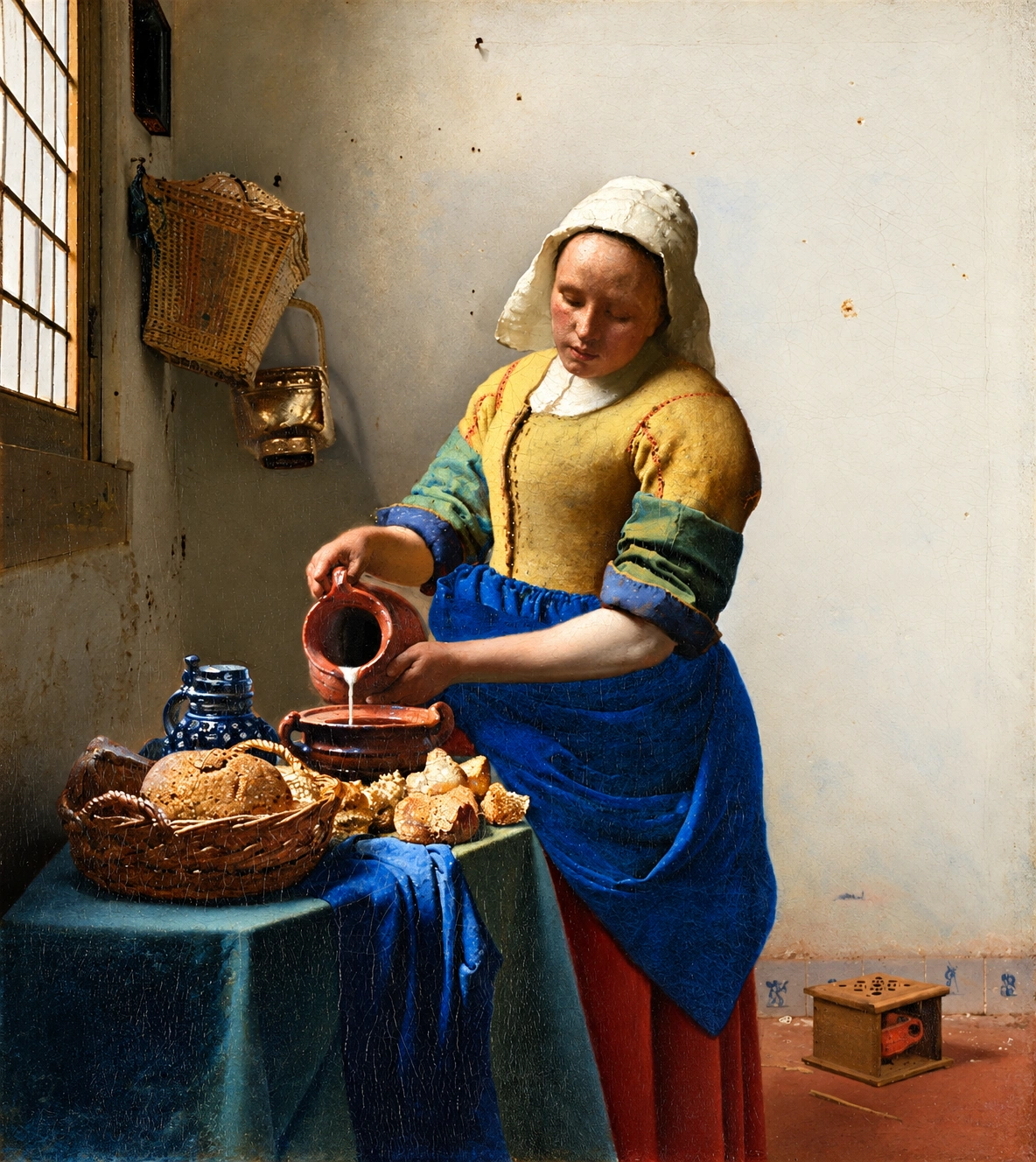
Free to Download & Reuse: You are welcome to use this image! If you republish or share it online, you must include a direct link back to this webpage for attribution.
Original Image Source: wikiart.org
Introduction to The Milkmaid by Johannes Vermeer
The Milkmaid, painted around 1658–1660 by Johannes Vermeer, is one of the most celebrated masterpieces of the Dutch Golden Age. This remarkable painting transforms an ordinary domestic activity into a scene of extraordinary beauty, dignity, and quiet contemplation. Through his exceptional treatment of natural light, vibrant colors, and carefully balanced composition, Vermeer captures a fleeting moment of everyday life with an intimacy that continues to fascinate viewers centuries later.
The painting depicts a young woman standing in a modest kitchen, carefully pouring milk from an earthenware jug into a ceramic bowl. Although the action appears simple, Vermeer elevates it through his masterful observation of textures, gestures, and atmospheric effects. The result is a composition that celebrates domestic labor while inviting deeper reflections on patience, concentration, and the significance of ordinary human experience.
Historical Context and the Dutch Golden Age
Johannes Vermeer created The Milkmaid during the Dutch Golden Age, a period of remarkable economic prosperity and artistic achievement in the Netherlands. During the seventeenth century, Dutch artists increasingly turned their attention toward everyday subjects, including domestic interiors, household activities, landscapes, and scenes of ordinary citizens. This growing interest reflected a society in which prosperous merchants and middle-class households became important patrons of the arts.
Unlike many European painters who concentrated on religious narratives or aristocratic portraits, Vermeer found inspiration in the quiet interiors of Dutch homes. His paintings frequently feature women engaged in familiar activities, such as reading letters, playing musical instruments, or performing household duties. These seemingly unremarkable moments become captivating through his sophisticated manipulation of light, perspective, and color.
The Milkmaid is particularly significant because its central figure appears to be a domestic servant rather than a wealthy member of society. Vermeer’s decision to devote such careful artistic attention to a working woman distinguishes the painting from conventional representations of social status and privilege. By portraying her with dignity and seriousness, he encourages viewers to appreciate the beauty and importance of everyday labor.
Composition and the Art of Simplicity
The composition of The Milkmaid is remarkably simple, yet every element contributes to its visual harmony. The woman occupies the central portion of the painting, standing behind a wooden table covered with bread, baskets, and ceramic vessels. Her body forms a stable vertical presence, while the horizontal surface of the table establishes a complementary structure that creates balance throughout the scene.
Vermeer directs the viewer’s attention toward the woman’s hands and the delicate stream of milk flowing from the jug. Her downward gaze reinforces this focal point, creating a natural visual connection between her expression and the activity she performs. The surrounding objects remain carefully arranged, supporting the central action without overwhelming it.
The painting’s relatively uncluttered background is equally important to its effectiveness. A pale wall, a small window, and a few modest household objects provide enough information to establish the setting without distracting from the woman. Through this restrained arrangement, Vermeer creates an atmosphere of stillness that makes the smallest details feel meaningful.
The Extraordinary Use of Natural Light
One of the most remarkable aspects of The Milkmaid is Vermeer’s extraordinary handling of natural light. Sunlight enters through a window positioned on the left side of the composition, illuminating the woman’s face, clothing, and the objects arranged across the table. This directional lighting produces subtle transitions between brightness and shadow, giving the figures and objects a convincing sense of physical presence.
The light appears especially beautiful as it falls across the woman’s yellow bodice and blue apron. These brightly colored garments contrast with the muted tones of the surrounding interior, making the central figure stand out against the pale background. The illuminated fabric also reveals Vermeer’s sensitivity to texture, as individual folds and surfaces respond differently to the incoming sunlight.
The wall behind the woman demonstrates his ability to transform an apparently empty surface into a visually engaging element. Rather than presenting a perfectly uniform background, Vermeer introduces delicate variations in tone and illumination that suggest the irregular texture of plaster. These subtle effects contribute to the painting’s atmosphere while enhancing the impression of a real, inhabited space.
Color Symbolism and Vermeer's Distinctive Palette
Color plays a central role in establishing the painting’s emotional and visual character. Vermeer’s combination of luminous yellow, rich blue, warm brown, and soft white creates a palette that feels both harmonious and remarkably vibrant. The contrast between the woman’s clothing and the neutral kitchen interior ensures that she remains the dominant presence within the composition.
The yellow of her bodice conveys warmth and vitality, while the deep blue of her apron introduces a cooler, more contemplative quality. Together, these colors create a striking visual balance that reflects Vermeer’s remarkable understanding of complementary relationships. Their intensity is particularly impressive because the surrounding environment remains comparatively restrained.
Earthy browns and ochres dominate the bread, baskets, pottery, and wooden surfaces. These natural tones establish a connection between the woman’s labor and the physical materials of domestic life. Meanwhile, the pale wall provides visual breathing space, allowing the stronger colors to achieve their full expressive impact.
The Milkmaid as a Symbol of Domestic Dignity
The central figure is portrayed with an unusual combination of physical solidity and emotional restraint. Her sturdy posture, practical clothing, and focused expression communicate a sense of competence and familiarity with her work. Rather than presenting her as a decorative figure, Vermeer emphasizes her active participation in the domestic environment.
The woman’s concentration gives the scene a meditative quality. She appears entirely absorbed in the act of pouring milk, seemingly unaware of the viewer’s presence. This psychological distance creates an intimate atmosphere while preserving her independence and dignity.
The painting may also invite interpretations connected to traditional Dutch values of diligence, moderation, and household responsibility. However, its meaning is not limited to a single moral message, particularly because domestic servants could carry complex associations in seventeenth-century visual culture. Vermeer’s achievement lies in creating a figure whose ordinary activity feels simultaneously realistic, dignified, and quietly mysterious.
The Symbolism of Bread and Milk
Bread and milk occupy important positions within the painting, both visually and symbolically. As essential foods in everyday Dutch life, they evoke nourishment, simplicity, and the routines of household existence. Their presence reinforces the domestic character of the scene while suggesting the fundamental relationship between labor and sustenance.
The pieces of bread spread across the table display remarkable variations in shape, color, and texture. Vermeer captures their rough crusts through carefully placed highlights and small touches of paint, making them appear almost tangible. These details demonstrate his ability to discover artistic beauty in objects that might otherwise seem insignificant.
Some interpretations suggest that the woman may be preparing a dish such as bread pudding, which would explain the combination of bread and milk. Although the precise activity cannot be established with complete certainty, the possibility reinforces the painting’s emphasis on practical household work. What matters most is the extraordinary attention Vermeer devotes to an action that would ordinarily pass unnoticed.
Texture, Realism, and Painting Technique
Vermeer’s technical brilliance becomes particularly evident in his representation of different materials. The rough surface of the bread, the smooth ceramic vessels, the woven baskets, and the heavy fabric of the woman’s clothing possess distinct visual qualities. Each surface responds to light in a convincing manner, creating an exceptional illusion of three-dimensional reality.
The artist also demonstrates remarkable control over the relationship between sharp detail and softer transitions. Certain highlights appear as tiny, luminous touches of paint, particularly across the bread and surrounding objects. These effects give the scene a sparkling immediacy without disturbing its overall tranquility.
Vermeer’s ability to suggest texture through carefully controlled brushwork contributes significantly to the painting’s enduring appeal. Rather than reproducing every detail with equal precision, he emphasizes selected visual sensations that help viewers recognize the physical qualities of the objects. This selective approach makes the painting feel both meticulously observed and artistically unified.
Stillness, Time, and the Beauty of Everyday Life
Although The Milkmaid depicts an ordinary household task, the scene possesses an almost timeless atmosphere. The flowing milk introduces movement into an otherwise remarkably still environment, creating a subtle contrast between action and permanence. Vermeer captures a brief instant yet gives it the emotional weight of something enduring.
The woman’s concentration reinforces this unusual treatment of time. Nothing in her expression suggests urgency, distraction, or concern about the world beyond the kitchen. Her attention remains fixed on the small responsibility before her, encouraging viewers to appreciate the significance of deliberate action.
This sense of stillness is one of Vermeer’s greatest artistic achievements. By eliminating unnecessary narrative complications, he allows light, color, and gesture to communicate the painting’s emotional depth. The result is a work that invites prolonged contemplation rather than immediate dramatic excitement.
The Lasting Legacy of The Milkmaid
Today, The Milkmaid is preserved in the Rijksmuseum in Amsterdam, where it remains one of the most admired paintings in the collection. Its reputation rests not on monumental subject matter or elaborate storytelling, but on Vermeer’s extraordinary ability to transform an everyday moment into a lasting artistic statement. The painting continues to inspire admiration for its luminous colors, sophisticated composition, and profound sense of human presence.
Johannes Vermeer demonstrates that artistic greatness does not require grand historical events or extraordinary characters. Through the simple image of a woman pouring milk, he explores the relationships between light, labor, material beauty, and human concentration. Every element contributes to a vision of domestic life that feels both immediate and universal.
The Milkmaid ultimately stands as a celebration of the extraordinary qualities hidden within ordinary experience. Its quiet atmosphere, masterful realism, and harmonious colors make it one of the defining achievements of Dutch Golden Age painting. More than three centuries after its creation, Vermeer’s masterpiece continues to remind viewers that even the simplest moments can possess remarkable beauty and significance.