Water Lilies by Claude Monet: Vibrant Color Edit
Free to Download & Reuse: You are welcome to use this image! If you republish or share it online, you must include a direct link back to this webpage for attribution.
Original Image Source: wikiart.org
Water Lilies by Claude Monet: A Floating World of Light
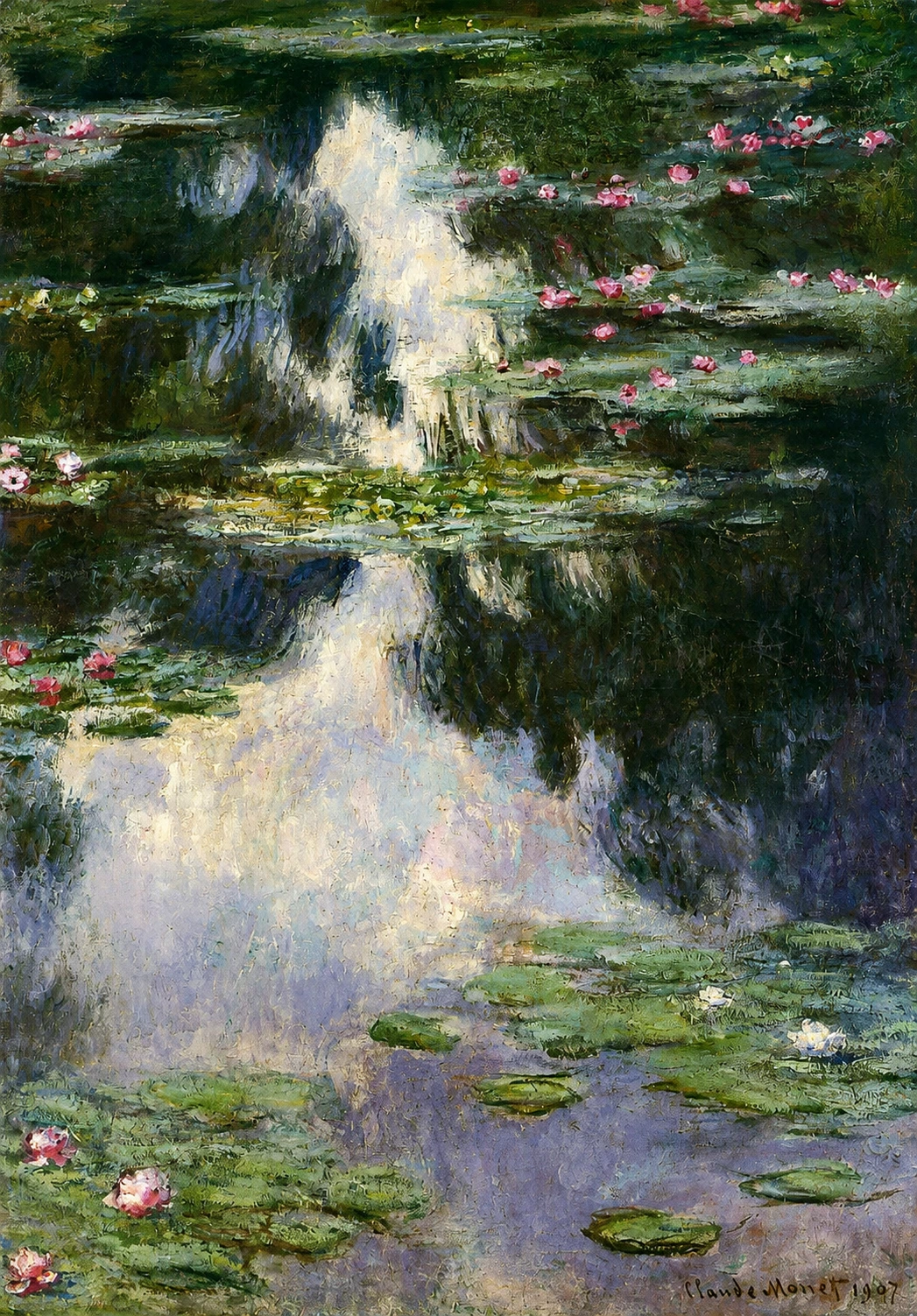
Claude Monet’s “Water Lilies” from 1907 belongs to one of the most famous and poetic painting series in the history of modern art. Created at Giverny, where Monet designed his own water garden, the painting shows a pond surface covered with lily pads, blossoms, reflections, and shifting light. Yet the scene is not simply a botanical study or a pleasant garden view. It is a meditation on perception itself. Monet turns water into a living mirror, where sky, trees, flowers, and atmosphere dissolve into one another.
In this work, the viewer is not placed on solid ground. There is no visible horizon line, no bank of the pond, no figure, and no architectural marker to stabilize the scene. Instead, everything floats. The painting asks the eye to move across the surface, to drift from pale reflection to dark shadow, from pink blossoms to green lily pads, from thick brushstrokes to soft passages of violet, blue, and white. “Water Lilies” is less a window onto nature than an immersion into nature’s changing appearance.
Monet’s Garden at Giverny
By 1907, Monet had been living at Giverny for many years, and his garden had become one of his most important artistic subjects. He did not merely find this landscape. He shaped it. The water lily pond, Japanese bridge, willow trees, and carefully arranged plantings formed a private world created for looking, painting, and studying light. Monet’s late work shows how deeply this environment absorbed him.
“Water Lilies” reflects the artist’s mature interest in repeated observation. Rather than painting a subject once and moving on, Monet returned again and again to the same pond under different conditions. Morning, afternoon, cloud, sunlight, wind, and seasonal change all altered the appearance of the water. The 1907 version captures this sense of instability. The pond is recognizable, but it is also mysterious. Forms appear, vanish, blur, and reappear, just as they would in real reflected water.
This painting also shows Monet moving further away from traditional landscape structure. Earlier landscape painting often depended on depth, perspective, and a clear division between earth and sky. Here, the sky is seen only through reflection. Trees are present only as shadowy shapes in the water. The natural world is still there, but it has been transformed into color, rhythm, and sensation.
Composition and the Absence of a Horizon
One of the most striking features of “Water Lilies” is its vertical composition. The painting leads the eye from the darker upper section toward the pale luminous center, then down into softer blue and violet reflections. The water lilies are scattered across the pond, creating points of visual rest, but they do not form a strict pattern. They seem to drift naturally, as if moved by the pond itself.
The absence of a horizon is crucial. Without a clear line separating sky from water, the viewer loses the usual sense of distance. The image becomes shallow and deep at the same time. The lily pads lie on the surface, but the reflections suggest depth beneath them. The pale vertical reflection near the upper center may suggest sky or light passing through trees, while the darker areas around it imply foliage mirrored in the pond. Monet creates a world where surface and depth cannot be separated.
This compositional choice makes the painting feel intimate and expansive at once. We are close enough to see the texture of the lilies and the brushwork of the water, yet the reflected sky opens the scene into something vast. The pond becomes a universe in miniature.
Color, Light, and Atmosphere
The color palette of “Water Lilies” is rich but controlled. Monet uses deep greens, blue blacks, soft violets, creamy whites, muted yellows, and touches of pink. The pink blossoms give the painting delicate points of warmth, while the green lily pads anchor the composition. Around them, the water shifts between shadow and light.
The central pale reflection is especially important. It creates a luminous passage that draws the viewer inward. This light is not painted as a hard shape. It is broken into strokes, touches, and flickering marks. It seems to shimmer rather than sit still. Monet understood that reflected light is never fixed. It trembles with the movement of water and changes with every passing moment.
The darker areas are equally expressive. They are not empty shadows. They contain blues, greens, purples, and subtle variations of tone. Monet’s shadows feel alive because they are made from color rather than simple blackness. This gives the entire painting a breathing quality, as though the pond is absorbing and releasing light.
Brushwork and the Texture of Vision
Monet’s brushwork in this painting is loose, layered, and highly active. The lily pads are suggested through rounded strokes and patches of green rather than carefully outlined shapes. The blossoms are small touches of pink and white, sometimes barely more than accents. The reflections are built from vertical and horizontal marks that overlap and blur.
This method is central to the painting’s power. Monet does not describe every object with exact detail. Instead, he recreates the experience of seeing. When we look at water, especially water filled with reflections, we rarely perceive it as a set of stable objects. We see flashes, fragments, ripples, and shifting colors. Monet’s brushwork captures that visual uncertainty.
The surface of the canvas becomes part of the subject. Thick and broken strokes remind us that this is paint, yet those same strokes also become water, leaves, flowers, shadow, and light. The painting moves between material reality and optical illusion. That tension gives “Water Lilies” its modern character.
The Role of Reflection
Reflection is not just a visual effect in this painting. It is the main structure of the work. The pond reflects the world above it, but the reflection is incomplete and transformed. Trees become dark masses. Sky becomes pale color. Light becomes a vertical glow. The real and the reflected merge until they are almost impossible to separate.
This gives “Water Lilies” a dreamlike quality. The painting feels quiet, but not empty. It suggests a world seen through contemplation, where ordinary nature becomes strange and profound. Monet’s pond is not a passive mirror. It changes what it receives. In this way, the painting can be understood as an image of perception itself. We never see the world in a purely neutral way. We see it through light, atmosphere, memory, movement, and feeling.
Why “Water Lilies” Still Feels Modern
Although Monet was one of the central figures of Impressionism, his water lily paintings also point toward later developments in modern art. The lack of horizon, the flattened surface, the loose brushwork, and the emphasis on color over precise drawing all anticipate abstraction. In “Water Lilies,” the subject remains recognizable, but it is close to becoming pure arrangement: green pads, pink flowers, dark reflections, pale light, and violet water.
This balance between representation and abstraction is one reason the painting remains so compelling. Viewers can enjoy it as a beautiful garden scene, but they can also experience it as a study of color and surface. Monet does not force a single interpretation. The painting invites slow looking.
“Water Lilies” by Claude Monet from 1907 is a masterpiece of atmosphere, reflection, and visual poetry. It transforms a simple pond into a shifting field of light, color, and sensation. Through its floating composition and expressive brushwork, the painting captures not only what Monet saw at Giverny, but how seeing itself feels when nature is constantly changing.