Rouen Cathedral Façade and Tour d’Albane by Claude Monet: Vibrant Color Edit
Free to Download & Reuse: You are welcome to use this image! If you republish or share it online, you must include a direct link back to this webpage for attribution.
Original Image Source: wikiart.org
A Complete Analysis of “Rouen Cathedral Façade and Tour d’Albane” by Claude Monet
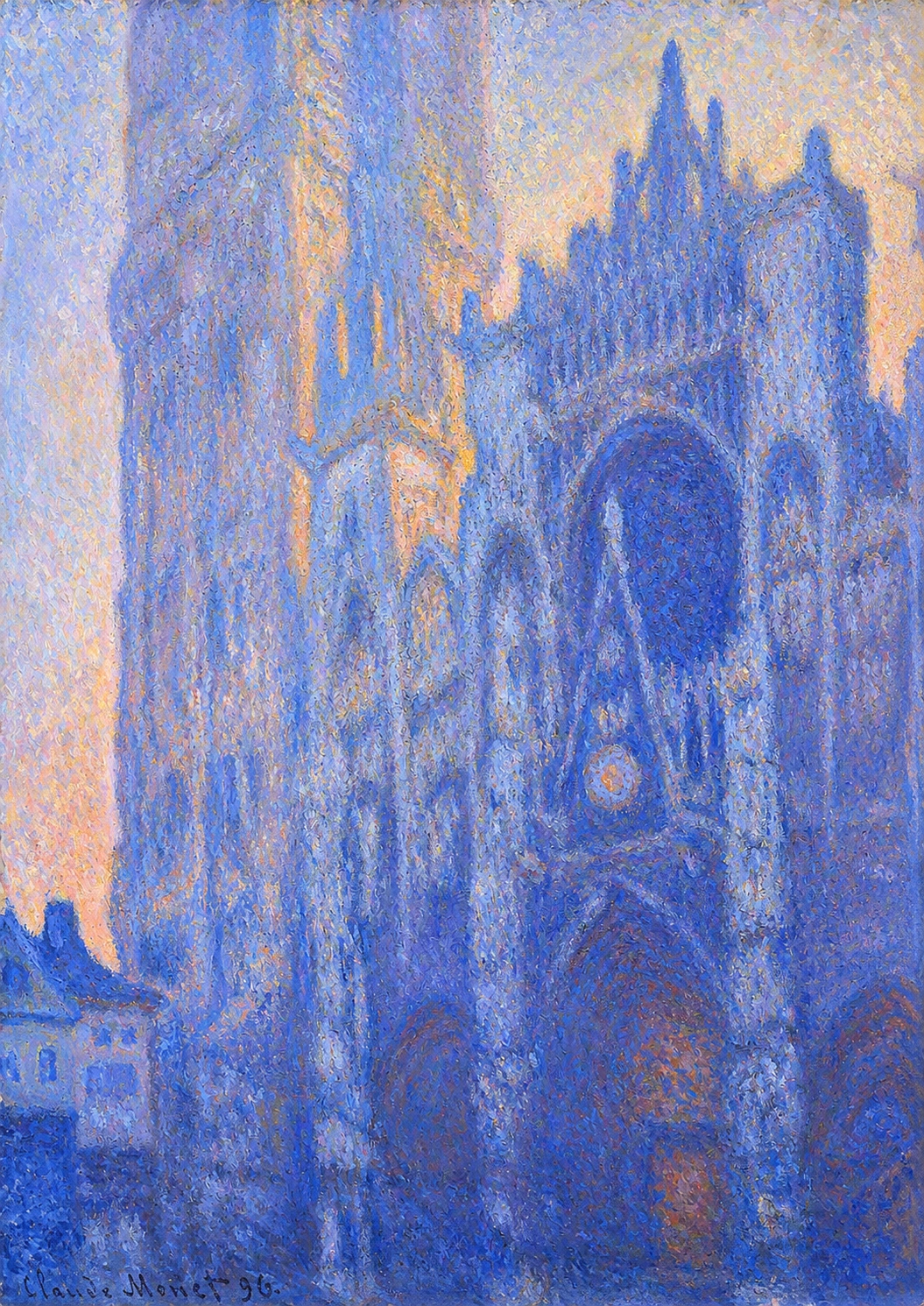
Claude Monet’s “Rouen Cathedral Façade and Tour d’Albane” from 1894 is one of the most atmospheric works from his celebrated Rouen Cathedral series, a group of paintings in which the artist returned again and again to the same Gothic monument under changing conditions of light, weather, and time of day. In this version, the cathedral does not appear as a solid architectural structure so much as a vast apparition of blue, violet, gray, and pale rose. The building seems to rise out of mist, dissolving at its edges while still retaining the unmistakable grandeur of its medieval form. Monet transforms stone into color, weight into vibration, and architecture into a living field of light.
The subject is Rouen Cathedral, one of the great Gothic monuments of France, but Monet’s real subject is perception itself. He is not interested in presenting the cathedral as a clear documentary view. Instead, he paints the way the façade and the Tour d’Albane appear when dawn light softens their details and turns the entire structure into a shifting veil of tones. The painting captures a moment when visibility is incomplete. The cathedral is recognizable, but it is also unstable, as though the eye is still adjusting to the morning air.
The Cathedral as Light Rather Than Stone
In “Rouen Cathedral Façade and Tour d’Albane,” Monet makes the cathedral feel almost weightless. Gothic architecture is usually associated with vertical force, carved stone, pointed arches, towers, portals, and elaborate surface detail. Here, those features remain present, but they are submerged beneath layers of color. The façade appears as a dense accumulation of blue marks, with touches of lavender, cream, peach, and pale yellow flickering across the surface. The Tour d’Albane rises to the right as a darker silhouette, while the main façade on the left is paler and more vaporous.
This contrast gives the painting its drama. The left side is washed in delicate light, almost as if the stone has absorbed the glow of dawn. The right side is deeper, cooler, and more mysterious. The cathedral’s mass is divided between illumination and shadow, but neither side is treated with hard outlines. Instead, Monet uses small, broken strokes that allow color to breathe. The building is not drawn first and colored afterward. It is built entirely from paint.
The result is a cathedral that seems to pulse. The rough texture of the brushwork imitates the carved complexity of Gothic stone, but it also suggests atmosphere. The many small strokes create a surface that feels alive, as though light is moving across it even while we look. Monet’s genius lies in making a fixed monument seem temporary. The cathedral has stood for centuries, yet in this painting it appears to exist only for a fragile moment.
Color and the Mood of Dawn
The dominant color of the painting is blue, but Monet’s blue is not simple or flat. It ranges from deep ultramarine to smoky violet, from cool gray-blue to pale icy tones. These blues give the painting a quiet, early morning feeling. They suggest the chill of dawn before sunlight has fully warmed the stone. At the same time, faint touches of pink, peach, and yellow appear in the upper background and across parts of the façade, hinting at the first arrival of daylight.
This subtle warmth is essential. Without it, the painting would feel purely nocturnal. With it, Monet creates the sensation of transition. The night has not fully disappeared, but morning has begun. The cathedral stands between darkness and light, between shadow and revelation. The pale glow behind the towers makes the structure feel monumental, yet also distant, as though wrapped in fog or suspended in memory.
Monet’s color is expressive, but it is not decorative in a simple sense. The blues are not merely beautiful. They carry the emotional temperature of the scene. They make the cathedral feel solemn, ancient, and dreamlike. The warmer touches prevent the image from becoming cold or lifeless. They suggest that the building is slowly being awakened by light.
Composition and Vertical Grandeur
The composition is tightly focused on the cathedral, leaving little room for surrounding street life or landscape. The monument fills the canvas almost completely. This closeness gives the viewer the feeling of standing directly before the façade, looking upward at a structure too large to take in all at once. The vertical format intensifies this sensation. The towers and pointed forms stretch upward, while the lower part of the painting remains dense and shadowed.
Monet does not present the cathedral as a perfectly balanced architectural study. Instead, he allows parts of it to appear more strongly than others. The left tower is pale and misty, the central portal is suggested through darker masses, and the Tour d’Albane on the right forms a commanding silhouette. This asymmetry makes the image feel natural and immediate. It is not a polished postcard view. It is an encounter with a massive building seen through a particular atmosphere.
The lower portion of the painting is especially important. It is darker, bluer, and more compressed, creating a visual base from which the cathedral rises. The upper part, by contrast, becomes lighter and more diffuse. This movement from dark density below to luminous softness above reinforces the spiritual associations of Gothic architecture. The eye is drawn upward, but not through sharp lines. It rises through color.
Monet’s Rouen Cathedral Series
“Rouen Cathedral Façade and Tour d’Albane” belongs to one of Monet’s most important serial projects. During the 1890s, he painted the cathedral repeatedly, studying how the same subject changed under different light conditions. This method allowed him to push Impressionism beyond the quick outdoor sketch. He was no longer simply capturing a passing impression in one sitting. He was investigating the endless variability of vision.
The Rouen Cathedral series is often seen as one of the great achievements of late Impressionism because it turns repetition into discovery. Each version of the cathedral is similar in subject, but radically different in mood. Some are warm and golden, others pale and chalky, others fiery, others shadowed. In this blue version, Monet emphasizes dawn, coolness, and mystery. The cathedral becomes less a monument of history than a screen on which time and weather reveal themselves.
This approach was bold because it challenged the traditional hierarchy of painting. A cathedral would normally be painted for its historical, religious, or architectural significance. Monet does not ignore those meanings, but he places visual experience above narrative. The importance of the building lies in how it appears, how it changes, and how light transforms it from one moment to another.
Texture, Surface, and Modern Vision
The painting’s surface is thick, active, and richly worked. From a distance, the cathedral emerges as a recognizable structure. Up close, it breaks apart into strokes, flecks, and patches of pigment. This tension between image and surface is central to Monet’s modernity. He asks the viewer to see both the cathedral and the paint at the same time.
The façade becomes almost abstract in places. Architectural details are not carefully described, yet their presence is felt through rhythm and density. The repeated touches of blue and violet suggest carved niches, arches, towers, and shadows without defining them completely. Monet trusts the viewer’s eye to complete the image. He does not tell us everything. He gives us the sensation of seeing.
This makes “Rouen Cathedral Façade and Tour d’Albane” feel remarkably modern. The painting is still representational, but it approaches abstraction through light and color. It shows how a familiar object can become unfamiliar when seen with enough intensity. Monet turns the cathedral into an event of perception.
The Meaning of the Painting
At its deepest level, this painting is about the instability of appearances. Rouen Cathedral is a symbol of permanence, faith, history, and human craftsmanship. Yet Monet shows that even such a monumental structure is never seen the same way twice. Light changes it. Weather changes it. The viewer’s position and mood change it. The painting suggests that reality is not fixed in the way we often imagine. It is continually shaped by perception.
There is also a quiet emotional power in the work. The blue atmosphere creates a mood of contemplation. The cathedral appears grand but not triumphant, sacred but not theatrical. It is a vision of stillness before the day begins, when the world is present but softened. Monet’s painting invites slow looking. It rewards attention to small differences in tone, texture, and light.
“Rouen Cathedral Façade and Tour d’Albane” is not simply a picture of a famous building. It is a meditation on how light gives form to the world. Through blue shadow, dawn warmth, and vibrating brushwork, Monet makes the cathedral feel both ancient and fleeting. The stone seems to dissolve, yet the image remains unforgettable. In this balance between permanence and transience, Monet created one of the most poetic visions of modern painting.