The Luncheon of the Boating Party by Pierre-Auguste Renoir: Vibrant Color Edit
Free to Download & Reuse: You are welcome to use this image! If you republish or share it online, you must include a direct link back to this webpage for attribution.
Original Image Source: wikiart.org
The Social World of Renoir’s Riverside Modernity
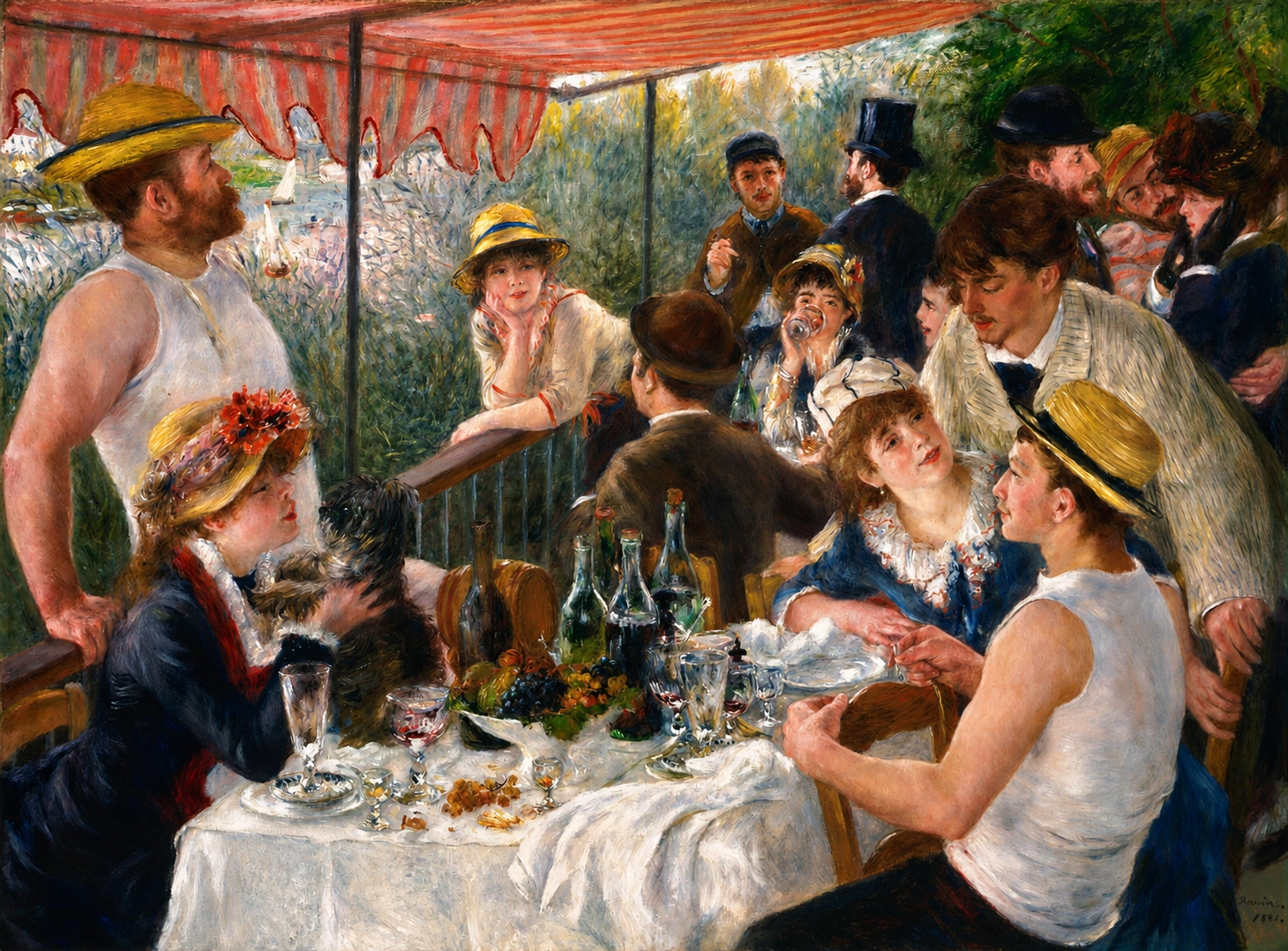
Pierre-Auguste Renoir’s “The Luncheon of the Boating Party,” painted in 1881, is one of the most celebrated images of Impressionist leisure. Set on the balcony of the Maison Fournaise, a restaurant on the Seine at Chatou, the painting captures a gathering of friends, artists, models, patrons, and fashionable Parisians enjoying food, drink, conversation, and afternoon light. The scene appears spontaneous, as though Renoir has simply recorded a happy moment before it disappears. Yet beneath that effortless surface is a carefully arranged composition that brings together portraiture, still life, landscape, modern fashion, and the shimmering atmosphere of Impressionism.
The painting belongs to a period when Renoir was deeply interested in modern life. Instead of turning to ancient myths, grand battles, or religious drama, he painted the pleasures of contemporary society. Boating, dining outdoors, flirting, talking, and dressing well become worthy subjects for serious art. “The Luncheon of the Boating Party” is not only a picture of a meal. It is a vision of Parisian social life in the late nineteenth century, where urban people escaped the city to enjoy nature, companionship, and the changing rhythms of modern leisure.
Composition and the Feeling of Movement
At first glance, the scene feels crowded and informal. Figures lean, turn, gesture, listen, and look in different directions. No single person fully controls the composition. Instead, Renoir creates a web of glances and bodies that keeps the viewer’s eye moving across the canvas. The table in the foreground anchors the painting, while the striped awning above creates a warm, enclosing space. The railing opens the scene toward the river and the landscape beyond, giving the painting both intimacy and air.
Renoir balances the composition with remarkable skill. The broad white tablecloth catches the strongest light and forms a luminous base for the scene. Around it, the figures create a loose circular rhythm. The woman with the small dog at the lower left, often identified as Aline Charigot, draws us into the painting with her soft profile and colorful hat. Across from her, the muscular man in the sleeveless shirt turns inward, his body forming a strong diagonal. Behind them, other figures overlap in layers, creating depth without making the space feel rigid.
The painting’s liveliness comes from this combination of structure and looseness. Renoir does not arrange the group like a formal portrait. He allows bodies to interrupt one another, faces to appear partly hidden, and gestures to remain unfinished. This gives the impression of real social life, where conversations happen at once and attention shifts constantly.
Light, Color, and Impressionist Atmosphere
The color palette of “The Luncheon of the Boating Party” is one of its greatest pleasures. Renoir fills the scene with creamy whites, rosy skin tones, straw yellows, deep blues, warm reds, and fresh greens. The striped awning casts a reddish glow over the upper part of the painting, while the tablecloth reflects bright outdoor light from below. This creates a sense of warmth and radiance that feels both natural and festive.
Renoir’s brushwork is soft and mobile. Edges often dissolve, especially in the background foliage, the clothing, and the table setting. Glasses, bottles, fruit, and plates are not described with hard precision, but with touches of paint that suggest sparkle and reflection. The viewer understands the objects because of color, light, and placement rather than exact detail. This is central to Renoir’s Impressionist method. He is less concerned with fixed outlines than with the sensation of seeing.
The painting also shows Renoir’s love of human warmth. Unlike some Impressionist works that emphasize landscape or atmospheric distance, this painting is deeply social and physical. Faces glow, arms rest heavily on chairs, fabric catches the light, and bodies occupy space with relaxed confidence. Renoir’s light does not simply illuminate the scene. It seems to soften relationships between people, making the entire gathering feel generous and alive.
Fashion, Class, and Modern Leisure
One of the most fascinating aspects of the painting is its mixture of social types. The guests are not dressed alike. Some wear boating clothes, including sleeveless shirts and straw hats. Others appear in more formal city clothing, with dark jackets, elegant hats, and carefully arranged dresses. This contrast reflects the changing social world of Renoir’s time. The riverside restaurant becomes a place where different forms of modern identity meet.
The painting suggests pleasure without solemnity. People are eating and drinking, but the meal is almost over. Bottles are open, fruit remains on the table, napkins are crumpled, and glasses catch flashes of light. Renoir does not present luxury as something distant or aristocratic. Instead, pleasure appears casual, shared, and immediate. The scene celebrates the new culture of leisure made possible by trains, suburban restaurants, boating clubs, and the growing desire of Parisians to escape the city on weekends.
Yet the painting is not merely documentary. Renoir transforms this social moment into an ideal of harmony. The guests may belong to different worlds, but within the painting they are united by color, sunlight, and rhythm. Their differences become part of the scene’s richness rather than a source of conflict.
Portraiture Within a Group Scene
Although “The Luncheon of the Boating Party” feels like a casual gathering, many of the figures were people Renoir knew. This gives the painting the character of a group portrait, but not in the traditional sense. Instead of presenting sitters frontally and formally, Renoir shows them absorbed in their own interactions. Their personalities emerge through posture, expression, and placement.
Aline Charigot, who would later become Renoir’s wife, appears tender and playful with the small dog. Her presence adds softness to the foreground. The seated man with his back partly turned creates a barrier between the viewer and the deeper space, making us feel as though we are looking into an ongoing conversation. Other figures glance outward, talk privately, or listen from the margins. Renoir’s genius lies in making each person feel distinct while preserving the unity of the whole.
This approach gives the painting emotional complexity. It is cheerful, but not simplistic. Some figures seem engaged, others distracted. Some are open to the group, while others retreat into private thought. The result is a scene that feels convincingly human.
Why the Painting Still Matters
“The Luncheon of the Boating Party” remains powerful because it captures a universal desire: the wish to belong to a beautiful moment. Renoir gives us food, sunlight, friendship, conversation, color, and ease. At the same time, the painting is aware that such moments are temporary. The looseness of the brushwork, the shifting glances, and the half-finished gestures all suggest passing time.
The painting is also one of Renoir’s great achievements because it combines ambition with accessibility. It is large, complex, and carefully composed, yet it does not feel heavy. It offers the pleasures of Impressionism while also showing Renoir’s deep respect for the figure and for older traditions of painting. The result is a masterpiece that feels modern, intimate, and timeless.
“The Luncheon of the Boating Party” is more than a charming restaurant scene. It is a radiant image of modern life at its most sociable and sensuous. Renoir turns an afternoon gathering into a celebration of light, friendship, and the fleeting beauty of shared experience.