Sunday Afternoon on the Island of La Grande Jatte by Georges Seurat: Vibrant Color Edit
Free to Download & Reuse: You are welcome to use this image! If you republish or share it online, you must include a direct link back to this webpage for attribution.
Original Image Source: wikiart.org
An Icon of Modern Leisure
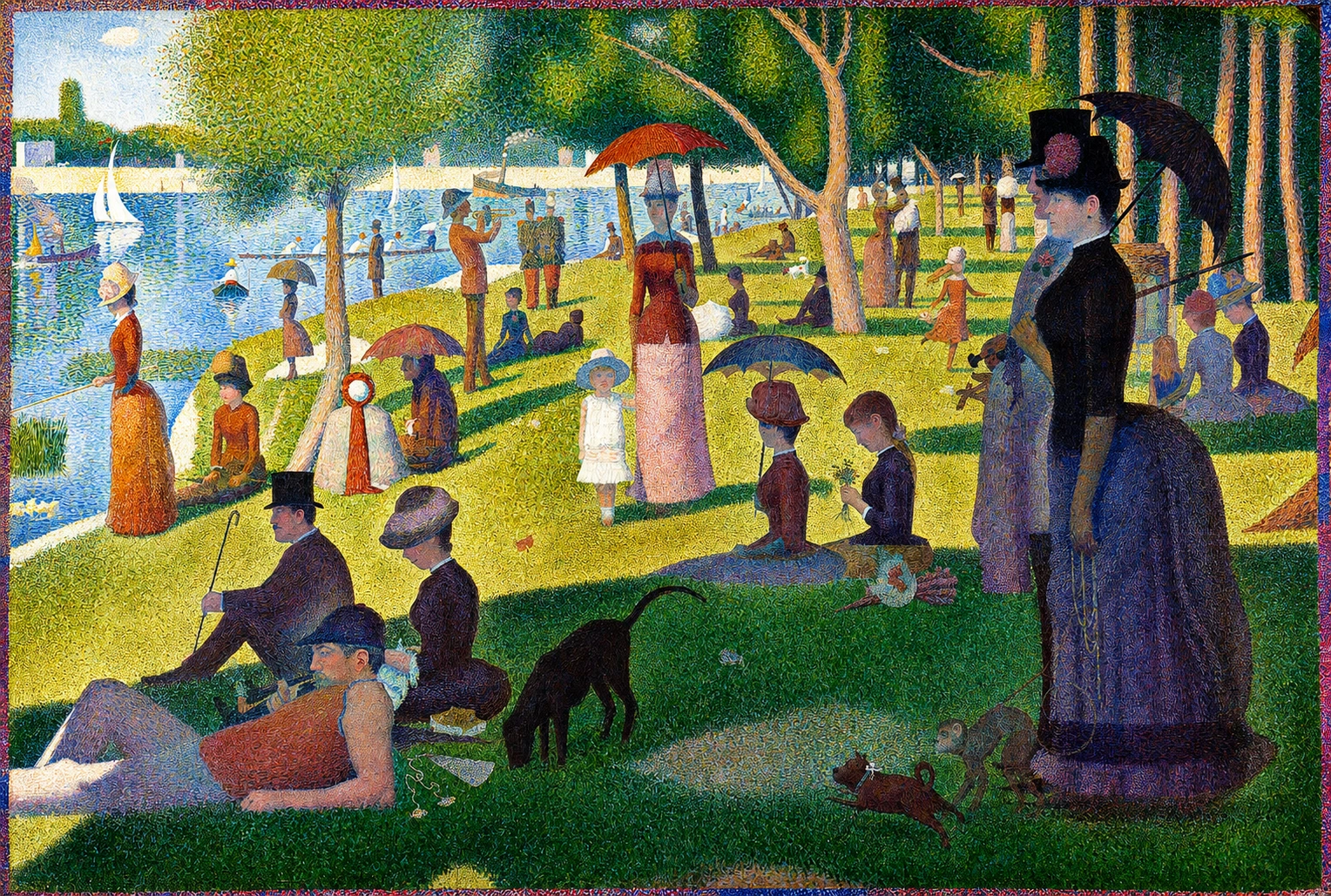
“Sunday Afternoon on the Island of La Grande Jatte” by Georges Seurat, completed in 1886, is one of the defining paintings of modern art. At first glance, it appears to show a calm weekend scene: fashionable Parisians relaxing on a grassy island beside the Seine. People stroll, sit, fish, sail, and enjoy the sunlight under the trees. Yet the painting is far more than a pleasant image of leisure. It is a carefully constructed vision of modern life, shaped by order, stillness, color theory, and psychological distance.
Seurat painted La Grande Jatte, an island on the Seine near Paris, at a time when the city was changing rapidly. Industrial growth, urban planning, public parks, and new patterns of recreation had transformed how Parisians spent their free time. The painting captures this new world of middle-class and working-class leisure, where people gather in public spaces but remain strangely separate from one another. The scene is social, but not intimate. It is crowded, but quiet. This tension gives the work much of its lasting power.
Composition and Structure
Seurat’s composition is remarkably controlled. The figures are arranged across the canvas with almost architectural precision. Instead of a loose snapshot of people in a park, the scene feels staged, balanced, and deliberate. Vertical tree trunks, upright figures, parasols, and hats create a rhythm across the surface. The shoreline curves gently through the painting, leading the eye from the shaded foreground to the glowing river and distant boats.
The large woman on the right dominates the composition. Her dark dress, tall hat, and parasol create a strong vertical shape, almost like a column. Beside her, a small monkey adds a strange and memorable detail, suggesting fashion, eccentricity, and perhaps a subtle critique of social behavior. In the lower foreground, reclining figures rest in the shade, while farther back, smaller people appear scattered across the grass. This arrangement gives the painting a sense of depth, but also makes the figures seem frozen in place.
The painting’s stillness is one of its most striking qualities. Even though the scene includes many activities, there is little sense of movement. The people look almost sculptural. They do not interact naturally or express strong emotion. Their poses are simplified, formal, and sometimes rigid. Seurat turns a lively public park into a scene of quiet observation.
Pointillism and the Science of Color
The painting is famous for Seurat’s use of pointillism, a technique in which tiny dots or strokes of pure color are placed side by side. Rather than blending colors smoothly on the palette, Seurat allowed the viewer’s eye to mix them visually. This method was connected to contemporary scientific theories about color and perception. Seurat believed that carefully arranged colors could create greater brightness, harmony, and optical intensity.
In “Sunday Afternoon on the Island of La Grande Jatte,” the surface is built from countless small touches of color. Greens, blues, yellows, oranges, violets, and reds shimmer across the grass, water, clothing, and shadows. The result is not soft naturalism, but a vibrating visual structure. The park seems filled with light, yet that light is controlled and analytical.
This technique also changes how the viewer experiences the scene. From a distance, the image appears unified and calm. Up close, it breaks apart into dots, marks, and color relationships. The painting therefore asks the viewer to move between illusion and construction. We see both the world Seurat depicts and the method he used to create it.
Modern Life and Social Distance
Although the painting shows leisure, it does not feel carefree in a simple way. The people appear near one another, but emotionally distant. Many face away, look sideways, or remain absorbed in their own private worlds. The standing figures seem posed rather than spontaneous. The seated figures do not form warm social groups. Even the children, animals, and boats feel incorporated into a larger pattern rather than captured as lively individuals.
This emotional coolness reflects one of the central themes of modern art: the experience of being alone in a crowd. Public leisure in modern Paris brought people together, but it also emphasized class, fashion, display, and social boundaries. Seurat presents a society that is organized, visible, and elegant, but also somewhat detached.
The clothing is especially important. Hats, parasols, bustled dresses, jackets, and formal silhouettes define the figures by social role and appearance. They are not painted as deeply individualized personalities. Instead, they become types within a modern urban scene. The park becomes a stage where people perform respectability, fashion, and leisure.
Light, Shade, and Atmosphere
Seurat’s handling of light is both beautiful and unusual. The left side of the painting opens onto the bright river, where small boats and sails create a feeling of freshness and distance. The water sparkles with blue and white tones, while the far bank glows in pale light. In contrast, the right and lower portions of the painting are darker and more shaded, filled with deep greens, purples, and blues.
This contrast between sunlight and shade helps structure the painting emotionally. The bright river suggests openness and movement, while the shaded foreground feels heavier and more enclosed. The figures in shadow appear especially still, as though caught outside ordinary time. The entire scene has the clarity of a summer afternoon, but also the dreamlike suspension of a memory or tableau.
Seurat’s color choices prevent the painting from becoming merely realistic. Shadows are not simply black or gray. They contain violets, blues, greens, and complementary tones. Light is not simply white. It is broken into many tiny touches that create optical vibration. This gives the painting its distinctive balance of precision and radiance.
Why the Painting Matters
“Sunday Afternoon on the Island of La Grande Jatte” matters because it transformed an ordinary modern subject into a monumental image. Seurat took a scene of weekend recreation and treated it with the seriousness once reserved for historical, religious, or mythological painting. The scale, discipline, and structure of the work give everyday life a grand presence.
The painting also marks a turning point after Impressionism. While the Impressionists often emphasized spontaneity, quick perception, and changing light, Seurat pursued a more systematic method. He kept the modern subject matter of Impressionism, but replaced loose brushwork with calculated color and design. This made him a central figure in Neo-Impressionism and an important bridge toward later modern movements concerned with abstraction, structure, and visual theory.
The painting’s lasting appeal comes from its contradictions. It is bright but restrained, crowded but silent, decorative but psychologically complex. It celebrates leisure while questioning the social world that produces it. It appears simple from a distance, but becomes astonishingly intricate up close.
Final Reflection
Georges Seurat’s “Sunday Afternoon on the Island of La Grande Jatte” is not just a picture of people enjoying a park. It is a modern masterpiece about vision, society, and order. Through pointillist color, careful composition, and an unforgettable sense of stillness, Seurat created an image that feels both familiar and mysterious. The painting captures the pleasures of modern leisure, but also the quiet distance between people in a changing urban world. Its beauty lies not only in its color and design, but in the strange silence that fills the scene. More than a century later, it remains one of the most recognizable and thought-provoking images of nineteenth-century art.