The Fighting Temeraire by J.M.W. Turner: Vibrant Color Edit
Free to Download & Reuse: You are welcome to use this image! If you republish or share it online, you must include a direct link back to this webpage for attribution.
Original Image Source: wikiart.org
The Fighting Temeraire by J.M.W. Turner: A Vision of Glory, Loss, and Change
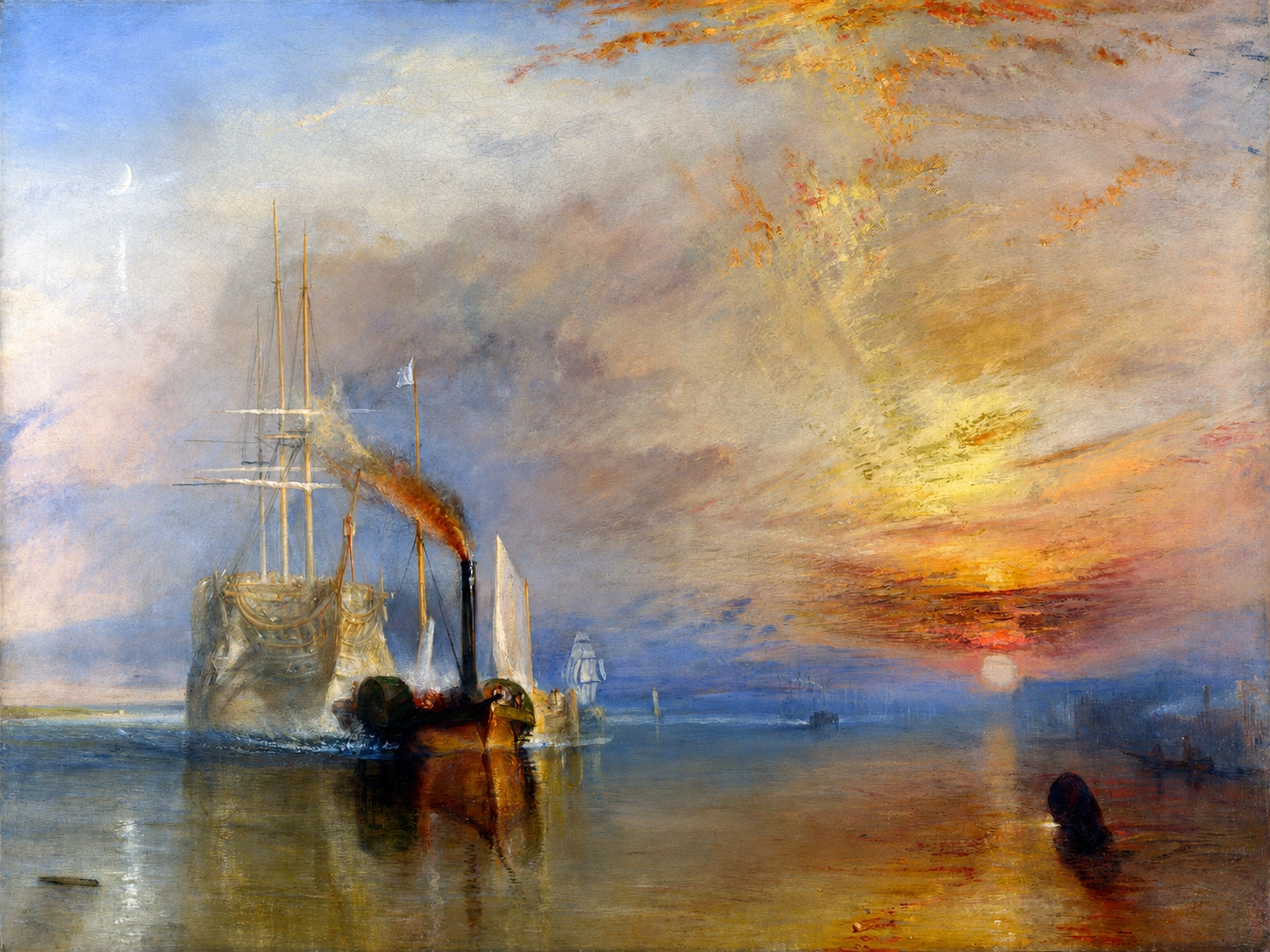
J.M.W. Turner’s “The Fighting Temeraire” is one of the most powerful paintings of the nineteenth century because it transforms a naval subject into a meditation on memory, national pride, technological change, and the passing of time. Painted in 1839, the work shows the HMS Temeraire, an old British warship famous for its role in the Battle of Trafalgar, being pulled by a small steam tug toward its final destination, where it will be broken up. Turner does not present the ship in the heat of battle or at the height of its power. Instead, he shows it in a moment of surrender, not to an enemy fleet, but to history itself.
The emotional force of the painting comes from this contrast between past and present. The Temeraire appears pale, ghostly, and almost dreamlike. Its tall masts rise against the sky like the remains of a vanished heroic age. The steam tug, by comparison, is dark, compact, practical, and modern. It pushes forward with a smoking funnel, pulling the larger vessel despite being much smaller. Turner makes this tug look almost harsh beside the graceful old ship. It is not beautiful in the traditional sense, but it is powerful, efficient, and unavoidable.
Composition and Visual Drama
The composition is carefully arranged to create a sense of movement from left to right. The Temeraire sits on the left side of the painting, luminous and dignified, while the tug pulls it toward the darker, industrial future. The ship is large, but it does not dominate through force. Instead, it seems to fade into the atmosphere, as if already becoming a memory. Turner’s placement of the vessel slightly away from the center makes the scene feel like a farewell rather than a celebration.
The right side of the painting contains the setting sun, whose intense glow fills the sky and water with red, gold, orange, and purple tones. This sunset is not just a natural effect. It functions as a symbol of ending. The day is closing, just as the age of sail is closing. The sun’s reflection stretches across the river, creating a path of light that feels both beautiful and mournful. Turner turns the sky into an emotional landscape, where color carries as much meaning as the objects themselves.
The tugboat’s smoke cuts across the scene with a dark, diagonal force. It stains the air and interrupts the delicate light surrounding the old ship. This visual contrast helps explain the painting’s deeper meaning. The modern world is energetic and productive, but it also brings pollution, noise, and disruption. Turner does not simply reject progress, but he shows that progress has a cost. Something graceful and historically meaningful is being lost.
Color, Light, and Atmosphere
Turner’s handling of color is central to the painting’s beauty. The Temeraire is painted in soft whites, silvers, pale blues, and warm creams, giving it an almost sacred presence. It does not look like a heavy wooden warship so much as a vision or apparition. This choice makes the ship seem removed from ordinary reality. It belongs to memory, legend, and national imagination.
The sky is far more expressive than realistic. Turner fills it with dissolving clouds, glowing light, and delicate transitions between cool and warm tones. The upper left is calm and blue, while the right side burns with sunset color. This shift across the canvas mirrors the painting’s theme: the movement from an older, quieter world into a fiery, uncertain modern age.
The water reflects both the ship and the sunset, softening the entire scene. Reflections blur the boundaries between object and atmosphere. The Temeraire’s image in the water appears unstable, reinforcing the idea that its glory is fading. Turner’s brushwork is loose and suggestive, especially in the sky and river. Rather than describing every detail, he lets light and color create mood. This is one reason the painting feels so modern. It looks backward to naval history while also anticipating later developments in atmospheric painting and abstraction.
The Meaning of the Temeraire
The HMS Temeraire was not an ordinary ship. It was associated with British naval greatness, especially because of its role at Trafalgar in 1805. By choosing this vessel, Turner gives the painting national significance. The ship represents courage, empire, memory, and the heroic mythology of the Royal Navy. Yet Turner’s genius lies in refusing to paint it triumphantly. He shows it being removed from service, stripped of purpose, and taken apart.
This makes the painting more complex than simple patriotism. The old warship is honored, but it is also helpless. Its guns are silent, its sails are gone, and it depends on the steam tug to move. Turner presents the Temeraire as noble but obsolete. The painting suggests that even the greatest symbols of power eventually become relics.
The steam tug is equally important. It represents industrial modernity, a world driven by engines rather than wind, coal rather than sail, and utility rather than ceremony. The tug is not treated with the same beauty as the old ship, but Turner does not make it weak. In fact, it is the active force in the painting. The future may be less elegant, but it is stronger in practical terms. The tug pulls history forward, whether anyone wants it to or not.
A Painting About Time and Modernity
“The Fighting Temeraire” is often admired because it captures a universal feeling: the sadness of watching something beloved disappear. The painting is not only about a ship. It is about aging, memory, and the replacement of one world by another. The Temeraire can be read as a symbol of any tradition that once seemed permanent but eventually gives way to change.
Turner’s sunset deepens this meaning. Sunset is naturally beautiful, but it also marks an ending. In the painting, the sun seems to burn with the last radiance of the old age. Its glow is magnificent, but it cannot last. The moon appears faintly on the left side of the sky, introducing another quiet symbol of transition. Day gives way to night, sail gives way to steam, glory gives way to memory.
The painting also reflects Turner’s fascination with industrial change. Throughout his career, he painted ships, storms, fire, steam, and light as forces that reshape human life. Here, technology is not shown as a simple victory. It is shown as something dramatic, unsettling, and inevitable. The modern tug is small, but it changes the meaning of everything around it.
Why the Painting Remains So Powerful
The enduring appeal of “The Fighting Temeraire” lies in its balance between historical specificity and emotional universality. A viewer does not need detailed knowledge of British naval history to feel the sadness and beauty of the scene. The painting communicates through contrast: old and new, light and dark, beauty and utility, memory and progress.
Turner’s achievement is that he makes a practical event feel mythic. A ship being towed to be dismantled becomes a grand image of civilization in transition. The painting mourns the passing of the Temeraire, but it does not freeze history. The tug continues moving. The smoke rises. The sun sinks. Everything in the painting suggests motion, even as the viewer pauses before it.
“The Fighting Temeraire” remains one of Turner’s greatest works because it is both visually radiant and emotionally profound. It honors the past without denying the future. It shows that progress can be necessary and still feel like loss. Through light, color, and atmosphere, Turner turns the final journey of a ship into one of the most moving images of farewell in Western art.